
Research Mennonite family history by community, migration route, and record type. A generic surname search can suggest possibilities, but repositories preserve very different evidence: congregation minutes, family Bible registers, cemetery transcriptions, diaries, community newspapers and earlier genealogists’ papers. The Mennonite Heritage Center in eastern Pennsylvania describes a substantial regional collection, while Mennonite Church USA points to other archives and discovery tools. Neither holds the entire history of all Mennonite families. This guide shows how to choose the correct region and repository, weigh compiled family histories against contemporaneous records, and construct a small, verifiable proof chain without inferring family connections from a shared surname or religious identity.
Use the family’s documented locality to select archives
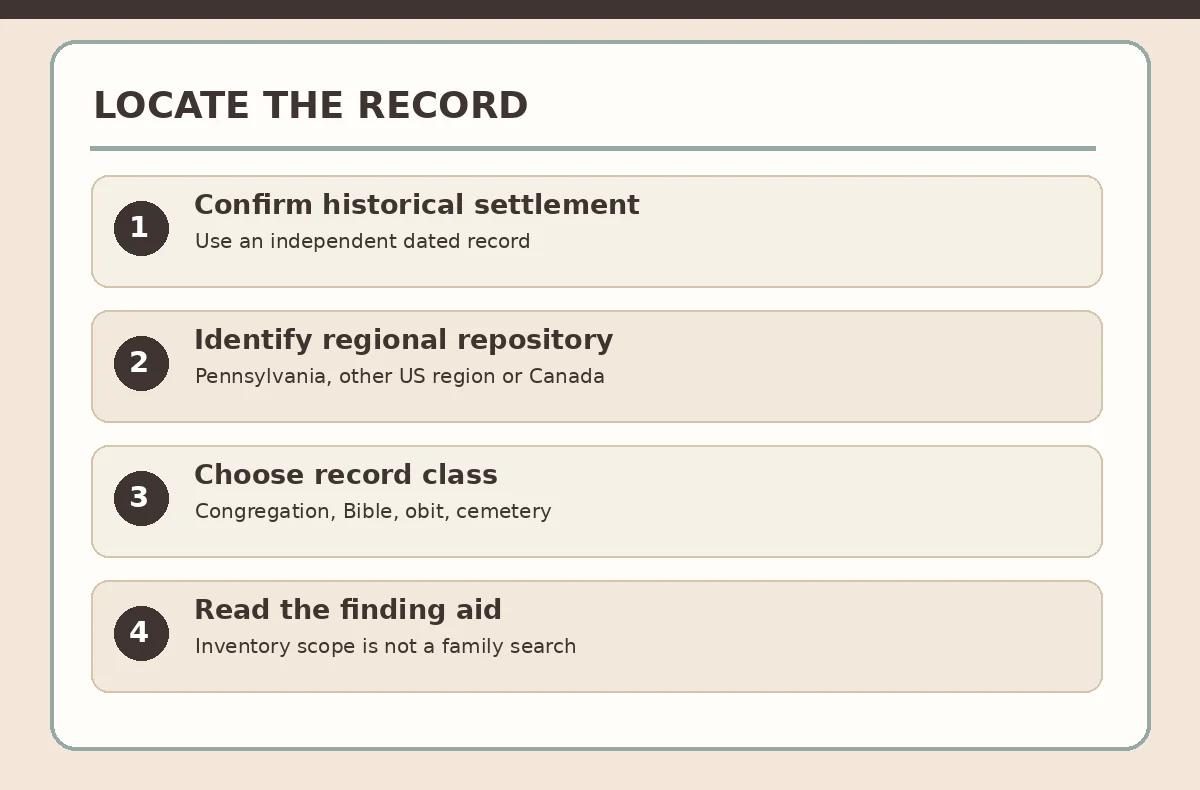
Determine the oldest proven town, township or settlement and a time window before choosing an archive. Mennonite communities have lived in different regions and moved across modern borders; a present-day state or surname alone does not identify the relevant congregation or repository. Search contemporary census pages, deeds, marriage records and obituaries for places and dates. Then compare them with the service areas of Mennonite collections. The Mennonite Heritage Center focuses on counties in southeastern Pennsylvania, while Mennonite Life describes collections centered on Lancaster and surrounding communities. An archive’s rich holdings make it valuable for that region but not a national index. Keep a locality table distinguishing where the family was documented from where a later relative believed it had originated.
Separate congregational files from compiled genealogy
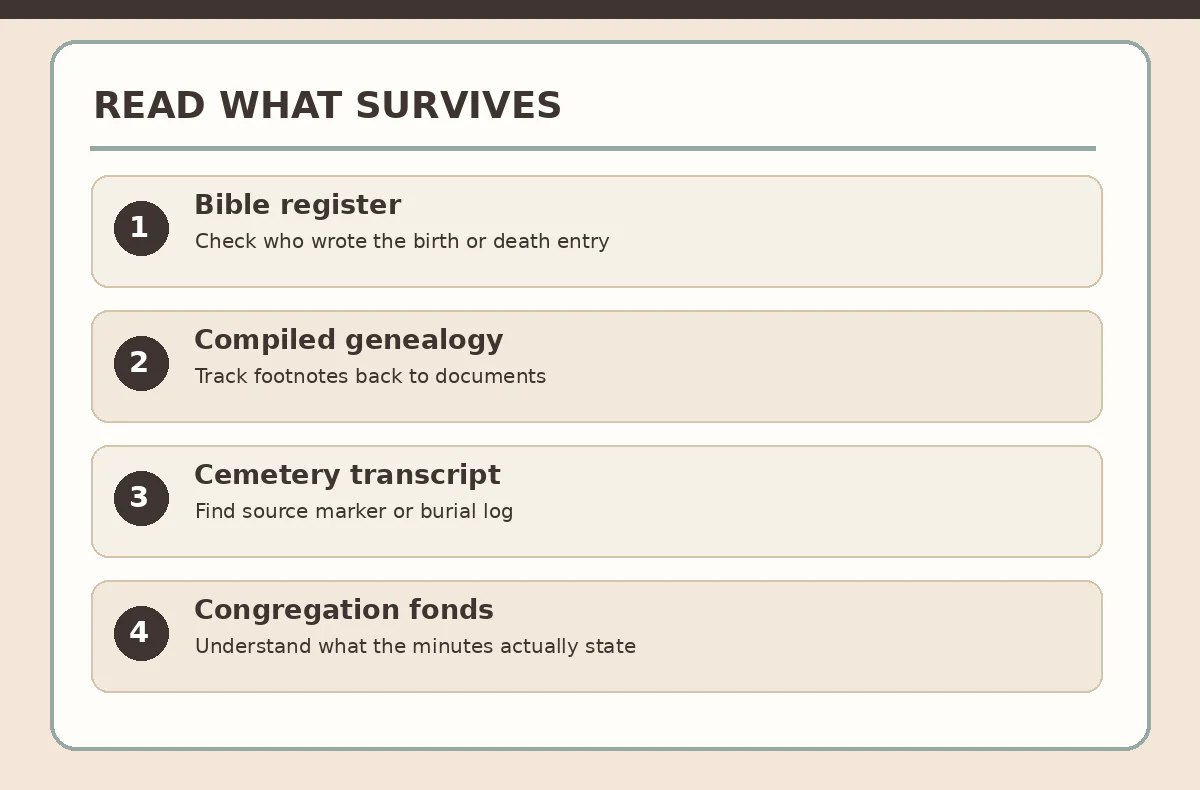
The Mennonite Heritage Center’s collection guides list records relating to regional conferences, individual congregations and institutions, while its genealogy resources include family research files and published histories. Congregational minutes may document actions taken by a church body, but they do not automatically list every family member. Compiled genealogies may be helpful road maps containing citations to books, letters or Bible records; they are not themselves direct proof that all linked generations are correct. When a pedigree gives a parent or spouse, record its author, date and cited source. Then seek an original entry supporting the relationship. In an archive inventory, distinguish the date range of a collection from the years of every document it contains. For a step-by-step method, see how to find Baptist church records for family history research.
Read handwritten family Bible registers carefully
Family Bible pages can hold births, deaths and marriages written in several hands across generations. The Mennonite Heritage Center states that its collection includes hundreds of Bible registers and inventories as well as some originals. Before treating a page as an eyewitness account, look for clues to when each notation was written: handwriting, ink, order of events, changes in spelling and entries added long after a death. A family register copied from another book can preserve useful details, but copying creates an additional opportunity for errors. Cite the present physical item or image, the Bible’s identifying description, the register page and who entered the information if that is known. A printed surname chart should not substitute for an image when an original register can be examined.
| Question to answer | Best supporting material | What it does not prove |
|---|---|---|
| Did this person belong here? | Original congregation register | Every member or relative was recorded |
| Which institution held the volume? | Repository finding aid or inventory | Every year or page survived |
| Is this the same individual? | Independent dated residence and names | A same-surname match is conclusive |
Treat cemetery transcriptions as leads to records
The Mennonite Heritage Center includes a cemetery database and transcripts from many local burial grounds; the page makes clear that its database spans more than Mennonite cemeteries. A burial listing can direct you to a cemetery and perhaps a gravestone or plot book, but an indexed burial year may have been copied from an inscription that is damaged or misread. Check the cemetery named, original transcription, grave marker image if safely available, and any office burial records. People sharing a plot or surname may have relationships other than parent-child or spouse. Where an inscription shows an incomplete date, do not fill the missing digits from an unverified online tree. Consider cemetery work one strand of evidence rather than a complete family reconstruction.
Follow community newspapers, obituaries and migrations
A Mennonite community newspaper, periodical or obituary may mention a birthplace, old home congregation, migration, or relatives; the Mennonite Heritage Center’s resource page identifies an obituary collection, and Mennonite Heritage Archives in Canada also describes community periodicals. Read publication date and editorial context. A person’s reported birthplace might be supplied by survivors decades after the event. Compare it with census declarations and church records before placing the location in a finished pedigree. If a family moved to Canada or across several states, search repositories on both sides of the move rather than expecting an eastern Pennsylvania center to own later records. Keep original spellings, alternate language names and historical place jurisdictions separate.
Work through a fictional family link as evidence
Suppose a privately compiled genealogy assigns ‘Samuel Fretz’ to a household in 1855 and a regional cemetery index lists the same name in 1860. This is a plausible lead, not a proven single identity: both records may depend on an earlier printed account or refer to different men. Consult the genealogy’s cited documents, check actual burial-ground location, inspect Bible-register entries, and find an independent census or probate entry that fits the family structure. Treat a note saying ‘probably son of’ as the original compiler’s uncertainty, not as a firm genealogical conclusion. Write one question at a time, such as ‘Which Samuel lived in this township in 1855?’, and preserve alternative explanations. For a related choice, see our guide “Family Bible Birth Records”.

Build a repository request and next-step checklist
Send an archive a specific request: historical location, approximate years, congregation or family name, desired record class, and one cited lead. Ask whether the material is indexed, available online, open to appointment, or subject to permission and reproduction terms. Mennonite Church USA’s archive page identifies discovery resources rather than a universal membership search, and local centers maintain their own collection descriptions. If the first center lacks a source, log the result and test another repository tied to an actual migration route. Your final research table should list each proposition, supporting source, conflicting source, and next independent test. Identity and faith are sensitive; do not expose living people’s affiliations or assume that ethnic or religious community labels prove kinship. For a step-by-step method, see how to use Lutheran parish registers to research family history.
How We Research These Historical Records
We compared Mennonite Heritage Center’s named collection types with its detailed genealogy resource list and checked Mennonite Church USA’s national archival discovery page. We treated holdings as regional and cited Bible, obituary and cemetery records according to their evidentiary limits. All family examples are fictional.
More Records and Archives Guides
Official Archives and Source Documentation
Mennonite Heritage Center identifies family Bible registers, cemetery databases, genealogical files and obituary resources. Different cemetery, Bible and obituary collections have distinct informants and levels of evidentiary reliability.
MHC explains regional church and conference fonds and the scope of their finding aids. A dated conference collection description is not a blanket assertion that all congregation membership books remain extant.
Mennonite Church USA identifies national archival discovery resources and distinct repositories. The national directory points to multiple Mennonite record custodians, not a single searchable register.
Mennonite Life explains locality-focused family history and the value of citing source evidence. The regional research program offers a method for tracking individual local community sources.
The evidence diagrams present a method rather than an actual Mennonite family chart, and include no private affiliations of living individuals. These Mennonite holdings are discussed for research value, without paid referral or ecclesiastical affiliation; consult the GenHis affiliate disclosure.
No. Archives and compiled histories have regional and collection-specific scope; relationships still need original evidence.
It may provide valuable direct information, but ask who wrote the entry and how long after the event.
Not necessarily. The Mennonite Heritage Center describes records from other churches and local cemeteries too.
The family may have lived elsewhere or the relevant records may never have been deposited with that institution.
Follow each citation to an original or reliable contemporary document, comparing names, dates, places and alternative identities.