
The Overwharton Parish Register, 1720–1760 is a crucial early Stafford County, Virginia source, but most online researchers encounter a printed edition, not the original parish manuscript. Start with the Library of Congress digitization of William Fletcher Boogher’s 1899 publication, find the entry and record its exact wording and printed page. A Virginia Beach Public Library project notes a 1961 revision by George Harrison Sanford King and highlights names of enslaved people extracted for study. Distinguish the register’s reported event from what successive editors transcribed and interpreted; these are different layers of evidence.
Identify which Overwharton edition you are actually reading
The Library of Congress catalogues Virginia. Overwharton Parish register, 1720 to 1760 as a book compiled by William Fletcher Boogher and published in Washington in 1899. The library provides digital page images and bibliographic metadata for the volume. Virginia Beach Public Library separately describes a 1961 revision compiled by George Harrison Sanford King, based on the earlier publication, as well as a later study of enslaved names. These editions should never be cited as if they were independent original observations. Write “Boogher, 1899, printed transcription” beside any finding. If a quotation appears only in a later compilation, attribute it to that version and compare its wording wherever possible.
Find a name in the Library of Congress printed register
Open the Library of Congress page-image gallery and review the book’s title matter and organizational sections before jumping to a likely surname. Printed alphabetical arrangements, lists or later indexes may not reproduce manuscript chronological order. Search several spellings and compare entries that share the same surname; eighteenth-century recorders and later printers can vary in abbreviation. When a scan is difficult to read, enlarge the page image rather than relying on automated text extraction, which can misread old typography. Note the printed page and entry exactly, including neighboring entries and any editorial footnotes.
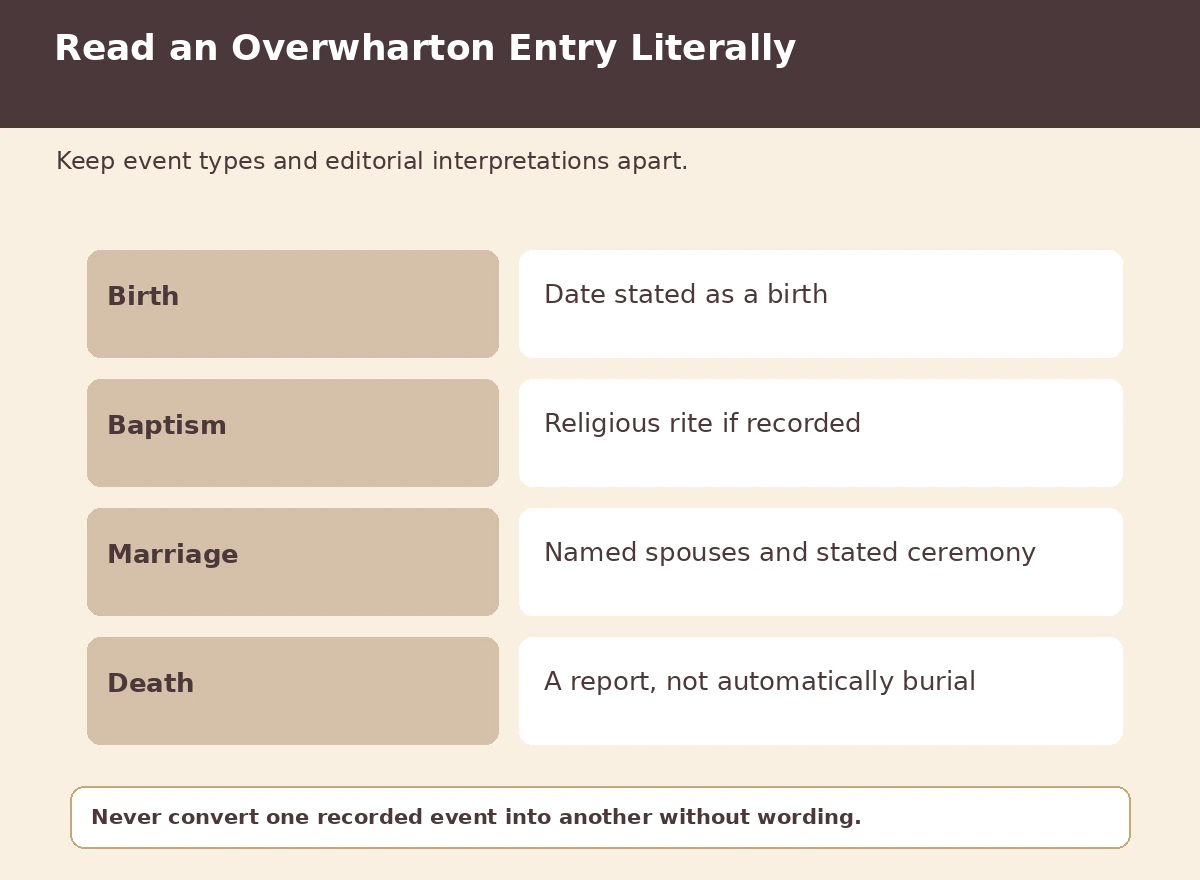
Separate birth, baptism, marriage and death statements in one entry
An early parish register can mix several event types. A sentence reporting a child “born” on a given date is not interchangeable with a baptism on another day. A recorded marriage may be an event directly described by the compiler’s source, while a death notation may not state a burial location. Transcribe the verb, date and named participants as written. If a page associates parents with a child, note exactly who is named rather than filling missing parentage from an online pedigree. These are useful historical reports, but even a faithfully published transcription should be evaluated against independent court, land, tax or later church records before an identity claim is considered proven.

Use Stafford County and historic parish geography as search context
Overwharton appears in publications about early Stafford County and the Potomac region, an area that underwent substantial civil and church boundary changes during the colonial period. The publication’s introductory history can point to nearby parishes and predecessor jurisdictions, but do not apply a modern county boundary uncritically to a 1730s event. A person who later lived in another county might appear in the same historical register, or a same-named person could be a neighbor rather than a family member. Link the parish entry to a dated deed, tax list, probate document or original location reference before making a migration story from the parish name alone.
| Layer | What it provides | Caution |
|---|---|---|
| Original parish register | Historical contemporary entries if located | Not inspected via a printed scan |
| Boogher (1899) | Published transcription and editorial history | Not an original manuscript image |
| King (1961) | Later revision reported by Virginia Beach PL | Not automatically independent evidence |
| 2010 library project | Extraction relating to enslaved individuals | Contextual study, not proof of kinship |
Inspect editorial modernization, initials and uncertain handwriting
A nineteenth-century editor might standardize punctuation, expand abbreviations or rearrange entries without documenting each intervention. Compare a printed statement with later editorial treatments and preserve discrepancies. If a name appears as a single initial, do not guess the full form; search contemporary records for a compatible person and label the expansion as a hypothesis. Historical dates can also be vulnerable to transcription errors or calendar-style confusion, so record the literal date first. Because the Library of Congress scan reproduces a printed book, it cannot by itself settle a question about the original manuscript’s ink, corrections or marginal placement. Describe that limitation in any proof summary.
Treat enslaved people named in the register as individuals, not property clues
Virginia Beach Public Library’s Overwharton project draws attention to people recorded as enslaved and to those identified as owners in the historical source. These relationships were created and labeled by an enslaving system; a register’s terminology is evidence of the recorder’s claims, not a statement of a person’s worth or a license to infer ancestry from an enslaver surname. Transcribe the individual’s recorded name, date, associated place and context faithfully. Do not assign an enslaved person a modern or inherited surname without corroboration. Seek manumission, probate, court, tax or subsequent records when available, and make the record gaps explicit. Careful context matters more than an attractive but unsupported family link.
Compare the 1899 Boogher printing with the 1961 King revision
A comparison table should ask what wording appears in each edition, whether one adds a location, heading, spelling or explanatory note, and whether the second offers an identified source for the change. Virginia Beach Public Library explicitly describes the King work as a revision of the earlier Boogher publication, so two matching transcriptions do not automatically constitute two independent pieces of evidence. Mark editorial variants separately from historical contradictions. If the original manuscript’s custodial location cannot be verified, say so and cite the printed version you actually viewed rather than claiming an inspection you have not made. The purpose of edition comparison is traceability, not forced harmonization.
Build a two-namesake test before accepting a colonial Virginia ancestor
For a common surname, assemble every plausible Overwharton entry and compare event date, named parents or spouse, locality and the person’s appearances in independent county documents. An illustrative example might contrast two men with the same given name: one is associated with a marriage date and the other with a child’s birth years later. Without independent identifiers, those entries could belong to one person or two. Record both options and the document that would discriminate between them. Parish proximity or repeated use of a name is not a proof of descent. This prevents an eighteenth-century publication from silently collapsing several historical people into a single online tree profile.

Create an edition-specific citation and state remaining uncertainty
Cite Overwharton Parish, the register’s date range, the Boogher 1899 edition, printed page or entry heading and the Library of Congress item URL with access date. Note that the page is a digitized book image. When using the King edition, give its own publication identity and page rather than borrowing a Boogher number. For the library’s enslaved-person extraction project, cite the project and its interpretive nature, not a fictitious original folio number. Your conclusion should separate what the printed text actually says, what is a plausible inference about identity, and what awaits examination of another original record.
More Records and Archives Guides
How We Research Overwharton Editions
We examined the Library of Congress bibliographic record and image-gallery access for the 1899 Boogher book and the Virginia Beach Public Library description of the 1961 revision and 2010 extraction project. We did not claim to have inspected the original eighteenth-century manuscript. All sample identity comparisons are explicitly hypothetical.
Primary references reviewed on October 24, 2026: Official source 1 — Library of Congress digitized public-domain 1899 edition of William Fletcher Boogher’s register publication and its bibliographic identity. Official source 2 — Virginia Beach Public Library notes the 1961 King revision and 2010 project extracting enslaved persons and people identified as owners. Official source 3 — Library of Congress page-image gallery for close inspection of the printed 1899 book. We do not claim any paid partnership or recommend an unverified affiliate offer. See our affiliate disclosure for the site policy.
It is a digitized image of William Fletcher Boogher’s 1899 printed edition, not the original eighteenth-century manuscript.
The Library of Congress catalogues the printed work as covering 1720–1760. Individual sections or entries should be checked for their exact range.
Not unless the entry states both. Preserve the specific reported event and its date rather than assuming the rites were simultaneous.
No. The later compilation is described as revising the earlier one; their agreement may reflect dependence, not two separate witnesses.
Record the person’s name and historical context respectfully, distinguish enslaver descriptions from verified identity, and seek independent records before asserting relationships.