
A historical U.S. telephone directory can connect a name, telephone number and location in a particular edition, but cannot by itself prove who occupied a house or owned the telephone line. The Library of Congress (LOC) telephone-directory guide supplies location-by-year inventories, digital collections and microform access routes. Start with the city and publication year, then decide whether you need a conventional name listing or a reverse directory organized by street address or number. That distinction often resolves a question that ordinary name searches cannot.
Check city and year holdings instead of guessing coverage
The LOC maintains an extensive but nonuniform U.S. telephone-directory collection. Its state-by-state access guide distinguishes digitized books, microfilm, phonefiche and print. Do not interpret ‘Library of Congress has telephone books’ to mean every locality is accessible as a free full-text scan. First record the city or exchange area as described at the target date; county lines and service areas may not coincide. Then check the year and format. Where the required city is absent from a digital search, inspect the print and microform inventories. A family may have had no listed line even when it lived in that city; the lack of a listing is not a census-like proof of absence.
Know which historic phone books LOC digitized
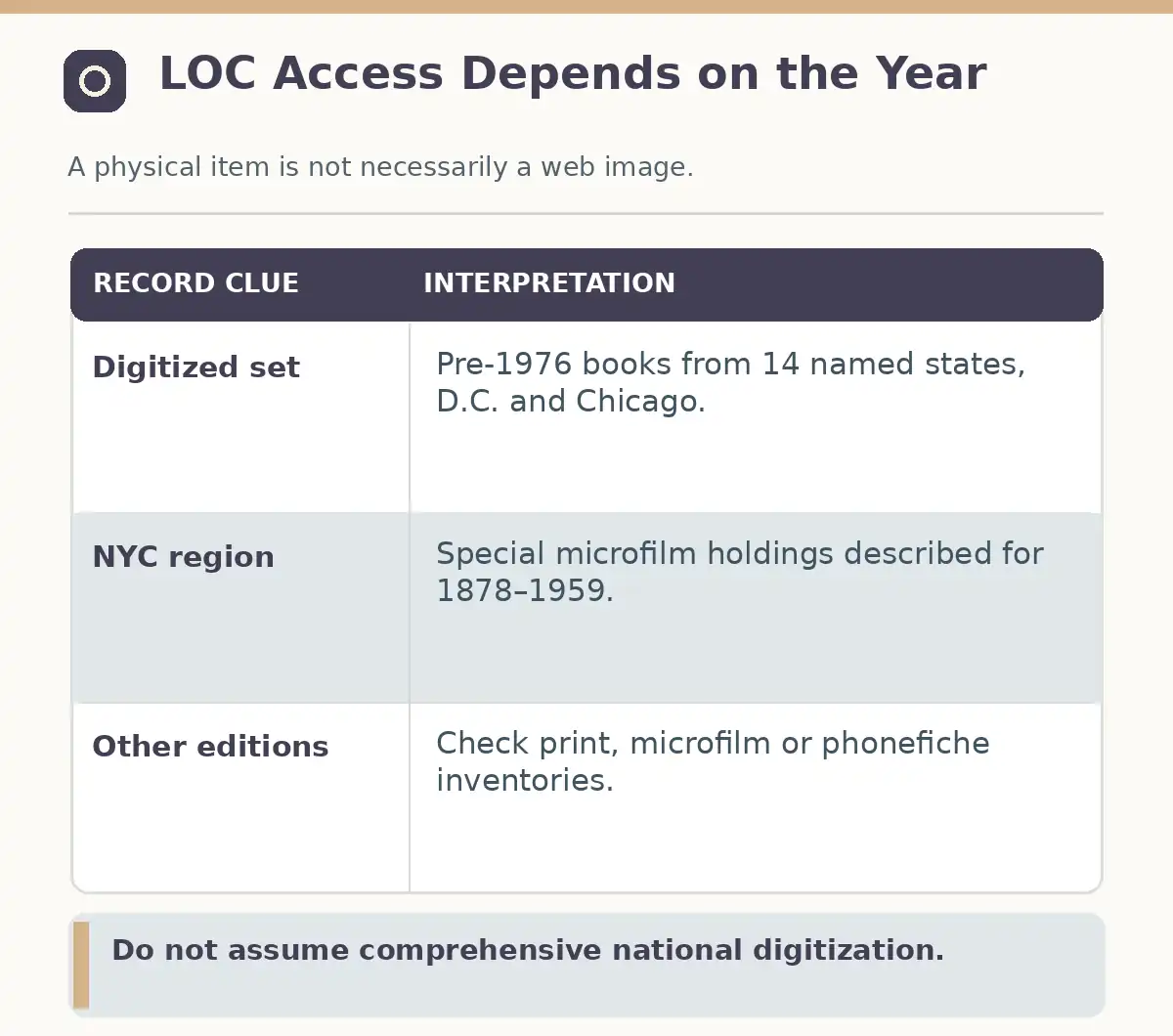
According to the LOC access page, pre-1976 directories for fourteen named states, the District of Columbia and Chicago were digitized from microfilm. The specified states are Alabama, Alaska, Arizona, Arkansas, California, Colorado, Connecticut, Delaware, Florida, Georgia, Hawaii, Iowa, Maryland and Pennsylvania. That is a statement of one digital collection’s coverage, not a promise that every issue in every local exchange survives. New York City and adjacent areas have a separate microfilm collection described for 1878–1959. Additional regional directories appear on microfilm and later phonefiche. Check the inventory for a precise location-year combination before opening a search engine or ordering a film.

Use a conventional listing to test a name and number
Most ordinary telephone directories organize residential or business subscribers alphabetically by some form of name. Transcribe the line exactly, including initials, suffix, listed occupation or business category when shown, exchange and number, town and edition date. Do not silently modernize an old dialling code; older exchanges and numbering plans changed. A number might be listed to a business, shared household or organization, not solely the relative you are researching. A married person may be absent from a listing because another household member was the subscriber. Search consecutive editions to see whether the number appears, changes or disappears. Only claim what the directory printed, not what you believe the line’s everyday use must have been.
Switch to reverse directories for a known address
The LOC reverse-directory guide explains that criss-cross directories are organized by address and telephone number, commonly without an alphabetical name index. If you begin with a street address rather than a person’s surname, this is the more direct route where a suitable edition survives. Open the relevant inventory, confirm whether a reverse volume exists for the city and year, then find the street and house number. Reverse directories especially require caution with apartment buildings, mixed-use properties and businesses. An address-to-number association can be a clue, not a lease, deed or assertion that a named person was the occupant. Write the exact print entry and use city directories or census returns independently.
Separate the date of publication from the date of residence
A phone-book edition reports what a publisher assembled for a service area around a particular time. It does not provide a daily household roster, and there may be a lag between service changes and printing. Two listings for the same name, address or phone number in successive years should be correlated with dated marriage, death, voting or property records. If an entry disappears, consider an unlisted number, publisher omission, cancelled service or changed business name before concluding migration or death. For a common surname, use the neighborhood and any documented workplace to keep possible subscribers apart. Telephone numbers can be transferred or reused; do not treat a number as a durable unique identifier for an individual. For example, a 1952 telephone listing for a surname and number in Chicago may help select the correct city, but another family with the same surname might share the page. Open the actual edition image, note the printed city and exchange, and compare the address with a 1950 household enumeration. If your search instead starts from a known storefront, a surviving criss-cross directory may identify the service listing at that address. Neither route by itself determines whether a proprietor owned the building or where employees resided. The precise edition, page, directory format and cross-record comparison are the evidence trail—not a search-result snippet alone. For a step-by-step method, see how to use historical city directories for family research.
Cite a particular edition and preserve the access route
A reproducible citation should state the directory title, city or exchange coverage, published year, page or frame, exact name or address, library collection and the URL or microfilm/phonefiche locator. The LOC’s librarian FAQ suggests selecting a city in the U.S. Telephone Directory digital collection and sorting its available editions by date. Save a scan or transcription within the collection’s reuse and privacy rules, including your date of access. For physical holdings, record the reading room and the requested city-year volume so another researcher can retrace it. Note whether the artifact was an alphabetical phone book or reverse criss-cross directory; the layout changes how a negative search is interpreted.

More Records and Archives Guides
How We Research U.S. Telephone Directory Listings
We derive coverage statements from the Library of Congress access guide, the reverse-directory explanation and the LOC reference FAQ. The diagrams separate city/year availability, name-first and address-first routes, and what a listed number can actually prove. For privacy and accuracy, we discuss historical editions rather than searching for contemporary living persons. Our affiliate disclosure covers editorial relationships; primary library inventories are the recommended sources.
No. LOC holdings include digital copies, print, microfilm and phonefiche, with significant differences by city and year.
A criss-cross directory arranged primarily by street address or phone number rather than surname.
The LOC describes digitized pre-1976 coverage for fourteen states, Washington, D.C., and Chicago; check locality holdings.
No. Subscriber listings can involve businesses, shared households or changing service arrangements.
Check adjacent editions, changed numbers, alternate names and independently dated records before inferring migration.