
For historical Ontario deaths, an alphabetical index is the starting point, not the death registration itself. Search the relevant event year, capture the stamped registration number and inspect the original page or request a copy. Official Archives of Ontario pages currently differ about whether its latest historical death holdings end in 1954 or 1955. That inconsistency must be checked with the archive for the year concerned, not silently resolved by a third-party index.
Start With Ontario Civil Death Registration in 1869
Ontario’s official vital statistics guide dates provincial registration of births, marriages and deaths to 1869. Before that point, use church burials, cemetery registers, probate files, newspapers and other surviving local materials rather than looking for a universal provincial death certificate. Even after 1869, registration practice and source completeness require checking the locality. A death occurring elsewhere may have been reported to another jurisdiction. Write down the death place, likely year and reported names of relatives before choosing the search index. Do not confuse a burial date with the date of death.
Check the Current Archive Year Limit Carefully
There is a documented difference between the Archives of Ontario topic page, which describes death registration books through 1955, and its February 12, 2026 copy-order page, which lists deaths through 1954. The first page also distinguishes available online image years from archive holdings. Both are official; neither should be silently treated as the sole definitive statement for a borderline registration. If searching a 1954 or 1955 death, verify current availability and the correct custodian directly with the Archives of Ontario before requesting records or claiming that an index is complete.
Choose Ancestry and FamilySearch by Coverage
The Archives of Ontario guide says Ancestry’s digitized Ontario deaths extend through 1953, while FamilySearch has domestic death registrations through 1937 and overseas registrations through 1947 in its described collections. These online year ranges differ from the archive’s physical book holdings. Access also differs: library institutional access, private subscriptions or a FamilySearch account may be relevant. Check the present provider conditions instead of promising universal free image access. A year unavailable on your chosen website can still belong to an archive holding; switch catalog routes before concluding no registration survives.
Find the Stamped Death Registration Number
Ontario’s archive explains that each civil registration carries a unique stamped registration number that may be located in alphabetical indexes or on the record itself. Copy the number, name, event year, registration place and source page. A modern database identifier is not necessarily the government’s stamped number. If a requester sends the wrong number, the archive may retrieve a different person or be unable to locate the item. If two namesakes share similar deaths, keep both candidate numbers until the actual registrations can be compared.
Inspect the Registration Instead of the Extract
An index search result may provide a name, approximate date, county and number while omitting informant statements or corrections. Open the original scan if the collection allows it, read all headings and look for marginal changes, date of registration and the signer. Transcribe birthplace, occupation, parents or marital status only if the form actually records them. Different forms and decades may supply different details. If a field is blank, do not invent a value from another person’s record. Cite the actual original image, not an index page, when the claim depends on a specific registration statement. Our guide “British Columbia Death Records” covers a related question.
| Source question | What to use | Important limit |
|---|---|---|
| What survives? | Archive books and online indexes | Different year ranges and access |
| What is not automatically proved? | Unverified family claims | Seek a different independent record |
| How to proceed | Read the actual archive item | Record repository, series, date and page |

Distinguish the Informant From Independent Proof
A death registration may include information supplied by someone with firsthand knowledge of the death but secondhand knowledge of the deceased’s birth or parents. Identify the informant where the document records one and evaluate each statement separately. A parent’s birthplace reported by an adult child can be a useful lead but may contradict a baptism or marriage entry. Likewise, a spouse’s surname on the registration is not automatically a maiden name unless the record says so. Preserve conflicts in a claim-level worksheet rather than selecting whichever detail best fits the existing family tree.
Build a Four-Date Ontario Death Timeline
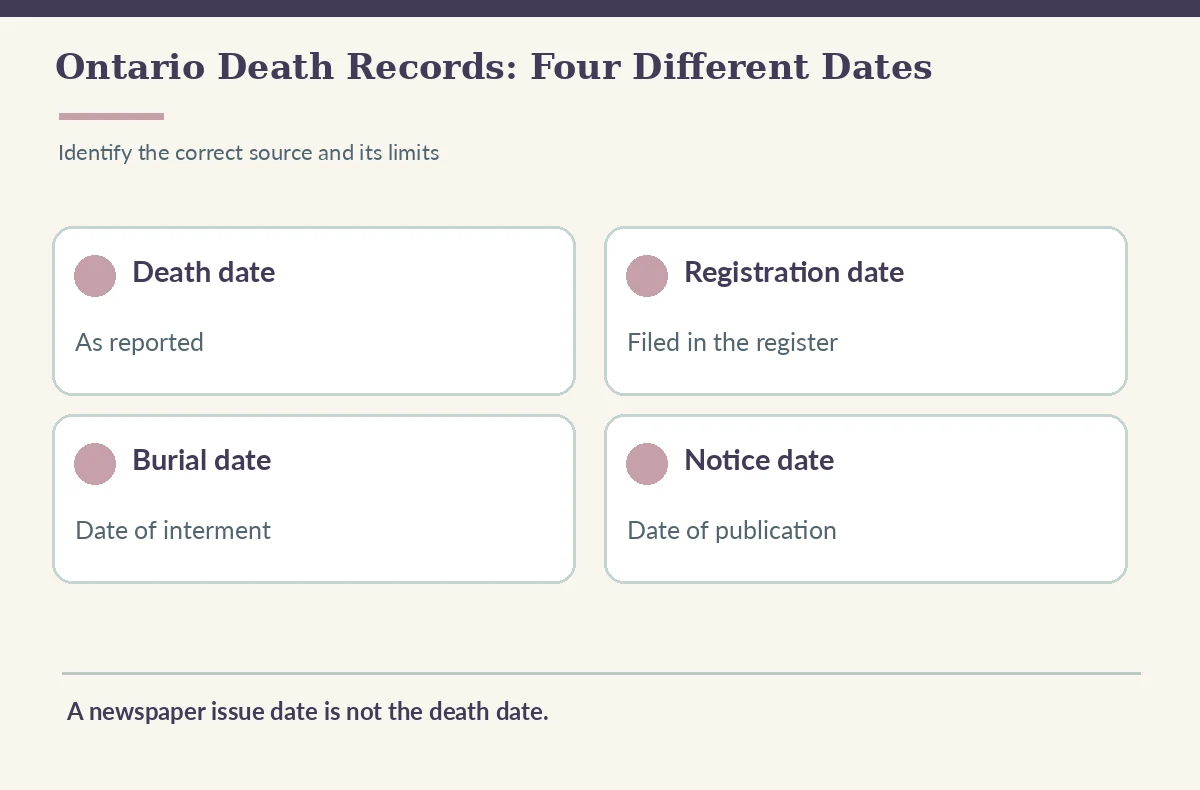
Separate the actual reported death date, filing or registration date, burial date and newspaper publication date. These can occur on different days without implying multiple people. If a certificate has a date column that is hard to interpret, check the original printed heading rather than borrowing the event type from a database export. Compare a cemetery register and obituary against the death registration by place, age and relative names. A notice published one week later is not a competing death date. A timeline can expose copying errors while retaining every underlying source.
Request an Archival Copy With a Complete Reference
The Archives of Ontario has a dedicated page for ordering certified copies of archived registrations. It asks for the name, event date and registration number. A certified archival copy serves purposes that a simple search index does not; check the current service conditions and fees with the archive instead of quoting old amounts. For more recent years outside transferred archival holdings, the Registrar General or ServiceOntario may be the relevant custodian. The cutoff must be verified, especially for years affected by the archive pages’ differing 1954/1955 statements. Our guide “Prince Edward Island Death Records” covers a related question.

Search Beyond the Index When No Name Appears
Try surname spelling variants, an alternate given name, a neighboring year and plausible county. If an Ontario resident died outside the province, check that other jurisdiction instead of expecting an Ontario death registration. Compare burial place and residence as distinct facts. FamilySearch’s online coverage lag means that a zero result after its last domestic year has little evidentiary value. Document platform, filters, date range and the difference between name search and manual index browsing. A defensible negative search must establish that the target record type should have covered that death. Our guide “Ontario Birth Registrations” shows how to find the original record after an index hit.
Resolve Two Same-Name Deaths With Independent Documents
Suppose two Ontario registrations name the same individual but show different ages. Make a two-candidate table using the registered death location, surviving spouse, informant, occupation and independently known address. Compare the original signatures and related census or marriage evidence where available. Do not treat a close age and matching surname as sufficient. If only an index is available, mark the match provisional and seek the actual registration or another contemporary source. End by stating the narrow fact supported—such as a registered death in a district—and which parentage or identity claims still require proof. If you want the full process, read how to research Ontario genealogy using civil and church records.
More Records and Archives Guides
How We Research Ontario Death Registrations
We checked the primary repository description against the independent scope or custody guide and another archival or library reference as applicable. Our tables distinguish information actually recorded from hypotheses about family identity. Illustrated books, forms, maps and example charts are conceptual teaching aids, not reproduced or attributed historical pages; no individual family discovery is asserted. Actual name-index coverage, image permissions and copy procedures should always be checked at the custodian before use. No product or paid referral is recommended; see our affiliate disclosure.
Ontario began provincial vital statistics registration in 1869, although older church and local death-related records also survive.
Official archive pages currently differ between 1954 and 1955; confirm the exact target year with the Archives of Ontario.
No. Provider date ranges and access conditions differ; holdings extend beyond some online indexes.
The archive asks for the individual’s name, event date and stamped registration number.
A parent name, when present, is a recorded assertion that must be assessed for informant knowledge and corroborated.