
For historical British Columbia death records, begin with the BC Archives genealogy index, then check whether an image of the death registration is linked. The provincial record series reaches back to 1872, but online indexes, digitized images and certified genealogy copies are different products. The government says anyone may apply for a genealogy-certified death registration after more than twenty years have passed since the death; more recent applications have eligibility limits. Treat a registered death as evidence for the event, but verify parentage and birthplace details that were supplied by an informant.
Start in the BC Archives historical genealogy index
The Government of British Columbia death-registration guidance directs family historians to the electronic historical vital-events index maintained with BC Archives. Enter the person’s name and a defensible date range. Test maiden names, previous surnames and likely spelling alternatives; a death index may file someone under the name reported at death rather than the family surname expected by a later descendant. Save the result’s registration number, year, place and any image or microfilm reference shown.
An index entry is a finding aid: it can establish that an event has been indexed, not that every transcription field is reliable. If an online hit seems to contradict a cemetery date, open the original registration if available before deciding which record is wrong. The two entries may describe registration date, event date or another person with a similar name. Use a birthplace, spouse or locality from independent sources to filter same-name candidates rather than silently changing the original spelling.

Read what an original death registration actually states
Historical death registrations can include a reported date and place of death, age, marital status, address, occupation and details about relatives or burial, but the recorded fields and their completeness vary over time. Do not apply every modern form label to an 1870s record. Transcribe each existing column and identify the person who provided information when the form names an informant. A medical certification, where available, has a different evidentiary role from an informant’s statement about birthplace or parents.
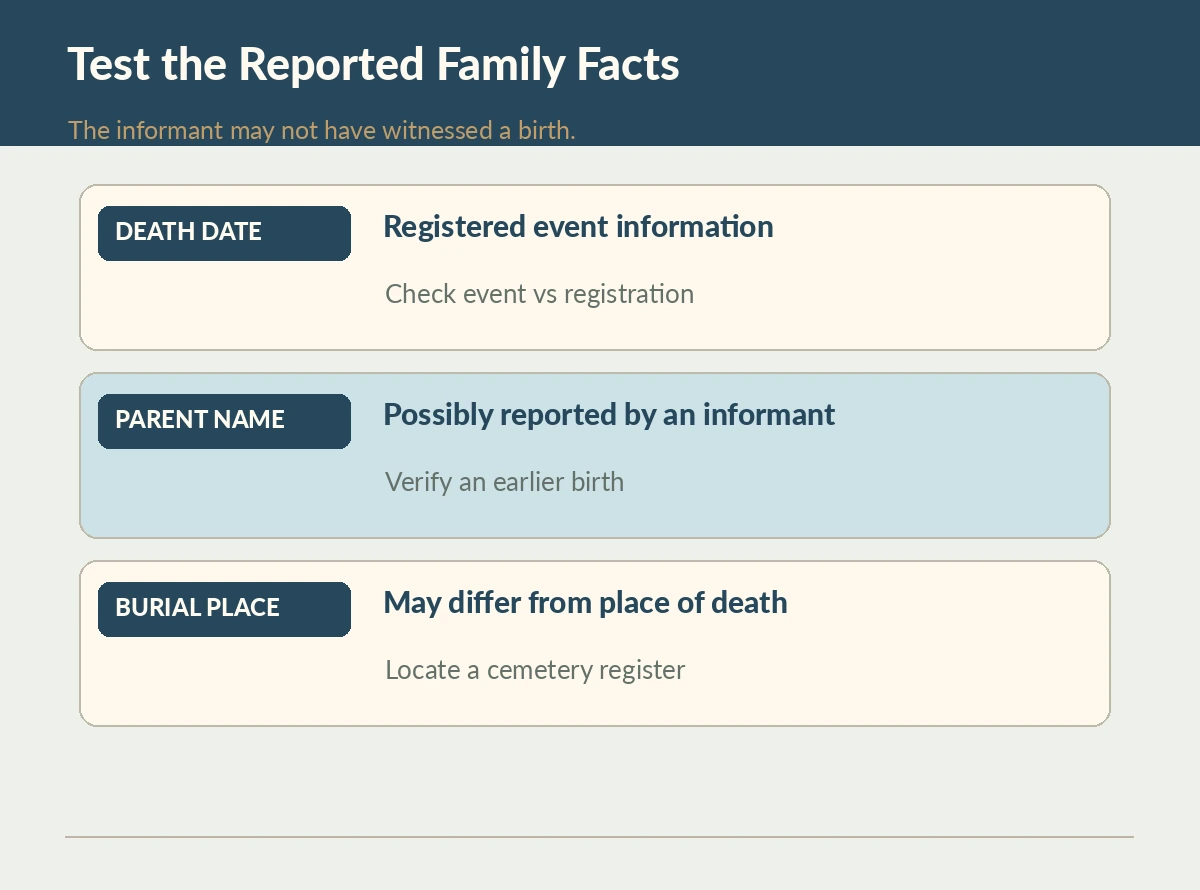
Separate three layers in a research note: observed entry (the actual writing on the registration), claim reported (for example a stated mother’s name) and independent proof (such as a birth or marriage registration). An adult child may accurately report the death date but misremember a grandparent’s maiden name. The death registration may point toward a prior family but cannot by itself prove all earlier biographical fields.
Distinguish index results, digitized images and official copies
BC Archives provides a historical index and many entries have images of registrations. Not all indexed records have freely viewable scans. Vancouver Public Library’s BC civil registration guide explains how microfilm references and image availability can differ, including later indexed years lacking corresponding public microfilm. If no image is linked, retain the registration number and look up the current instructions for requesting a copy; do not assume the entire original is lost.
For a certified genealogical copy the provincial authority describes a photocopy of the original registration and, if available, its medical certification. A certificate extract may differ from a full historical registration in purpose and fields. Research whether you need a full registration to settle an identity conflict before paying for official copies. Record what you actually ordered, and never describe an online index abstract as a legally certified image. Access charges and processing procedures can change after this article’s check date.
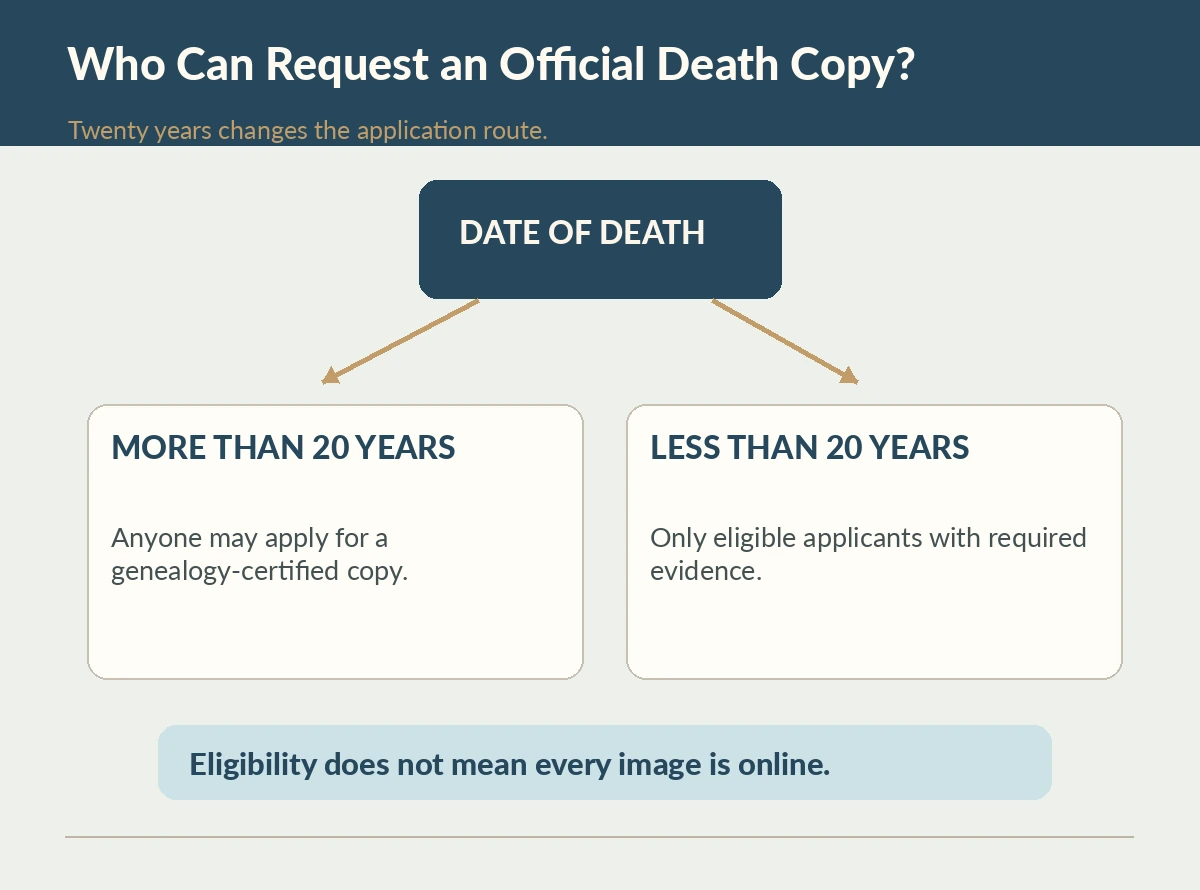
Apply the twenty-year historical access rule precisely
The current government eligibility rules say anyone can apply for a genealogy-certified death registration if more than twenty years have passed since the death. For deaths less than twenty years ago, eligibility is restricted to specified relatives and other authorized or justified applicants, who must show the required evidence. The twenty-year rule describes access to a copy; it is not a promise that every qualifying document is digitized or immediately retrievable through the public search tool.
A person who died near the moving cutoff requires a careful event-date check. Do not publish information about living relatives merely because it appears in a historic death document. Consult the official application instructions directly when privacy, certified-copy eligibility or fees matter. Do not try to circumvent restricted categories using third-party indexes. The correct research practice is to disclose the evidence source without exposing another person’s unrelated private details.
Reconcile a death entry with cemetery and newspaper evidence
A death registration can provide an event date while a burial record documents an interment and an obituary has a publication date. These are three different events and may span several days. Create a timeline with separate rows for death, registration, burial and obituary. If the dates differ, read the literal source wording, local time and recording practice before declaring an error. A grave memorial created decades afterward is a later statement, not necessarily a contemporaneous registration.
For similarly named residents, use spouse, approximate age, occupation, residence and burial place as independent check points. A registered death in Vancouver does not prove that all relatives named in an obituary lived there, nor does a memorial cemetery listing always prove physical burial at that site. Record whether each record is original, copied, indexed or commemorative. When the documents disagree on a parent’s birthplace, seek the birth registration or a contemporaneous marriage act.
Record a reproducible search and an honest negative result
A research log should show the BC Archives database queried, search date, surname variants, inclusive years, registration numbers and the availability of original images. Note whether you searched historic records only or consulted restricted-record procedures. If you locate only an index line, label the conclusion provisional and identify the missing registration as the next best evidence. A family tree entry without a record locator is difficult for others to verify. For a related choice, see our guide “Manitoba Historical Vital Records”.
When no result appears, distinguish a pre-1872 event, an incomplete index or image series, a different death jurisdiction, and an ordinary name-search failure. Check contemporary directories, cemetery interments or newspapers to narrow the correct city and date. Then re-run the index with corrected information and document what changed. Do not say that someone never died in British Columbia solely because a website search yielded no name; even a complete registration series is not equivalent to a perfect digital index. For the same kind of choice in another place, see our guide “Saskatchewan Historical Death Records”.
More Records and Archives Guides
How We Research BC Death Registrations
We used the British Columbia government’s genealogy death registration eligibility and copy description together with Vancouver Public Library’s civil registration access guidance. We preserve the 1872 starting date and the more-than-twenty-years copy rule without claiming the entire series is digitized. Also, We also differentiate an official event registration from an informant’s claims about earlier family facts, and avoid statements about current fees beyond what an applicant should verify directly.
This article uses government and institutional source guides rather than paid product placements. We make no affiliate product recommendation here; read the affiliate disclosure for our editorial policies. Examples are interpretive research scenarios, not verified genealogies of named people.
The provincial government says death registrations date back to 1872; earlier evidence may require church or colonial sources.
No. Many have images, but index coverage and digitized or microfilmed copies do not always match.
When more than twenty years have passed since the death, according to the current provincial eligibility guidance.
It may report parental details, but these can come from an informant and should be checked with earlier records.
Keep the event year, registration number, place, archive and image or film reference, together with the date of access.