
To trace an Ontario birth through the provincial system, begin with the annual birth registration index, record the stamped registration number and registration year, and retrieve the corresponding original entry. Ontario established province-wide civil vital registration in 1869, but surviving coverage, delayed filings and online image access vary. An index is a locator, not a complete birth certificate. The Archives of Ontario currently describes different terminal years on two official pages; check the latest holdings and ordering guidance before assuming that a recent historical year is searchable.
Choose civil registration or a pre-1869 baptism first
A reported Ontario birth in 1885 belongs in the provincial registration search, subject to gaps and late filings. A reported birth in 1848 does not automatically have a contemporary province-wide certificate: seek the relevant church baptism, community register, family Bible, or later delayed registration if one exists. The Archives of Ontario vital statistics guide notes that the province has some older church and court records but not comprehensive civil registration for those years. Use birthplace and denomination as search clues, never as proof that one particular parish served the family.
Start a working card containing the child’s probable birth date, parents’ names from independent records, the historical county or township, and two plausible name spellings. Keep a reported baptism date separate from a birth date. A church register might name sponsors or parents, while a civil entry could have different informant details. When deciding which collection to search, record the date and locality of the event, not just a modern province-wide database title. This avoids falsely interpreting an empty pre-1869 civil index as a missing ancestor. Our walkthrough on how to research Ontario genealogy using civil and church records sets out each step.
Find the annual index number and registration year
On the Archives’ birth-search instructions, the FamilySearch catalog route begins with Ontario vital-record indexes, then selects the index reel covering the birth year and surname. For many nineteenth-century indexes, surname sections are subdivided by initials; later annual indexes can run A–Z. The actual registration number is essential: copy every digit, the printed registration year, and the exact index name spelling. Preserve an ambiguous digit with a question mark in your transcription rather than silently converting it to the number you expected.
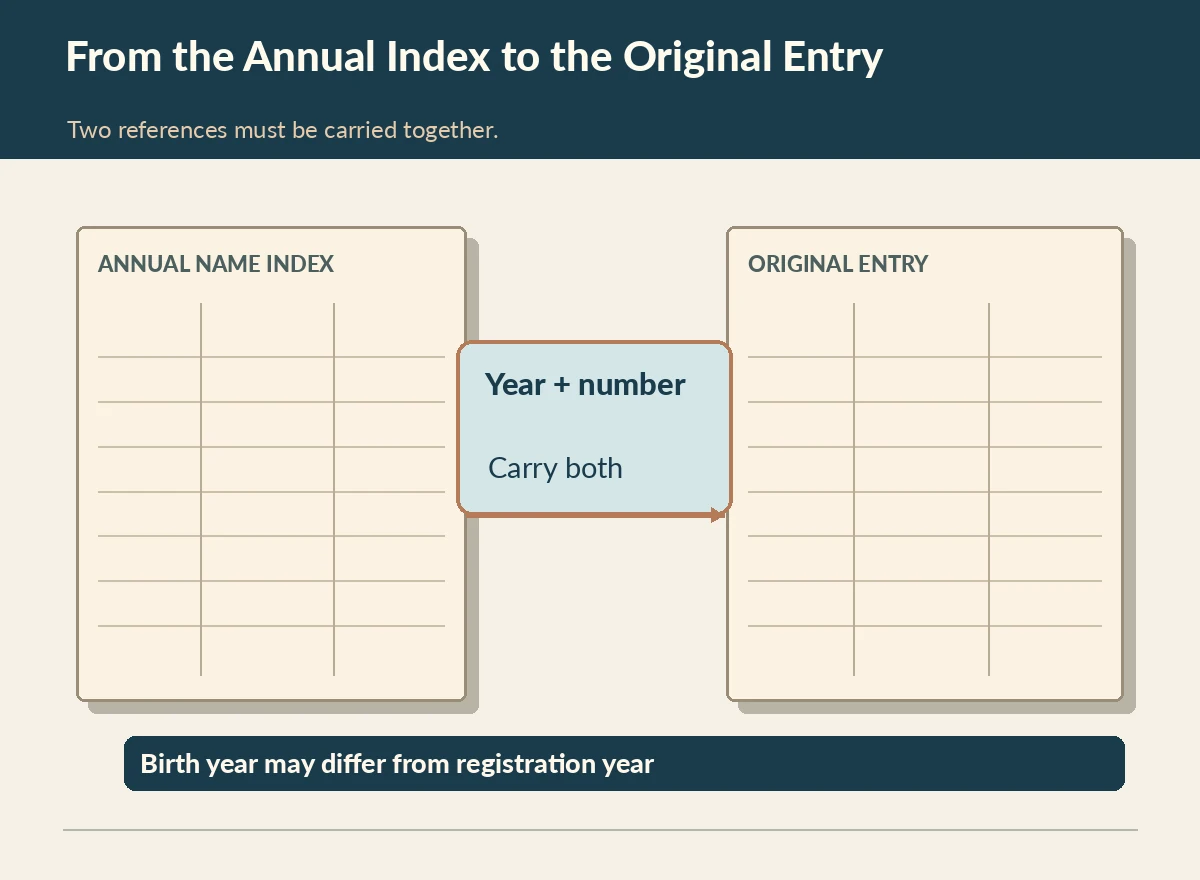
The index’s event year is not always the year that a delayed registration was filed. Make two separate fields: birth date reported and registration year printed. Search by the latter when selecting the original-volume or film range; searching only by birth year may lead to the wrong number sequence. If an index is not online for the period you need, the Archives’ reading-room microfilms provide an alternate route. A second person’s near-identical name can coexist in the same year, so record place and parents from the image before committing to an identity. Our guide “Early Nova Scotia Census Records” adds more detail on this.
Open the original registration instead of trusting a transcript
Once the registration number and year are known, locate the film or image group containing the appropriate annual sequence. The Archives explains that the registration index and the original registration may be on different reels. Check both the entry’s stamped number and its document heading. Transcribe date, place, child, parents, informant and any marginal annotation only where the actual form supplies them. Do not assume that every year uses precisely the same set of questions or that all reported information came from someone present at the delivery.
A website’s typed name may correct a spelling or introduce a new mistake. Compare every critical letter on the original page; retain the indexed spelling as a search alias. If parents appear, test them against a marriage record, census household and locality, especially when two couples share a surname. A certificate copy can be useful, but write down whether you consulted an original book image, a filmed copy, a digital index or a certified reproduction. That source classification determines how another researcher can retrace your evidence. Our guide “Ontario Death Registrations, 1869–1955” goes into more detail.
Compare the different online release ranges cautiously
The Archives’ main registration page says its original birth holdings extend to 1920, while its February 2026 order page lists births through 1919. The main guide separately describes Ancestry digitization to 1918 and FamilySearch births to 1912. These figures describe different services or pages, not a universal birth-year cutoff. For borderline years, confirm the exact holdings and route with the Archives before ordering or reporting that no record exists.
Ancestry Institution access may be available at the Archives and many public libraries, while FamilySearch access can require a free sign-in and may lack newly released images. Paid access and free access should not be confused with the underlying record’s survival. If an indexed entry is visible but its image is not, log the citation and request guidance on the original or a certified copy rather than treating a paywall or unavailable viewer as proof of no event.

Resolve delayed filings, namesakes and contradictory dates
Suppose a child’s birth was reported in an 1890 census-derived estimate but a registration appears in a later administrative year. That does not automatically make the entry false or identify it as delayed: inspect the original form for the event and recording dates. Compare parents’ complete names, maternal maiden name if recorded, place of birth and household addresses where available. A strong identity claim requires several coherent attributes, not merely a plausible surname and year. If a detail conflicts, preserve both versions and evaluate who supplied each statement.
For an apparent absence, repeat the index by variant spelling, initials, possible neighboring county and the year before or after the estimated event; check whether a delayed registration would have been filed later. Follow with a nearby parish baptism or later census if the civil collection is incomplete. Report exactly which alphabetical index ranges and original sequences you examined. The useful research result may be a justified list of still-open possibilities rather than a certificate attached to the wrong child.

Record a reproducible source citation and next action
A source note should identify the Ontario birth registration, registration year and stamped number, individual and location, date as written, source collection, image or microfilm identifier, repository and access date. Cite the handwritten entry as your evidence for the recorded statements; cite the index separately only if its interpretation or transcription matters. If you need a legally certified copy, consult the Archives’ current order instructions and distinguish this from a genealogical download. Certified copies may require details not yet established by an index-only match.
Use a concise status ledger: confirmed from image, reported but unverified, and not located within stated coverage. List the other records necessary to link the birth to the adult ancestor: a marriage showing parents, a household with coherent ages, or a death record reporting birthplace. A birth registration can identify facts supplied to a registrar; by itself it cannot prove that a same-named person found decades later is the child on that form. Link identities only after cross-record comparison. Our guide “Ontario Marriage Registrations” shows how to find RG 80-5 entries and verify a couple.
Read the Specific Archive Sources and Record Limits
The responsible repositories document their holdings and limitations: Ontario civil-registration introduction, exact index-to-original route and online holdings.; Current certified-copy requirements and 2026 holdings description.; Provincial registration index arrangements and original-document finding aids.. Record when each page was consulted; an access method or publication range can change independently of the original evidence.
More Records and Archives Guides
How We Research Ontario Birth Registrations
We reviewed the current Archives of Ontario vital-statistics search guide and its separately dated 2026 copy-ordering page, including their differing latest-birth-year descriptions. The workflow separates index references, registration-year numbering, original register images and certified copies. We do not treat availability on Ancestry or FamilySearch as proof of archival completeness.
No paid genealogical partner or affiliate recommendation is made here. For the site policy, read the affiliate disclosure. When a custodian charges for an image, application or certificate, check the official ordering terms directly.
The province-wide civil registration system began in 1869. Earlier births normally require church or other contemporaneous sources, though some delayed or exceptional records survive.
The number sequence belongs to the administrative registration. Late filing can make it different from the birth year, so record both rather than guessing.
No. The Archives currently describes FamilySearch birth images through 1912 and Ancestry through 1918; coverage and viewing conditions differ by platform.
Their currently displayed holdings and order instructions disagree around 1919–1920. Check with the Archives for a borderline-year request and note which page you used.
Not alone. Read the registration image, verify the stated parents and place, then compare independent records to prove the later person is the same child.