
Find an Ontario marriage by matching the year and registration number to RG 80-5, then compare the original entry with independent evidence. Begin with a single research question and a dated location, then identify the surviving original record before assigning a name to your family. A database entry is a useful lead, not proof of kinship or of a field absent from the document.
Choose the Correct Marriage Record Era
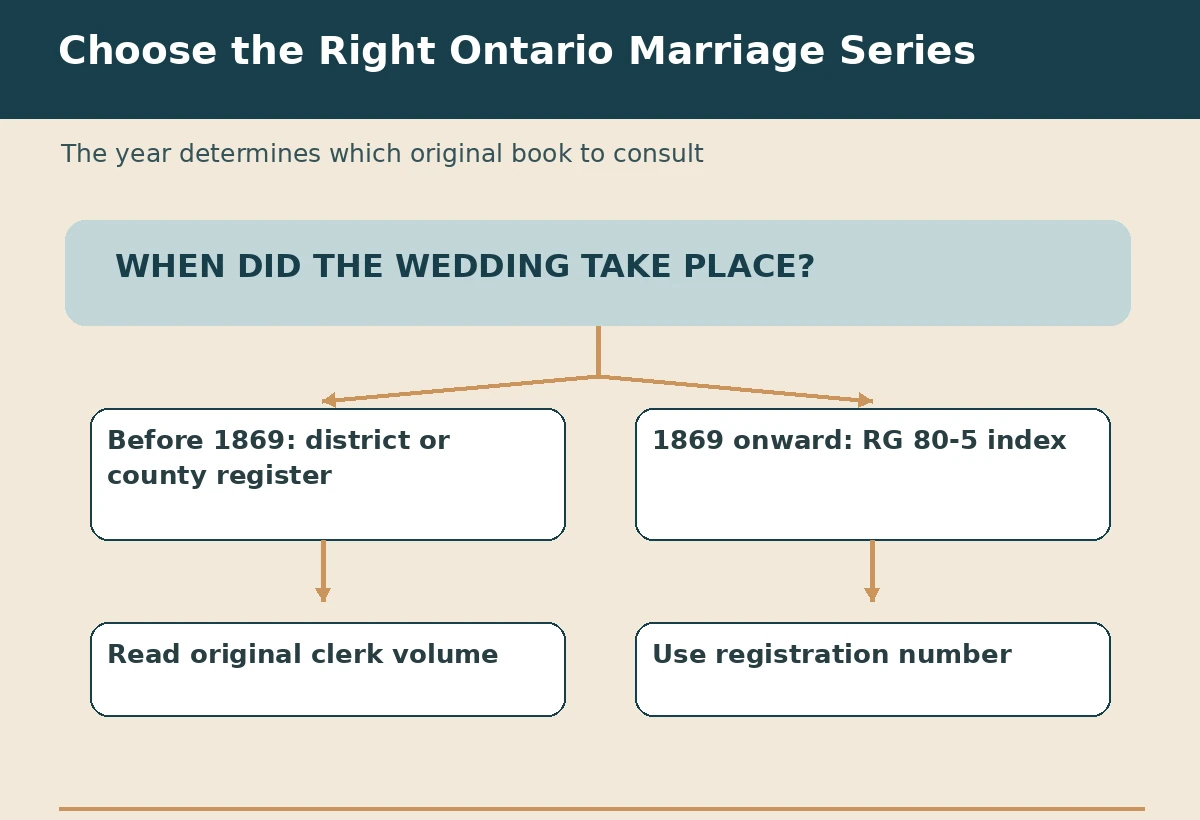
Ontario marriage research starts with the event date and the district in which the ceremony was reported, not the surname alone. Systematic provincial civil registration began in 1869, but earlier district and county marriage registers preserve some nineteenth-century ceremonies. A pre-1869 entry might survive in a clerk’s register, a denominational book or a published transcription rather than the later province-wide system. Write down an approximate wedding interval, both spouses’ names and a possible locality. Treat the date as provisional until a record names the event. This first choice prevents a searcher from concluding that a marriage did not happen merely because it falls outside a modern provincial name index. For a related choice, see our guide “New Brunswick Marriage Bonds, 1810–1932”.
Use the RG 80-5 Index Number as a Locator
For provincial-era registrations, the Archives of Ontario identifies marriage records with the archival reference RG 80-5. An annual alphabetical index is a finding aid: take the names as indexed, registration year and the exact number, then use that number to locate the relevant registration. Do not confuse the index number with a page in an unrelated parish transcript. If the entry is returned through a commercial database, read the collection title and whether the result includes an actual image. A name-only result may correspond to another couple, especially where both partners have common surnames. Preserve conflicting candidates until residences and witness details can be compared. Our guide “Ontario Birth Registrations” shows how to find the original record after an index hit.
Account for Different Online Coverage Dates
The Archives of Ontario’s vital-statistics topic page describes marriage holdings through 1945, while its separately maintained order page describes marriages through 1944. The topic page also lists different digitized coverage for Ancestry and FamilySearch, with FamilySearch ending earlier. These statements refer to different holdings, access products or pages that may not yet be synchronized. Do not resolve a boundary-year question by guessing which screen is authoritative. Verify the specific year using the current archival order or collection page and, if necessary, ask the custodian. A no-result search in a vendor index is not equivalent to a search of every archival volume. If you want the full process, read how to research Ontario genealogy using civil and church records.
Recover Pre-1869 District and County Entries
If the event predates province-wide registration, determine its historic county or district. Early district marriage registers and later county returns do not form one fully comprehensive continuous database. A printed index or transcription can lead to a microfilm reference, but it may omit handwriting, marginal notes and the original context. Check the Archives’ guide to pre-1874 marriage registrations to understand which local series applies. Follow the index reference into the actual return whenever available. Keep separate citations for an edited published transcription and an archived clerk’s book; an extracted couple name is not a substitute for viewing the source. Our guide “Ontario Death Registrations, 1869–1955” adds more detail on this.
Compare the Couple on the Original Registration
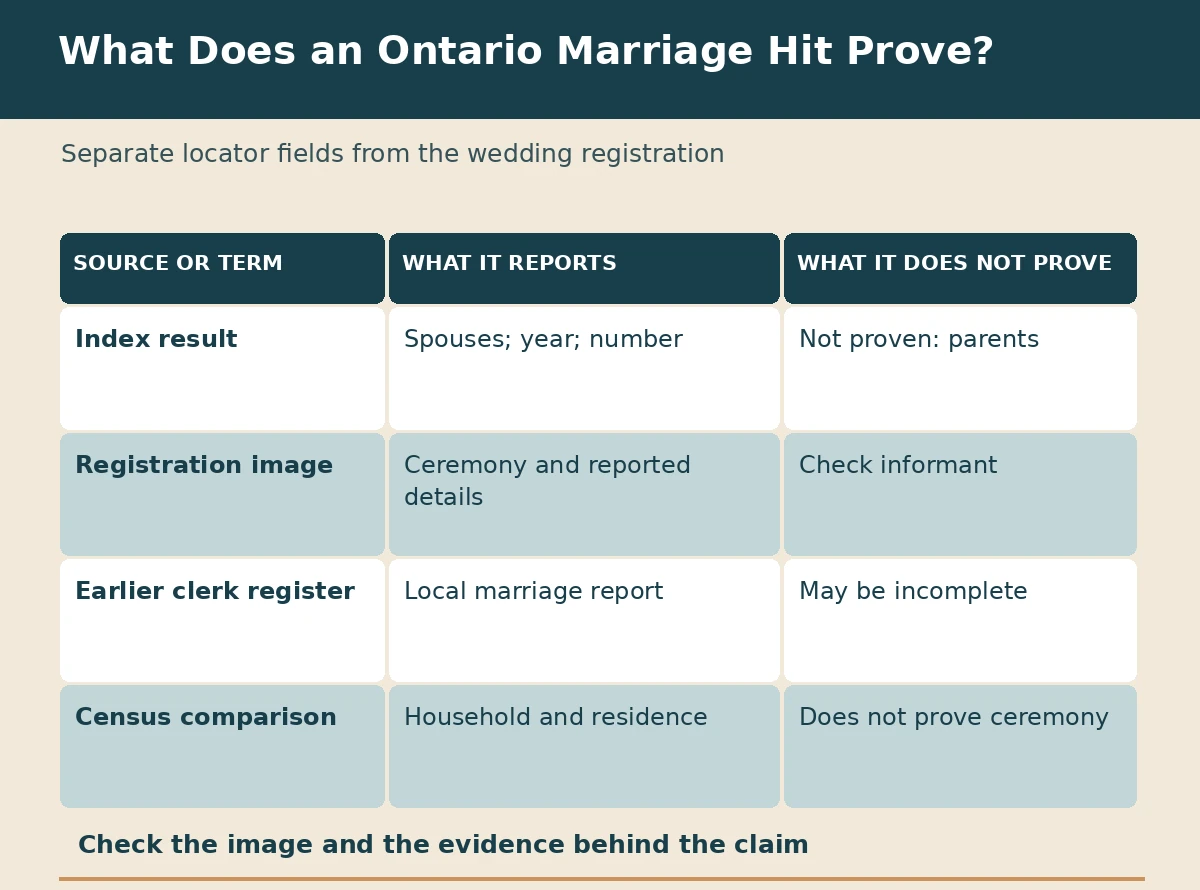
The correct image can offer more than a searchable couple name: look for the stated ceremony date and place, ages, residences, occupations, marital status, parents and witnesses, where the particular form supplies them. Older forms and inconsistent reporting can leave some columns blank. Do not reconstruct missing maiden names from a vendor hint or assume that a witness was related. Make a column for each spouse’s identifying characteristics and compare it with a census or baptism close in time. A strong candidate matches a cluster of independent details rather than one attractive surname spelling.
| Event situation | First route | Research warning |
|---|---|---|
| Before 1858 | Historic district register | Coverage varies by district |
| 1858–June 1869 | County marriage register | May need published index and film |
| From 1869 | RG 80-5 annual registration index | Online image coverage ends earlier than holdings |
| Recent event | Ontario Registrar General | Historic archive may not hold it |
Read Registration Dates Separately From the Wedding
An archival entry may show the marriage date, the date when information was entered or returned, and the date a copy was certified. These dates perform different jobs. Cite the date of the event as recorded, without converting a later administrative date into the wedding date. If an index gives only a year, do not manufacture an exact day. For a disputed marriage, place the couple’s appearances in contemporaneous censuses beside the civil record. Also distinguish evidence that a license or permission existed from a registration reporting a completed ceremony; different documents can explain apparently inconsistent dates.
Build a Two-Couple Identity Comparison
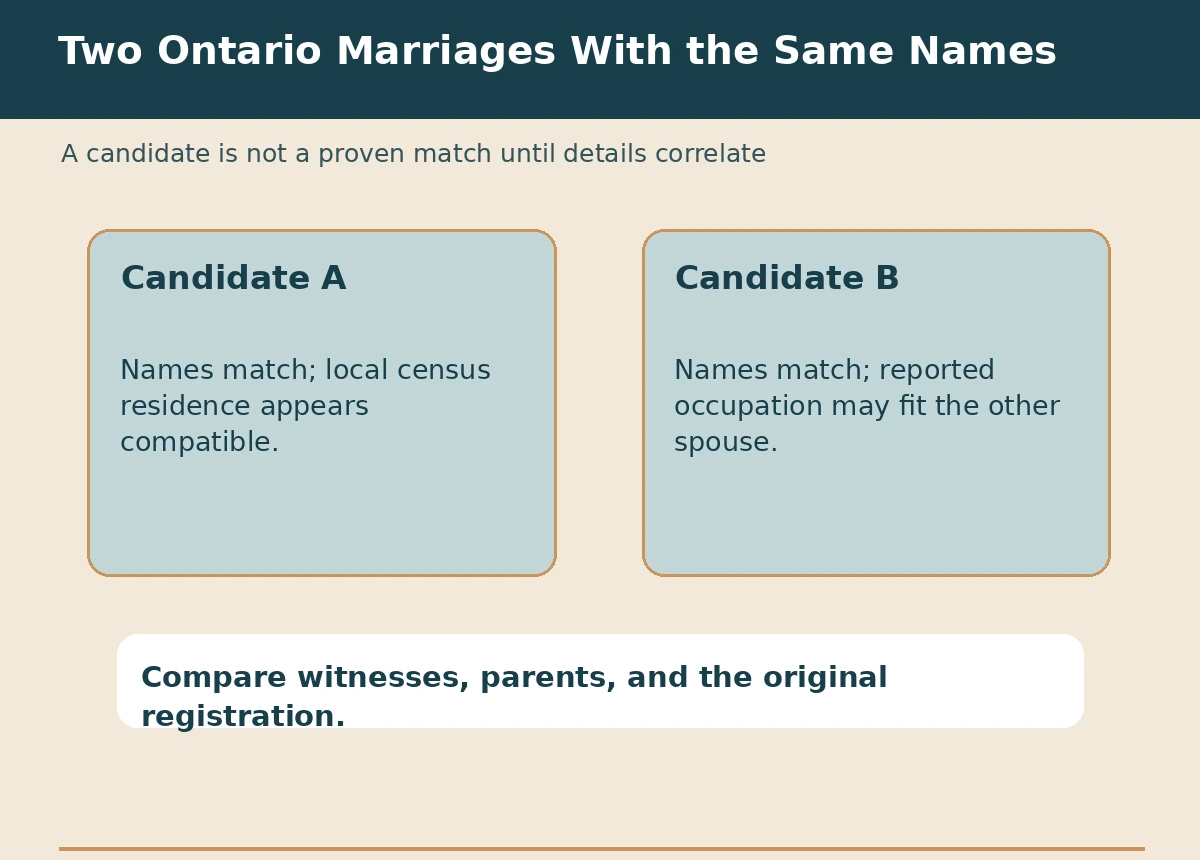
Imagine that the index lists two weddings for the same pair of common surnames within four years. Candidate A is in a county where the proposed bride appears in an earlier census, but Candidate B matches the groom’s reported occupation. Neither observation is sufficient alone. Record each candidate’s registration number, place and date separately. Obtain both images if feasible, then compare witnesses, parents and addresses against other dated sources. If one candidate remains unexplained, state that explicitly rather than silently discarding it. This is a hypothetical exercise; it illustrates the method and does not purport to reconstruct a real Ontario family.
Decide Between Research Access and Certified Copies
A digitized entry used for family-history research and a certified copy issued by the Archivist of Ontario serve different purposes. The archive’s instructions for certified copies request names, event date and registration number, using RG 80-5 for marriages. Whether a specific image is accessible online, on library microfilm or only by request is a separate practical question. Do not purchase an archival copy before checking free library or FamilySearch routes that may supply the required evidence. Equally, do not assume that a screenshot accepted for personal research meets a legal office’s documentation requirements.
Search Nearby Places After an Empty Result
If the expected couple does not appear, revisit the spelling of both surnames, possible remarriage, the bride’s recorded name and the event location. An Ontario resident might have married across a provincial or national border, and a marriage may have been reported by a different religious body. Try a broader year window and locate the district before treating a negative index result as important. Record the exact database, available years and spellings searched. Only after inspecting the surviving appropriate registers can a missing entry contribute qualified negative evidence. Lack of an online hit is a search outcome, not proof no marriage occurred. For the next step, our guide “Ontario Wesleyan Methodist Marriage Records” explains how to find registers and verify couples.
Write a Reproducible Marriage Citation
A usable citation states Archives of Ontario as custodian, marriage registration RG 80-5, the year and registration number, both spouses as written, and a film or image reference if examined. When only an index was viewed, label the citation as an index citation and do not describe unseen parental details. In a research log, place observed facts next to interpretations such as “probable father” or “likely second marriage.” Check the archive guidance again before an order because coverage and online platforms can change. This creates a clear handoff for anyone independently testing the claim. Our guide “Maine Marriage Records Before and After 1892” covers a related question.
More Records and Archives Guides
How We Research Ontario Marriage Registrations
We compared the Archives of Ontario vital-records topic page, its separate order page and the library microfilm guide. The article explicitly retains the discrepancy in latest marriage years instead of implying that one vendor index is complete. No hypothetical match is asserted as a historical discovery. Readers should recheck year-specific access, fees and registration numbers with the archive.
Reference guides reviewed on October 24, 2026: primary research guide; companion institutional resource; source collection. These links explain collection scope; they do not imply that we viewed every original entry or identified a particular ancestor. This article includes no paid recommendation. Our affiliate disclosure explains the site policy; no affiliate relationship is asserted here.
Locate the entry in the annual historical marriage index for the appropriate year; the exact registration number is the bridge to RG 80-5.
No. District and county clerks and religious bodies left varying series; surviving registers and indexes are not uniformly complete.
The archive maintains separate order and collection pages that currently differ. Confirm the specific boundary year with the custodian.
Not necessarily. Examine the actual registration and distinguish missing fields from facts given on a separate source.
No. A certified copy is an archive-issued product with its own ordering requirements; a database image can be useful evidence without being a legal certificate.