
Nova Scotia family historians can search an unusually useful but incomplete online collection of 1767–1838 census returns, assessments, and poll-tax records at Nova Scotia Archives. The site’s master search joins multiple source types, but the records are not a single household census with a uniform set of fields. An early census often names only a household head, while a tax document records people liable for an assessment. Open the digitized page behind each index match and write down exactly what kind of document you found before claiming that a named person lived with a particular family.
Pick an early census, assessment or poll-tax series
Begin with the Nova Scotia Archives collection search, which combines 69,807 personal names from its digitized early records. The title identifies a collection of different administrative purposes, not 69,807 family groups. A census return might present household totals, whereas an assessment could record property value and a poll-tax list could show named taxpayers. Select the individual database or record series when possible; the source heading often determines how to interpret a number beside a name. Do not merge two persons simply because they appear in the same town during an approximate decade.
Define one question before searching. For a probable 1820s resident, ask whether a named head appears in a surviving locality return; for a property hypothesis, inspect the relevant assessment; for taxation, check the poll-tax roll. Each answer has a different scope. A land-based assessment does not create a complete list of children, and an early household count rarely names each person. Write the collection title, year and locality at the top of the worksheet so a later summary does not silently promote a poll-tax appearance into an enumerated family.
Search by place and variant names, then inspect the image
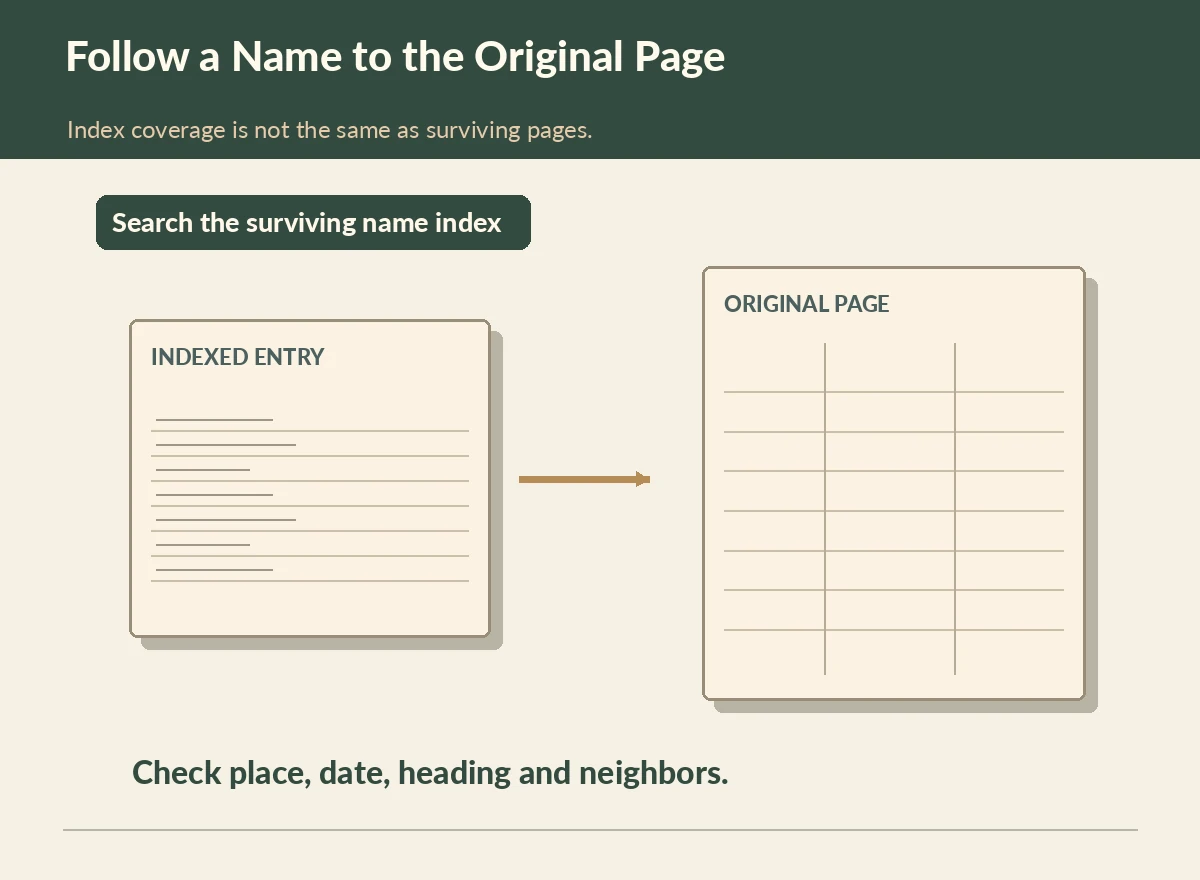
The Archives provides a master name search and smaller searches within the individual datasets. Try the most complete known surname, then historic variants, abbreviations and neighboring settlements. If a search finds a transcription, open the linked scanned source and inspect the surrounding lines. The manuscript’s date, column headings and locality caption can be more informative than the search-result screen. Record image number and shelf or archival identifier when available. A neighboring person is a useful research lead, but adjacency in an administrative list does not prove biological kinship.
To avoid a false negative, first ask whether the parish, township or district existed under that name when the source was created. Place spellings and boundaries changed, as did the population described by a particular enumerator. Where the archive shows only a fragment, use the image sequence to verify which pages actually survive. Try a spouse’s surname only when there is an independent basis for expecting that person to be named. A name index may be incomplete because a page was damaged or the historical source simply did not ask for that person’s name.

Read household tallies without naming unlisted relatives
Nova Scotia Archives explains that pre-Confederation returns often recorded a household head and a total rather than every individual. Some districts also named a wife, and a small number of Acadian returns name all household members. These variations make a universal census transcription template unsafe. If a return has groups of men, women or children, copy the counts and column definitions literally. A group of five household members cannot automatically be translated into one husband, one wife and three named offspring. Our guide “Nova Scotia Death Registrations, 1864–1974” covers how to find images and explain the gaps.
Age brackets, where present, describe the people counted on that return and not their individual birth certificates. Build possible birth-year intervals only after confirming the reference date and question wording. An occupation or religious category is a historical administrative report, not proof of occupational permanence or personal belief. For Acadian families, compare surviving all-name returns with independently held baptism, marriage or land records while recognizing that regional record coverage may differ substantially. A relationship must be documented outside an anonymous tally.
Identify the preservation and geographic gaps first
The Archives’ general guide calls records before 1861 haphazard and incomplete, even within surviving returns. Its collection introduction states that original census pages have been lost, damaged or destroyed; some records were already illegible when the archive acquired them. Therefore an empty search cannot mean that the family was absent from Nova Scotia. Identify whether your target community and the particular year were ever recorded, and whether the surviving manuscript includes that community.
Keep three separate no-result explanations: the person may not qualify for the tax or named-head list; the relevant geographic return may be absent; or an existing entry may be illegible or misindexed. Inspect printed finding aids and list boundaries before labeling a failed search meaningful. If only a historical transcript exists for missing pages, cite the transcript as such; do not imply that you inspected an original now lost. An archive’s frank acknowledgment of incomplete coverage is a research strength, not a reason to invent a reconstructed household.
Use the correct archive when the target date is later
Nova Scotia Archives’ online early collection covers material through 1838 and explains that the next provincial census was 1851. For the enumerations from 1851 to 1931, the provincial guide directs researchers to Library and Archives Canada. That is a repository transition, not evidence that the early archive has every census image. At the other end of the chronology, the Archives points to Acadian 1671–1752 returns on microfilm 12084, which need their own location and coverage checks.
If an adult appears as a named head in 1838 and a comparable name appears in 1851, treat them as two candidates to reconcile. Check age, locality, other named household members, property and marriage records. Neither a numerical household tally nor a census interval documents what happened in the years between. The new national collection may offer different columns and names; preserve the definition of each record rather than mixing all the results in an undated family summary.

Write a citation that preserves record type and doubt
A sound citation gives the year, creating office or locality, original document type, image or archival reference, repository and viewing date. Record the exact spelling from the image and the separate search spelling. If an entry is an assessment or poll tax, name it explicitly in your conclusion. Report whether the subject was an individually named taxpayer, a named census head, or an unnamed person inferred only from a tally. These roles cannot be exchanged simply because the collection’s public title uses the word census.
Build a comparison table for two similar-name candidates using locality, record-year, household or tax attributes, and independent documents. A small disagreement in spelling may be tolerable, while two clearly different residences on the same date demand explanation. End each session with an action: search another surviving locality, inspect an original image, consult a parish entry or check a later census. The end goal is a defensible observation and a precise next source, not the appearance of a complete pre-Confederation family list.
Read the Specific Archive Sources and Record Limits
The responsible repositories document their holdings and limitations: 69,807 indexed names, original image links and early return preservation limits.; Head-of-household and poll tax definitions and guidance for 1851 onward.; Federal historical census repository and later-year search route.. Record when each page was consulted; an access method or publication range can change independently of the original evidence.
More Records and Archives Guides
How We Research Nova Scotia Early Returns
We compared Nova Scotia Archives’ early-record image database description with its separate census-and-poll-tax research guide and Library and Archives Canada’s census holdings route. We treat 1767–1838 as a selected survival window and keep household counts separate from individually named taxpayers. No simulated example is represented as an actual historic return.
No paid genealogical partner or affiliate recommendation is made here. For the site policy, read the affiliate disclosure. When a custodian charges for an image, application or certificate, check the official ordering terms directly.
No. The Archives explicitly warns that no single early return or combined series is complete for the whole province.
Usually not. Many early returns identify only a head and household totals, though a small number of Acadian sources name more people.
No. It was created for taxation and generally names those subject to the assessment, not every resident.
Use Library and Archives Canada’s historical census resources for the 1851–1931 series and confirm its available years and districts.
State the locality, date, surviving record type and search variants; do not conclude the person was absent from the province.