
The 1893 New Zealand women’s suffrage petition is searchable by surname, place and sheet number through NZHistory. Find a possible signer in the transcript, then inspect the digitized original sheet and compare the address with independent family records. A signature establishes participation in this petition, not automatic electoral registration or a recorded vote.
Begin with the searchable petition, then check its scope
To find a possible ancestor in New Zealand’s 1893 women’s suffrage campaign, search the NZHistory suffrage petition database by surname, town, city or sheet number. Then open the linked image of the original signature sheet before deciding that the entry belongs to your relative. This is not a universal list of New Zealand women or a copy of the 1893 electoral roll.
Archives New Zealand explains that thirteen suffrage petitions were submitted in 1893 and that the large surviving petition contains more than 25,000 signatures. The database concerns that major preserved document. Someone absent from it may have signed another petition, may not have signed at all, or may be obscured by a transcription variation. Search scope needs to be stated before calling a failure meaningful.
Search surname variations, locations and sheet numbers
Start with the narrowest credible historical clue, especially a surname paired with a district around 1893. Try known maiden and married names where independent documents justify them, and expand to initials or common spelling alternatives. NZHistory permits filtering by written name and normalized location information, but those fields may not be identical to the original handwriting. Avoid adding family relationships to a matching surname without evidence.
The original petition circulated as separate signed sheets gathered into a very long roll. The database includes a sheet number; retain it as a stable route back to a scan. If several candidates appear, make a small table of sheet number, exact transcribed name, original written address, normalized town and a competing candidate ID. Sorting by address or sheet can reveal neighbors, but adjacent signatures are not proof that two people lived in one household.

Distinguish original writing from later database fields
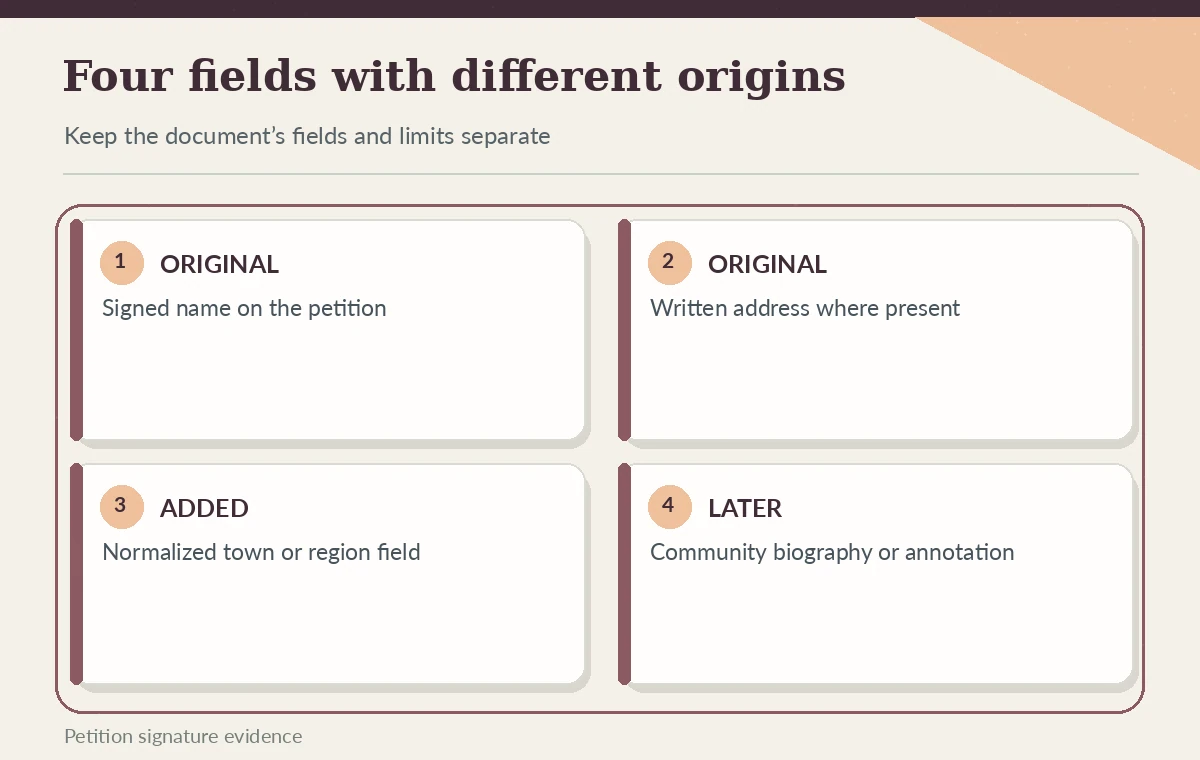
NZHistory describes a volunteer-produced 1993 transcription and notes that its suburb/town and city/region categories were added to standardize locations. That design makes searching easier, but it also creates two levels of evidence: the original name and address as written on the petition, and a later interpretation of that location. Open the original sheet and transcribe it separately before citing a place to the household level.
Handwriting, faint ink, abbreviations and original spellings can create uncertainty. If a name looks different on the scan than in the digital record, record both versions without silently correcting the historical signer. NZHistory also reports duplicate-looking sheets and unresolved gaps in the text-versus-original comparison. A repeated entry or a database total cannot be used to prove two distinct people.
Identify a signer without projecting a biography onto her
Consider a fictional Mary Ann Wilson indexed in a small Canterbury community. Another Mary Wilson may live in the same region, and a mother and daughter may share initials. The next task is not to assign the sheet to one woman by intuition; it is to compare the petition address with a dated marriage, death, land, school or electoral record. Record the approximate ages and any evidence that either woman used the recorded form of the name.
The National Library’s biography guide explicitly cautions that mothers and daughters may be difficult to distinguish, and some signatures use a husband’s initials. A written address may be a useful match clue but is not itself a marriage record or a parent–child statement. If the evidence remains ambiguous, identify the petition entry as a candidate and describe what additional dated document would resolve it.
Do not confuse signing with registering or voting
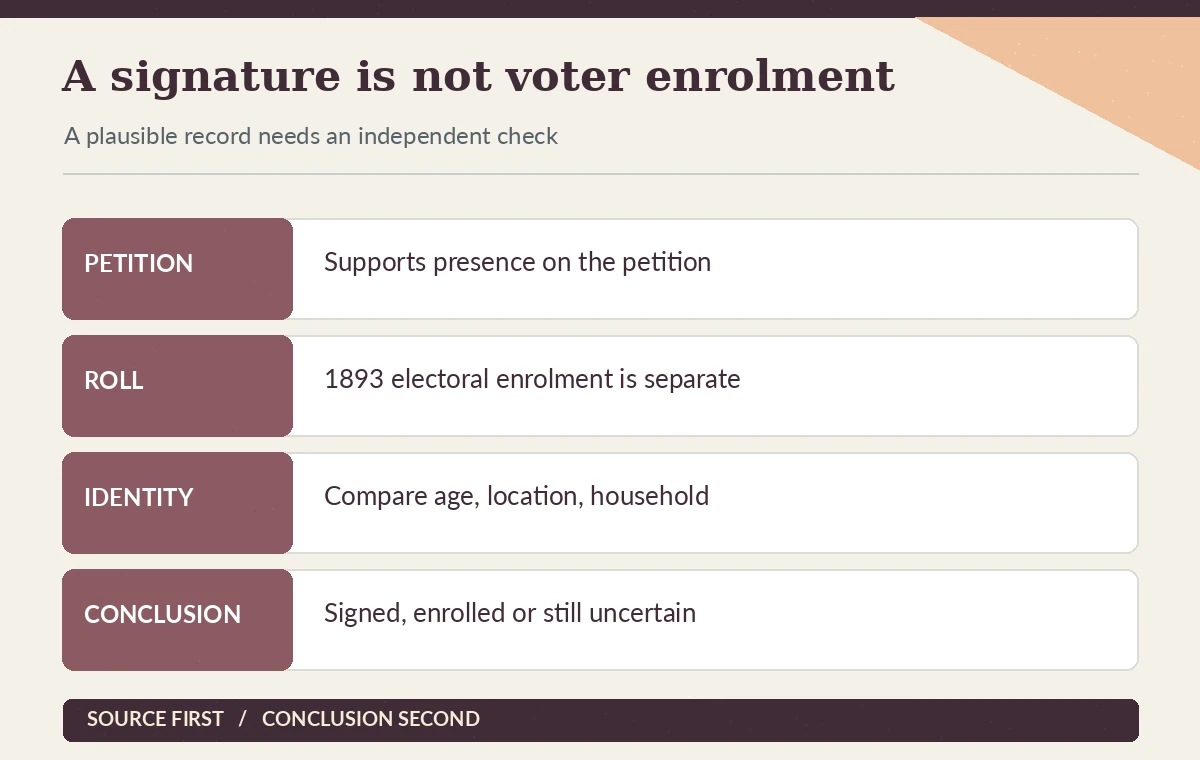
Signing a petition expresses support for a parliamentary change; it does not show that the signer enrolled to vote in the first election afterward or that she cast a ballot. The National Library specifically distinguishes the 1893 petition database from the 1893 electoral roll and earlier petition series. The legislature changed voting eligibility in 1893, but individual registration and an actual vote are separate facts requiring separate sources.
Create three evidence statuses in the research log: signed petition, electoral enrolment located, and voting behavior not established. Even where the same name appears on an electoral roll, compare place and identity details; do not equate a printed candidate in one source with the signer without a bridge. Treat women who were eligible yet not present in the petition as ordinary possibilities, not as evidence of opposition to the cause.
| Evidence checkpoint | Record the observation | Do not infer |
|---|---|---|
| PETITION | Supports presence on the petition | Identity without a second source |
| ROLL | 1893 electoral enrolment is separate | A precise date not given by the record |
| IDENTITY | Compare age, location, household | An undocumented relationship or event |
| CONCLUSION | Signed, enrolled or still uncertain | Certainty beyond surviving evidence |
Contextualize the record without making modern assumptions
The suffrage petition is a historically significant collective political document whose named signatures provide a rare avenue into women’s recorded public activity. But the surviving text does not contain an individual’s full political beliefs, motivations or family circumstances. A person may have signed for reasons not recoverable from the sheet. Resist the urge to invent speeches, activism or correspondence for a relative whose only surviving reference is a signature.
Period electoral definitions and political language require historical context, and the archive’s coverage is not the same as an exhaustive census of all people living in New Zealand. If writing a family account, quote or transcribe only the actually visible name and address and then explain what is inferred from external records. Credit the archive and the people who created the searchable transcript. For the fuller picture, see our guide “New Zealand Historical Electoral Rolls”.
Cite the sheet, the entry and your independent match
A reliable citation contains the 1893 Women’s Suffrage Petition, the NZHistory entry, sheet number, exact visible signed name and written address where legible, and Archives New Zealand as custodian of the original document. A second citation may name the normalized database fields and access date. Where the scan conflicts with the transcript, explain that difference rather than discarding one layer.
Finish with a cautious statement: a woman using the recorded name signed on this particular sheet, and a separate set of dated records either identifies her or leaves her identity unresolved. That is a useful, defensible family-history result even when no later electoral evidence can be found.
How We Research The 1893 Suffrage Petition
For this guide we examined the current official repository descriptions and related research guidance listed below. We separated catalog coverage from image-level evidence and used deliberately fictional examples for matching exercises. Search interfaces, restrictions and individual item survival can change; check the repository before requesting records. The method tests only the types of claims these documented sources can support, and it does not assert that any fictional person or sample transaction is an actual archival entry.
More Records and Archives Guides
Archive Catalogs and Primary-Source Finding Aids for The 1893 Suffrage Petition
NZHistory: searchable surname/place/sheet database and links to digitized original sheets (nzhistory.govt.nz).
NZHistory: petition provenance, volunteer transcription, additional normalized place fields and duplicate/gap cautions (nzhistory.govt.nz).
Archives New Zealand: the surviving major petition, context of 13 submitted petitions and original sheet availability (archives.govt.nz).
National Library: distinctions between signers and electoral enrolment, transcription pitfalls and same-name generations (natlib.govt.nz).
Editorial disclosure: This article contains no paid recommendation or approved affiliate placement. The site-wide policy is available at GenHis affiliate disclosure. Historical records may include inaccurate or discriminatory wording; reproduce it only as needed for a sourced analysis and avoid identifying or speculating about living people.
Use NZHistory’s petition database by surname, place or sheet number, then open the linked image of the original sheet.
No. Petition signatures and electoral roll registration are different records; the National Library explicitly warns against equating them.
Not always. The suburb/town and city/region fields were normalized for the database, so inspect the original address separately.
Compare the written address, household context and independent civil or electoral records; mothers and daughters can have identical or similar names.
No. The searchable source represents the main surviving petition, not all 13 separate petitions submitted that year.