
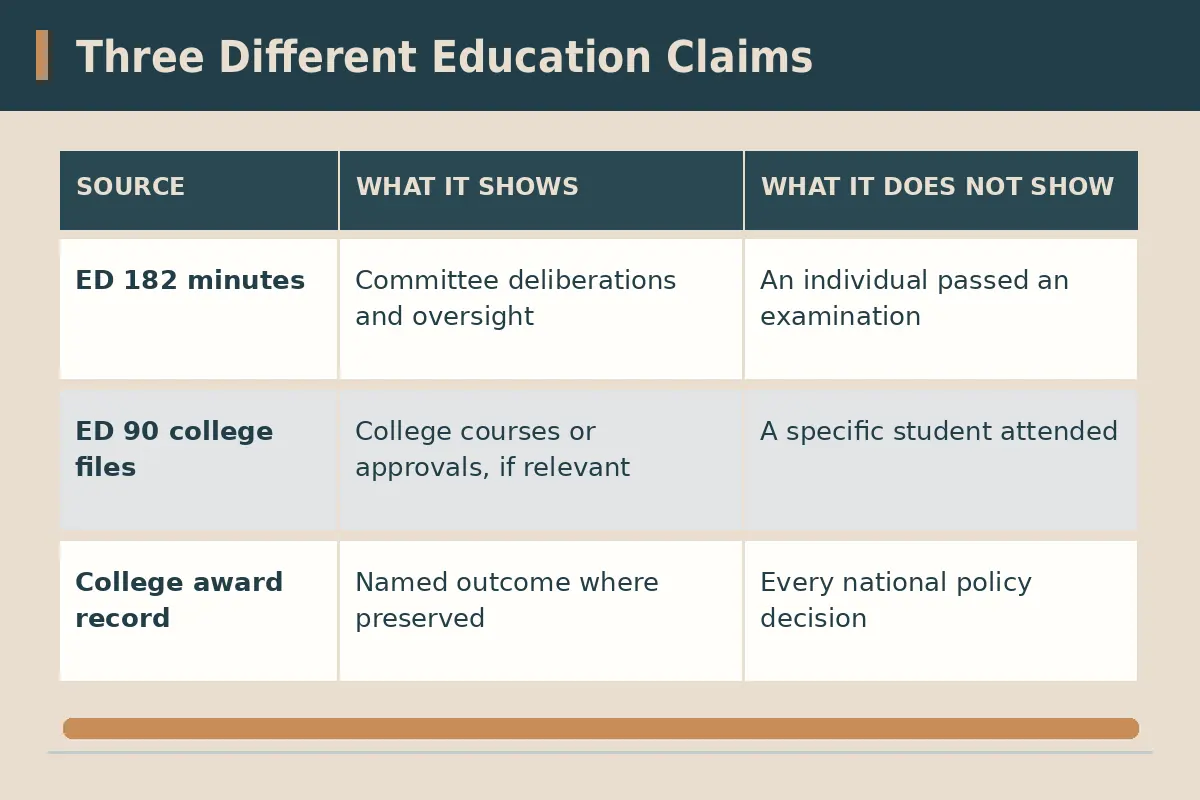
ED 182 documents the joint committees behind Britain’s historic National Certificates and Diplomas, but it does not by itself prove a named student graduated. The steps below separate what the archival record actually says from later interpretation, locate a full reference, and identify independent proof before making a stronger claim.
Start With the Qualification, Not the Family Legend
ED 182 is a central-government archive for the Joint Committees that oversaw the curricula and award of National Certificates and National Diplomas in vocational subjects. The National Archives dates this committee system broadly from 1920 to 1987. It is useful if you want to establish which committee handled a type of qualification or how a course was supervised; it is not automatically a transcript of your grandfather’s marks. Begin with the exact words printed on a surviving certificate, a course timetable, a professional membership form, or a college prospectus.
Write two separate questions. The institutional question may be “Was a national certificate course in this subject approved for this college in the relevant year?” The personal question may be “Did this particular student complete the course and receive an award?” A committee minute could help with the first and leave the second entirely unresolved. Note the awarding body, subject, college name at the time, and approximate years rather than searching only for a common surname in every education series.

Read Committee Minutes as Policy and Course Evidence
The joint committees drew representatives from technical colleges, professional bodies, education departments and teaching organizations. Their surviving minutes and papers may reveal discussion of curricula, standards, administration and awards, depending on the file. Before using a passage, identify the committee, meeting or paper date, agenda subject, and whether the text records a proposal, agreement, condition or later report. An agenda item about a course is not necessarily the approval of that course, and approval alone does not prove that a named college taught it immediately.
For a reproducible search, try contemporary subject language and institutional names, then restrict the Discovery catalogue to ED 182. Compare the description and year of any resulting piece with your evidence. Browse adjacent references if a keyword search finds no match: many catalogue entries summarize folders rather than every course mentioned within them. On examination of an original, copy the minute number or page number, not only the file title. Keep the committee’s decision separate from any inference about actual teaching.
Even where a course had national recognition, requirements could change by subject, level and year. Compare the historical award title character for character; an “ordinary,” “higher,” or other certificate designation may signify a different route. Where the wording is unclear, label the qualification unidentified and seek the issuing institution rather than modernizing the title from memory.
Use ED 90 Without Conflating National and Local Records
The National Archives also points technical-college researchers to ED 90 for college organization and applications for approval of National Certificate courses. These are distinct research routes. ED 182 can address how a committee administered a qualification system; ED 90 may concern an institution and its course arrangements. A college application, where found, need not mean permission was granted, and a centrally approved program need not prove uninterrupted local delivery in every academic year. Record the exact authority, date and status of each statement.
Suppose a fictional family note claims that “R. Morgan qualified in electrical engineering in 1958.” First check whether the paper describes an examination, an apprenticeship, membership in a professional body, or an actual National Certificate. Seek committee context in ED 182, a potentially relevant college file in ED 90, and the named candidate’s outcome from the institution or surviving awarding-body records. Do not supply an imaginary college or fill missing examination results from the national committee’s existence.
Handle the 1973 Transition and the End of the Committees
The official further-education guide explains that responsibility began passing to the Technician Education and Business Education Councils in 1973, following the Haslegrave Committee recommendations, and that the joint committees gradually disbanded, with the final one ending in 1987. This is a process, not a universal switch flipped on one day. An early-1980s certificate may require checking the actual responsible body and award wording rather than assuming every old committee had vanished or every new council had taken over.
Build a dated change table for the precise subject: committee or council, surviving minute or regulation, qualification title, effective year and institution. ED 163 covers the Haslegrave Committee’s inquiry and ED 212 includes subsequent implementation files according to the same archive guide. Those series are supporting policy routes, not substitute personal examination records. If an award appears near the administrative transition, use the actual certificate or college document to determine which authority issued it.

Make a Defensible Statement About the Graduate
For a named person, prioritize a surviving original certificate, examination results, course register, professional registration or the college’s archived student records, subject to access restrictions. Compare the student’s full name, dates, date of birth or addresses where recorded with independent family evidence. A published list of award holders can provide a lead, but a surname match without corroboration is weak, especially in a large city. An institutional anniversary booklet can identify a course while overlooking unsuccessful or part-time students.
The finished citation should identify whether you actually saw a page or merely a catalogue description. Record ED 182 plus the full piece reference, the document’s internal date and the exact committee decision. In the final narrative you might write, “The committee considered the qualification in that year,” then separately document, if possible, “The college records show the person earned the named award.” Leaving the second sentence unproved is more accurate than treating national oversight as an individual diploma.
Keep a search ledger with the original and successor college names, committee title, date span, Discovery reference, page consulted and access outcome. The absence of a name in a committee volume is generally not negative evidence of failure or nonattendance. Committee files were not compiled as exhaustive student lists.
More Records and Archives Guides
How We Research This Archive Series
This guide starts with the official description in The National Archives’ research guidance, not a claim that we have inspected a particular person’s private file or a specific original piece. The archival statements here concern the series or research method. A hypothetical example is labelled as such; it is not a newly discovered historical event. We use the Discovery search guidance to distinguish keyword matches from archive holdings and document contents, because catalogue descriptions do not transcribe every word of an original.
For every real candidate, record its historical place or person’s name, the creator, document type, date, full ED 182 piece or item reference, access restrictions, and the exact claim being tested. The official citation guide explains how to document those references so another researcher can retrace them. An unread document remains a catalogue lead, never proof of imagined details. If a record is missing, preserve the searched terms and dates and examine survival and alternate custodians before interpreting the gap.
Before sharing a conclusion, audit the difference between original source wording and your interpretation. Require independent evidence for any further claim about an individual, property owner, legal effect, or completed action. Respect archival access limits and living people’s privacy. This website also provides an affiliate disclosure; no paid partnership or commercial access is implied by these archival references.
Minutes and papers of Joint Committees responsible for National Certificate and Diploma curricula and administration; contents depend on the piece.
No. It is a committee collection, not a comprehensive register of named graduates.
ED 90 concerns technical colleges and approval of courses; personal attendance or examination evidence may survive with the college or awarding body.
Responsibility began transferring to new technician and business education councils; verify timing and the body responsible for a particular award.
As an unproductive catalogue or committee search, not proof that the person never studied or earned an award.