
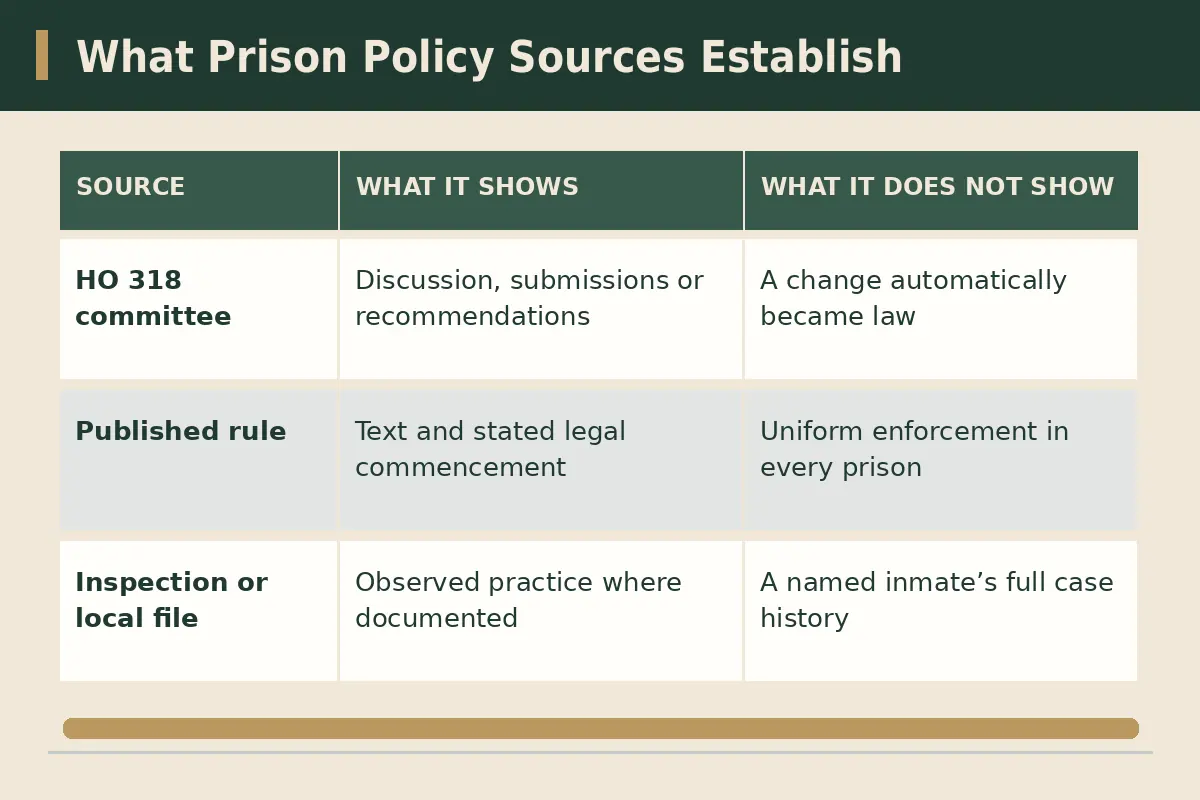
HO 318 can show what the early-1980s prison disciplinary committee discussed, yet a recommendation is not an enacted rule. The steps below separate what the archival record actually says from later interpretation, locate a full reference, and identify independent proof before making a stronger claim.
Set a Narrow Question About Prison Discipline
The National Archives points researchers to HO 318 for Home Office papers of the Committee on the Prison Disciplinary System in the early 1980s. It is a collection for investigating policy debate and recommendations, not a searchable database of disciplinary hearings involving every imprisoned person. Frame the question precisely: Which procedure was discussed? What concern was raised? Did the committee recommend change? Was the rule changed later? These are four separate claims that may require four kinds of source.
Choose a limited historical interval and a particular concept, such as a hearing procedure, representation, appeal or sanction, rather than searching the word “discipline” without context. Capture the exact terminology used in the period. Modern legal or administrative vocabulary may not match a 1980s committee paper. If your question concerns a named prisoner, do not start by assuming an inquiry file reveals their record; individual criminal or prison files have different access and privacy constraints.

Distinguish Submissions, Minutes and Adopted Conclusions
Committee records may contain evidence submitted by interested parties, internal minutes, drafts, correspondence, or final recommendations. The title of a document alone does not show which of those it is. On examining a file, record who made each statement, to whom, on what date, and in what procedural stage. A witness submission is evidence that the view was expressed; it is not automatically evidence that the committee accepted the account or that an alleged event occurred exactly as described.
Where a report contains recommendations, quote the operative words with their qualifications. Did it ask a minister to consider an option, propose a formal amendment, or describe an existing practice? Do not collapse a discussion of safeguards into a statement that the safeguards were available in all institutions. A clear evidence grid has columns for the claim, the speaker or body, document date, status (allegation, proposal, adopted finding) and what would confirm its legal effect.
The committee’s remit should be checked from the actual report or establishing papers, not inferred from its title. An inquiry may consider several legal and administrative categories with different standards. Preserve a direct quotation or detailed paraphrase for each category and do not join a preliminary option to a later ministerial decision without a documented link.
Find the Later Authority Before Claiming Reform
A committee report does not itself amend prison rules. Look for the government response, a relevant statutory instrument, amendment, departmental instruction or later published guidance, and check the actual effective date and jurisdiction. A proposal may be rejected, modified, implemented gradually or confined to a particular procedure. A press summary might say “reforms announced” while the legal instrument states an entirely different commencement arrangement. The instrument and its transitional provisions matter more than shorthand headlines.
Use two parallel timelines. The inquiry timeline contains the committee’s formation, evidence, minutes and report; the implementation timeline contains decisions, rules, instructions and measurable practice where sources survive. Do not draw an unqualified arrow from the inquiry to the later rule simply because the subject is similar. Record what connects them: an explicit government reference to the recommendation, the explanatory note to a measure, or another dated official record showing the reasoning.
Check Prison-Level Practice Without Assuming Uniformity
Even when a published rule took effect nationally, it does not follow that every local incident used an identical process or that every prison preserved comparable files. Inspection reports, published annual reports, contemporary institutional guidance and archival local correspondence may offer evidence of how a rule worked in a particular setting. Date each source and check whether it concerns England and Wales or a different prison jurisdiction. Avoid translating administrative categories across national borders without checking whose regulations applied.
As a hypothetical example, suppose a newspaper in 1984 describes a new appeal right for inmates. First identify whether the report concerns a recommendation, a proposed rule or a measure already in force. Next locate its authoritative text and commencement. Only then ask how a named prison applied it, using evidence from that prison rather than generalization. Without an accessible case file, you cannot assert that a particular person appealed, won, or was punished under the rule.

Cite Policy Carefully and Protect Personal Records
Discovery provides a search route to catalogue descriptions, dates and piece references. Search HO 318 with a focused topic phrase and year, then browse by reference and inspect the actual document where possible. Note the creating authority, internal title, page or folio, and exact status of a recommendation. A no-result keyword search can reflect brief descriptions or alternative wording and does not show that no evidence exists. Record searched terms, dates and any access limitations.
A responsible social history reports competing submissions as attributed perspectives without endorsing unsupported allegations. Sensitive material about identifiable individuals may be restricted or inappropriate to reproduce even when a catalogue record is publicly discoverable. For public-facing family writing, distinguish institutional analysis from private disciplinary or medical details, respect current archival access rules, and avoid imputing misconduct from a committee discussion. A narrow, well-cited finding about a historic rule can be valuable without naming a prisoner at all.
If a historical source says a change “followed” a report, investigate whether that means chronological succession or a recorded policy response. The two meanings are not interchangeable. Where the documentary connection is missing, write “later rules addressed a related issue” rather than “the committee caused the reform.”
More Research Method Guides
How We Research This Archive Series
This guide starts with the official description in The National Archives’ research guidance, not a claim that we have inspected a particular person’s private file or a specific original piece. The archival statements here concern the series or research method. A hypothetical example is labelled as such; it is not a newly discovered historical event. We use the Discovery search guidance to distinguish keyword matches from archive holdings and document contents, because catalogue descriptions do not transcribe every word of an original.
For every real candidate, record its historical place or person’s name, the creator, document type, date, full HO 318 piece or item reference, access restrictions, and the exact claim being tested. The official citation guide explains how to document those references so another researcher can retrace them. An unread document remains a catalogue lead, never proof of imagined details. If a record is missing, preserve the searched terms and dates and examine survival and alternate custodians before interpreting the gap.
Before sharing a conclusion, audit the difference between original source wording and your interpretation. Require independent evidence for any further claim about an individual, property owner, legal effect, or completed action. Respect archival access limits and living people’s privacy. This website also provides an affiliate disclosure; no paid partnership or commercial access is implied by these archival references.
Home Office papers of the early-1980s Committee on the Prison Disciplinary System, as identified by The National Archives.
No. Test later legal or administrative authority and commencement separately.
It should not be treated as a comprehensive named case-file series; inspect descriptions and respect privacy limits.
Find a government response, relevant rule or instruction, its effective date and independent practice evidence.
Only that the terms did not match indexed descriptions under the chosen filters; browse references and synonyms.