
Start With a Hulk Register, Not a Passenger List
An ancestor recorded in HO 9 was on a prison hulk, a former vessel used for confinement near an English naval base, not necessarily on a convict ship sailing to Australia. The National Archives dates its hulk registers and related letter books to 1802–1849. Names, convictions and places of conviction may be recorded, but a register entry has a different evidentiary purpose from a shipping manifest. The central research question is which prisoner was confined, on which hulk and when.
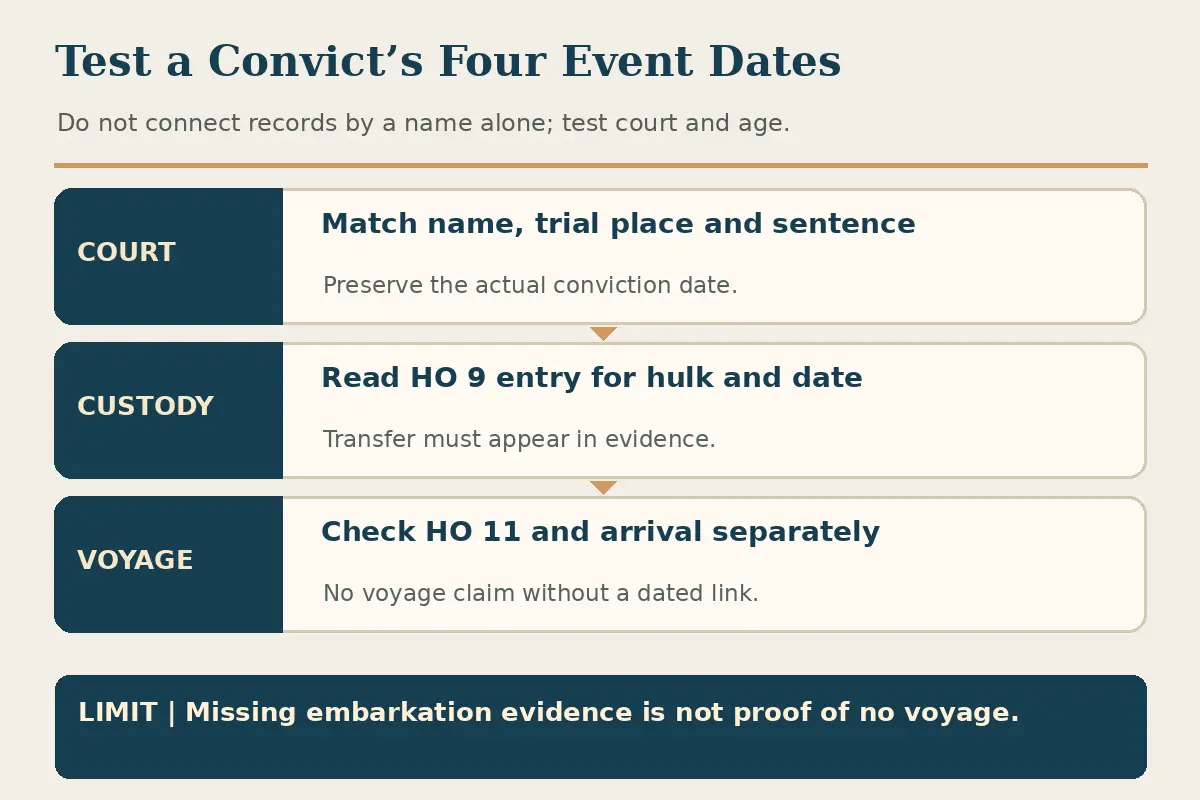
Hulks were stationary prisons within a changing penal system. A court might impose transportation, yet a prisoner could spend a long period on a hulk or never leave Britain. In some cases a person was moved between establishments before a destination was decided. Treat a court sentence, a transfer into custody, a departure from Britain and an arrival abroad as four independently dated events. Their absence from one record is not proof that another event did not occur.
The National Archives prisoners and convicts guide identifies HO 9 among searchable hulk materials and warns that surviving prisoner registers are typically concise. When opening an indexed result, check the original heading, the name of the vessel or establishment, the register date, and what column actually contains a place. A surname match without age, offence, court or chronological fit is only a candidate.
Choose HO 9, HO 8 or HO 11 for the Question
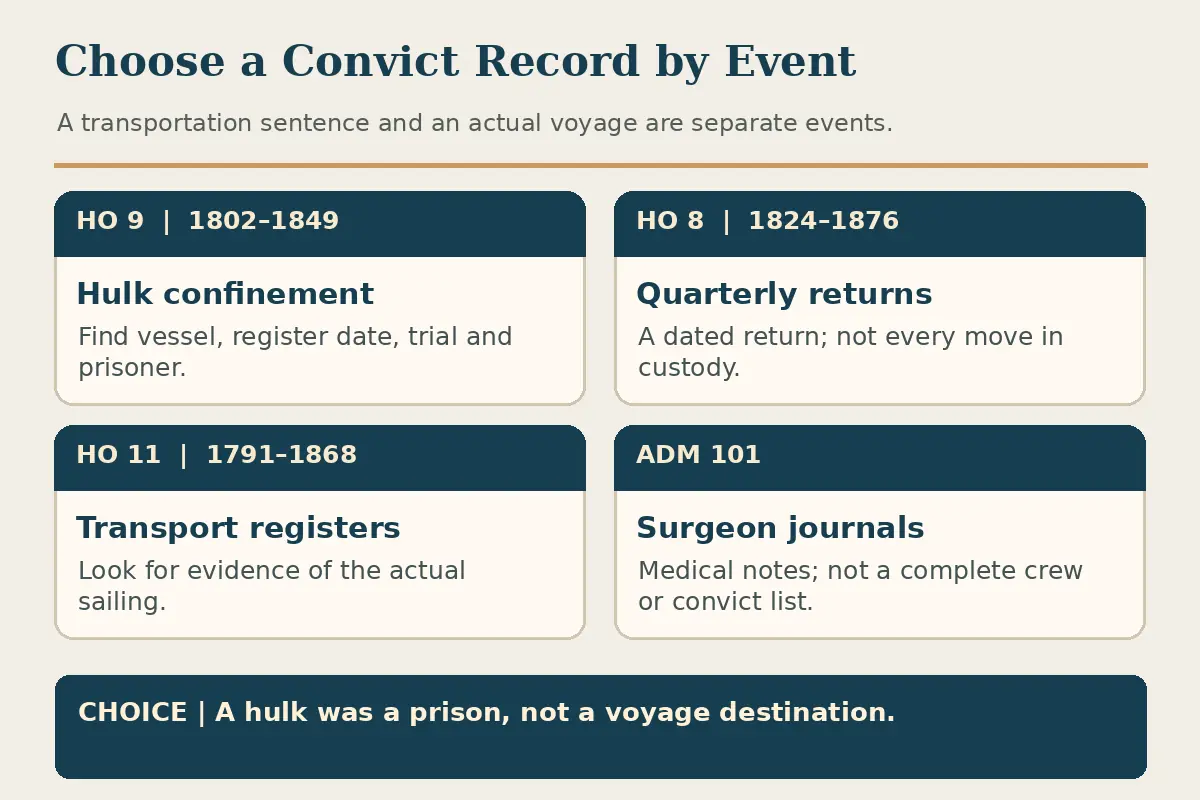
Use HO 9 when the question is confinement aboard a hulk in the 1802–1849 range. HO 8 preserves quarterly returns of prisoners, including some prisoners on hulks, but a quarterly count or return is not automatically a continuous personal biography. HO 11 concerns people listed for actual transportation voyages; it is a different register with a ship-and-embarkation research purpose. Keep the source series visible beside every conclusion.
Ancestry offers name searching for HO 9 under its access arrangements. The National Archives digital microfilm guide notes partial material in HO 9, including registers and a letter book, but availability for a piece does not guarantee every name is indexed or every book is online. Use the Discovery catalogue to confirm which piece survives and whether an original, digital image, derivative transcript or short description was inspected. Record the actual site and date of access.
When a court location is given, identify the relevant assize, quarter sessions or other trial archive before claiming a precise offence or verdict. The wording of an indexed “crime” field may be standardized by an indexer rather than copied verbatim. If an HO 9 entry indicates another vessel or a changed status, search a subsequent record for that movement; do not infer the movement from the mere existence of a later route.
Build a Four-Event Convict Timeline
Make a table with columns PERSON AS WRITTEN, AGE, TRIAL PLACE, TRIAL DATE, SENTENCE, HULK, REGISTER DATE, DOCUMENTED TRANSFER and OUTCOME SOURCE. Use exact wording for age and punishment. An age on an admission register may be approximate, and two prisoners with the same common name can have similar offences. Keep a separate column for match confidence rather than forcing every entry into a single person.
Consider a hypothetical entry for a prisoner sentenced to seven years’ transportation. That records a judicial penalty; it does not prove he boarded a transport ship or reached a colony. A later HO 11 entry naming a transport and associated conviction, corroborated by the same court and date, may support actual embarkation. An arrival list is still a separate kind of evidence. Do not translate “ordered for transportation” into “transported to New South Wales.”
The accompanying comparison chart keeps three claims apart: HO 9 documents confinement, HO 8 can describe a quarterly custody status, and HO 11 can connect a named person to a transportation register. If a hulk spelling varies, record the variant rather than silently substitute a modern name. Some hulks were refitted or reassigned, so the ship name alone is not the prisoner’s permanent identifier.

Test Departure, Arrival and Family Identity Separately
The criminal transportation guide distinguishes HO 11 transport registers from ADM 101 and MT 32 surgeons’ journals. A surgeon’s journal may describe a voyage and individual patients but cannot be assumed to list the entire group of convicts. Likewise an arrival list needs the correct vessel and date. A sentenced prisoner absent from a specific journal may simply not have required medical attention.
For a reliable identity match, compare trial county, sentence date, age, known residence, aliases and any occupation. Consult local court material or parish records where available, and cite apparent conflicts rather than hiding them. A later person of the same name in Australia is not automatically the convict in HO 9; require an additional link such as a matching ship, date, administrative number or independently documented life event.
Negative searches require a precise statement of coverage. “No HO 11 match found for the spelling in the available index” is reproducible. “He remained in England” is a different assertion needing evidence. If the hulk records end before a possible departure, a missing outcome is predictable rather than surprising. The same caution applies when a database contains only selections of the original register pages.
More Records and Archives Guides
How We Research Hulk Imprisonment Without Myth
Our record sequence begins with the alleged person and court, identifies the HO 9 hulk entry, then asks whether later records actually document transfer, embarkation and arrival. We distinguish the words used in the original hand from those added by a commercial transcription. The three illustrations are teaching reconstructions, not facsimiles of specific convicted people or genuine hulk registers.
A usable citation includes National Archives series and piece, page or folio, vessel, entry date and repository or licensed image source. Where court papers and transport registers disagree, preserve each date and investigate rather than selecting the most dramatic version. Respect the subject’s circumstances: imprisonment and forced transportation are not incidental decorations in family history.
Before paying for an image, check the source’s described coverage and whether a catalogue record provides enough information to request it. Our affiliate disclosure explains the site’s commercial position. This method does not require any particular subscription to decide that a hulk confinement record is not evidence of an overseas landing.
Prison hulk registers and related letter books for 1802–1849, with coverage and fields varying by record.
No. A prisoner might remain in custody in Britain; use actual voyage and arrival evidence.
No. HO 8 contains quarterly returns, whereas HO 9 includes hulk registers and associated material.
It contains convict transportation registers organized around ships and departures, subject to survival and indexing limits.
ADM 101 often concentrates on treatment and medical incidents; it is not necessarily a complete passenger roster.