
The New South Wales Colonial Secretary’s Papers for 1788–1825 can reveal an early settler or convict in correspondence about employment, land, family requests, movement, permits or official business. Begin by recording the person, approximate year and precise question. Search the Museums of History NSW index before accepting a family-tree assertion about the person’s government dealings. The index points to surviving correspondence, not an exhaustive list of every colonial resident. Most useful results lead to a dated document whose wording must be interpreted in the context of the writer, recipient and administrative purpose. A petition is especially valuable testimony, but is not necessarily a decision.
Search names, ships, officials and subjects separately
The official index is arranged by surname and subject, with entries for individual people, ships, places and government activities. Search surname variants and initials before assuming a name is absent. For convicts, add the transport ship when reliably known, because people of the same name may be divided by ship within the original index structure. A search for a land petition might also need the recipient’s name or the official responsible for recording it. Keep a four-column search log for personal name, ship, government correspondent and subject; record what returned a hit and what did not. Do not merge similar names prematurely.
Follow the index reference into the complete image
The archive states that its current index includes digital copies and that the documents can be retrieved through Collection Search. Open the specific detail and record the archival series, reference, document date, writer and document type where displayed. View all surviving images of the item, rather than lifting one sentence from a search-result summary. A letter can have an enclosure, an endorsement, a docket or a reply on the reverse. These parts may change the interpretation. If the image or a page is inaccessible, describe the index as a finding aid and mark the original unexamined instead of claiming to have read it.
Identify the correct Colonial Secretary record series
The index includes several letters-received and letters-sent series, not a single alphabetized register of family facts. Museums of History NSW identifies correspondence such as NRS 897 and special bundles such as NRS 898, among other series. Match the item’s own archival locator to the catalogue description before citing it. The date of an inward letter is not necessarily the date of any later outbound instruction or action. When one index entry points to multiple items, preserve the separate series identifiers and their distinct functions. A plausible family connection depends on the substance of each item, not simply the umbrella title of the collection.

Account for incomplete indexing in later early-colony bundles
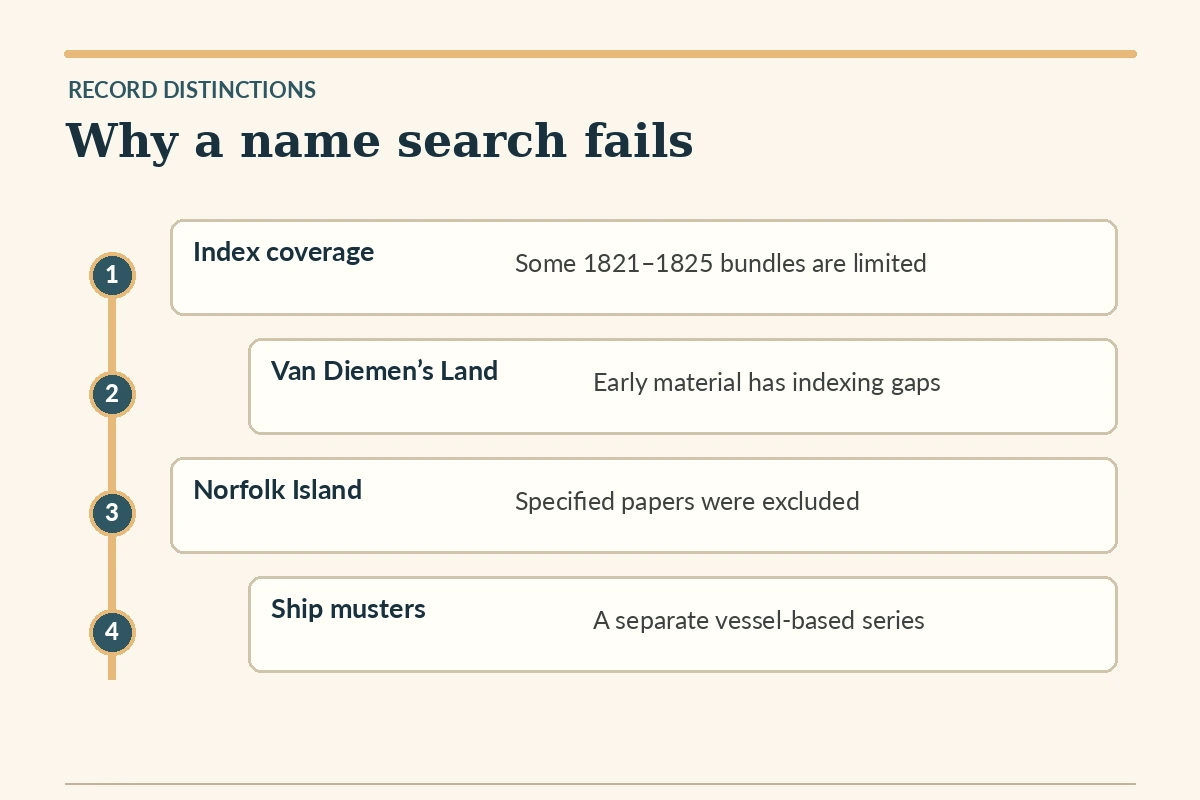
The official project notes more limited indexing in portions of the main letters received for 1821–1825. Certain Van Diemen’s Land letters, especially material from March 1804 through July 1821, were also incompletely indexed. This changes the meaning of a failed name search. If a family event falls in one of these spans, search the government correspondent, district and relevant volumes, not merely the person’s surname. Write down which records were browsed manually and which were searched only through the online index. “No entry under this spelling” cannot safely become “no correspondence existed.” Our guide “Parramatta Female Factory Index, 1826–1848” shows how to find women and children.
Recognize excluded Norfolk Island and convict-ship material
The archival index explains that the poor condition of the Norfolk Island Papers for 1794–1813 and 1825 kept them outside the original indexing project. Another excluded collection is NRS 1155, musters and other papers relating to convict ships, 1790–1849, arranged by vessel. A missing Colonial Secretary index result may therefore reflect the project’s scope rather than a failure of the historical government to create a record. If your research concerns a particular Norfolk Island posting or convict voyage, pivot to the relevant series description and ship-based holdings. Do not state that excluded records have all been destroyed. If that is your next decision, our guide “Western Australia Colonial Secretary Letters, 1828–1878” explains how to find original files.
Distinguish petitions, recommendations and final decisions
A convict’s request to marry or to reduce a sentence shows that a request was made or entered into government correspondence. A memorial seeking land can describe a family and livestock; it does not by itself prove title was issued. An official endorsement may recommend approval or refer the matter to another office without closing it. For each finding, copy the document’s action verb and date into a decision ledger: requested, referred, recommended, approved, refused or unresolved. Follow a later reply, register or grant before claiming the event happened. This distinction prevents a remarkably detailed petition from hardening into an inaccurate family narrative.
Compare correspondents to resolve same-name candidates
Imagine two fictional men named James Kelly in early NSW, one identified by a transport ship and the other by a settlement district. An indexed land request signed “J. Kelly” cannot be assigned to either using the surname alone. Copy the sender’s address, date, signature, role, named associates and ship references from the image. Then compare them with an independent convict indent, muster, land register or church record. Where the clues agree only partially, retain two candidates. The original letter is stronger than a modern transcription for its precise wording, but even the original may contain self-reported or mistaken personal details. Our guide “NSW Convict Applications to Marry, 1825–1851” shows how to read the original register.
Use places with historical jurisdiction in mind
A correspondence reference to Parramatta, Port Macquarie, Moreton Bay or Van Diemen’s Land reflects an administrative network whose jurisdictions changed over time. Use the historic term as written, then separately identify the modern repository. For example, letters about an outlying establishment may be located in NSW government correspondence even when the place later belonged to a different state. Do not assume modern borders determine which early record series holds the evidence. Build a small place-and-date table recording the document’s locality, office responsible, and present custodian; this can explain why a local online collection appears empty.
Cite the entire archival chain, not just the search hit
A useful citation names the issuing repository, the series identifier, the specific item or volume, the correspondence date, writer and recipient when present, and the image or page actually reviewed. Include the URL and access date, but do not rely on a changing search-results URL as the sole locator. Transcribe ambiguous words with brackets or a question mark rather than correcting the historical spelling silently. When a document uses language about First Nations people or other groups that is inaccurate or harmful, quote only what is necessary for analysis and explain its colonial administrative perspective. Our guide “Tasmania Colonial Secretary Correspondence, 1824–1854” adds more detail on this.

Document a negative search and choose the next record
If the surname search fails, repeat with aliases, ship, locality, employer, government officer and subject. Note if the target years overlap the indexed project’s limited bundles or its excluded series. A useful conclusion says “I searched these spellings in this index on this date and checked these corresponding volumes without identifying a match.” The next route might be an original convict indent, land memorial, NSW church entry or a different Colonial Secretary series from 1826 onward. This source-specific exit rule is more informative than a generic list of websites and keeps the unresolved identity question honest.
| Search route | Strongest next step | Evidence limit |
|---|---|---|
| Surname or alias | Index detail and original image | Same-name candidates may coexist |
| Ship name | Compare convict indent and correspondence | Ship alone does not identify person |
| Land application | Seek subsequent grant or title | Request does not prove grant |
| Empty index result | Review limited and excluded series | Missing hit does not prove absence |
How We Research
This guide was developed from the named archival institutions’ own series and access descriptions, checked on October 21, 2026. We reviewed the source’s record scope, date boundaries and instructions for locating an original page, and compared the intended search problem with GenHis’s existing topic catalogue. Example people and documents are fictional teaching cases, not real archival transcriptions. A catalogue result, a firsthand document and an interpretation are labeled as different levels of evidence. Readers should recheck repository terms and access restrictions; this is educational historical research guidance, not legal, medical or identity-certification advice.
More Records and Archives Guides
NSW Colonial Secretary indexes and correspondence guides
Official index description, included series, omissions and limited indexing (mhnsw.au).
Archival overview of letters received, letters sent and special bundles (mhnsw.au).
Instructions for browsing the historical correspondence and distinguishing date ranges (mhnsw.au).
Editorial disclosure: GenHis is an independent family-history publication. No paid partnership, archival endorsement or access guarantee is claimed in this guide. Verify current repository terms and handle sensitive records respectfully. For commercial-link policies elsewhere on this site, read our affiliate disclosure.
Use the Museums of History NSW index and follow an entry into Collection Search for its digitized original.
No. The archive notes limited indexing for portions of 1821–1825 and some Van Diemen’s Land correspondence.
No. A request or permission needs comparison with a marriage register or another independent record of the event.
Specified Norfolk Island Papers were excluded from the original index project because of their condition.
Not reliably. Compare ship, place, date, associates and the original document with independent sources.