
For a NSW divorce between 1873 and 1923, start with Museums of History NSW’s Divorce Records Index, which gives party names, case year and divorce number. Then locate the corresponding court papers in the State Archives catalogue, particularly NRS 13495. An indexed case or filed petition alone does not prove a divorce became final. Look for the actual court orders, especially any decree nisi and decree absolute, and record which documents survive.
Start with the correct NSW time period
NSW divorce proceedings began under colonial divorce legislation in 1873. The public online Divorce Records Index covers 1873–1923; it is not an index to every divorce through 1976 or to modern Family Law Court cases. MHNSW’s broader guide explains that historical files span parts of 1873–1976, with gaps and special access paths. Begin with a documented marriage and a likely later separation period. Record both spouses’ identities and any known locations before treating an index result as a match. Someone who later called themselves divorced in a directory or death certificate may still need independent proof of an actual legal decree. For a related choice, see our guide “Victoria Divorce Files, 1861–1950”.
Search petitioners and respondents, not just surnames
The NSW online index supports searching by names and other available criteria. Its results can supply petitioner, respondent, year, remarks and divorce number. Search a woman under married and other documented surnames, and use the other spouse’s name to distinguish common-name candidates. A co-respondent may appear in an underlying index, but should not be called a spouse or relative without evidence. Do not use the number of index entries to assume a number of distinct marriages or completed cases. The online page includes examples with notes about crossed-out or duplicate entries; take the remarks field seriously when choosing a file.

Follow NRS 21360 into the actual case papers
MHNSW identifies the online name index as derived from NRS 21360, the historical index to matrimonial causes files, while NRS 13495 is the main divorce and matrimonial cause case-paper series. The index is a locating tool; the case papers are the documentary evidence. Record the parties as spelled, year, case number, catalog entry and any reel or item reference. Then search the MHNSW catalogue by names plus “divorce” or consult its linked ordering route. If a PDF symbol is shown, check the available digital file. Otherwise follow the archive’s copy or reading-room instructions and current conditions. Our guide “NSW Insolvency Records, 1842–1887” adds more detail on this.
Understand petition, allegation and court order
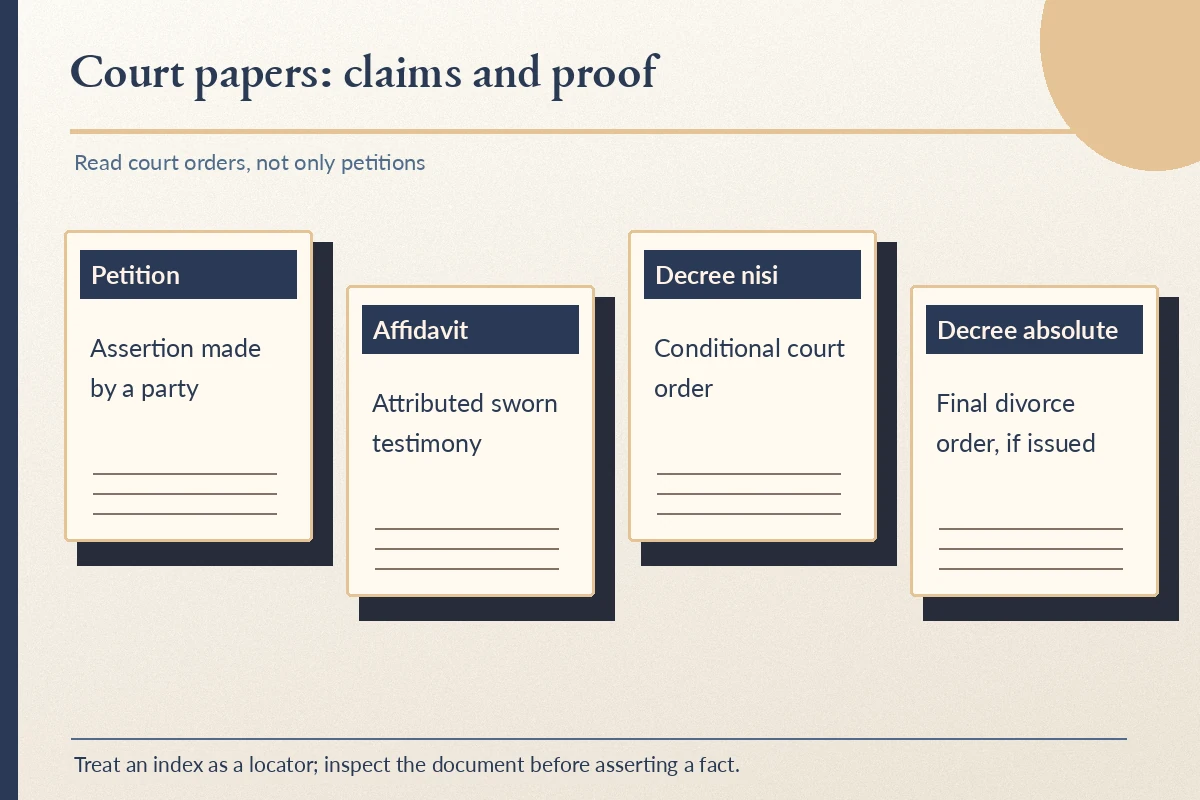
A petition begins or frames a court claim; it is not a judicial finding. An affidavit records what a witness swore, not necessarily an established fact. A decree nisi is a conditional stage in a divorce process, while a decree absolute is the final order when issued under the historical legal process. MHNSW warns that decrees are not always included in a case file. When a researcher has the petition but cannot find an absolute decree, the responsible statement is that proceedings were initiated, not that the marriage was conclusively dissolved. Record whether the document is a pleading, testimony, interim order or final decision. For a comparable plan elsewhere, our guide “New Zealand Divorce Files Before 1926” shows how to verify petitions and final decrees.
Read the parties and dates as separate claims
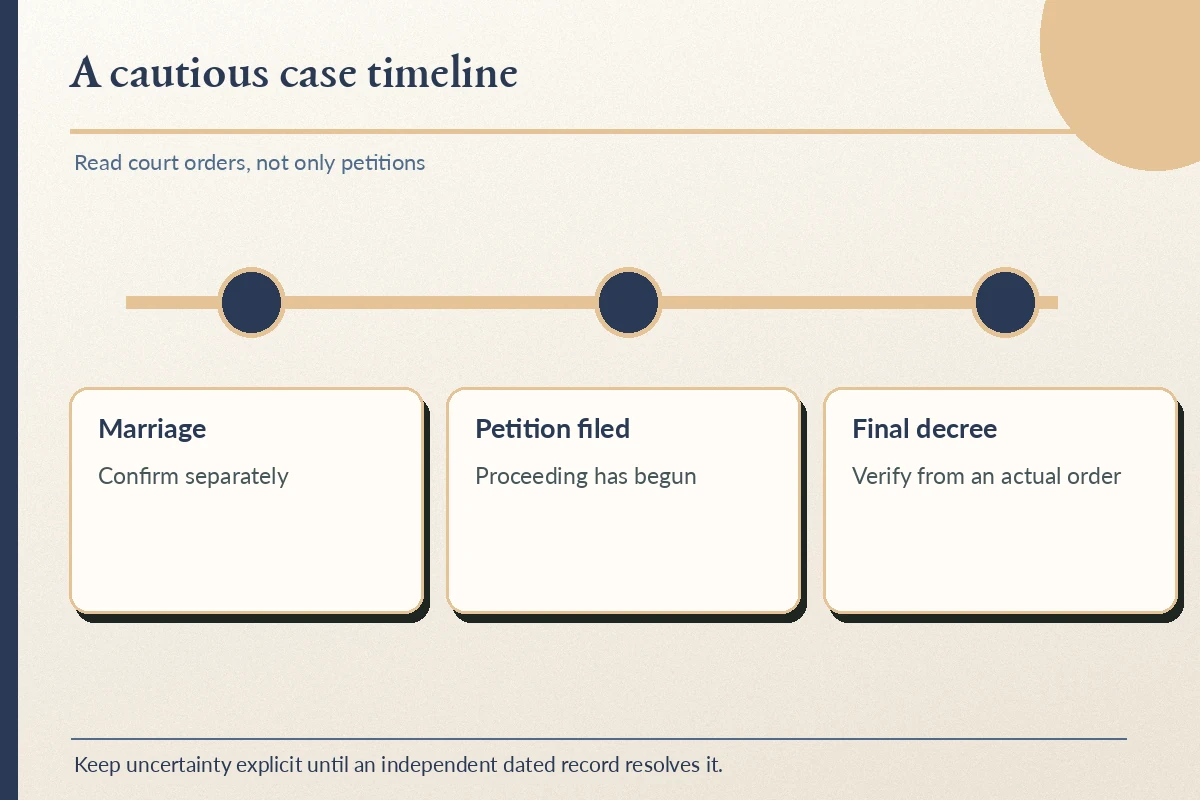
Create a compact chronology including marriage, petition filing, hearing, decree nisi and any decree absolute. Capture whether a date refers to an event, testimony recorded later or the archive’s coverage period. A fictional couple, Laura and Samuel Reed, might have married in 1903, petitioned in 1912 and obtained a later decree. These names and dates are illustrative only. If your file lacks a final order, say so rather than inventing one. Compare a claimed marriage place in the court file against a civil or church record. Keep apparent discrepancies visible until independent evidence resolves them.
Do not confuse a detailed file with proved family history
Court papers may mention children, addresses, occupations, marriage certificates or letters, but the surviving contents vary widely. Classify every assertion by creator and purpose. A petitioner has reasons to tell a particular story, a witness may repeat hearsay, and a copy of a certificate is evidence of a separate registration. A child named in an affidavit may require a birth record to verify parentage. Court claims about behavior, health or morality deserve particularly careful attribution because they may reflect contested allegations and era-specific stigma. Never turn a pleaded accusation into a biographical fact without supported context.
Deal with missing or difficult index entries
Try alternative spellings, different parties’ surnames and an expanded year window. Check the guide before assuming an index covers a later case; MHNSW describes catalog-based access, microfilm years and missing sequences for portions of the twentieth century. The 1873–1923 index is specifically useful for its own period. An online name miss can arise from spelling, indexing or record survival, not only absence of a case. Preserve the search terms and the date. If you have a divorce number from another source, that identifier can be more productive than repeated surname searches.
Test a namesake against independent records
Suppose two people named Charles Moore appear in a NSW court index. Compare both spouses’ full names, places of marriage, children and chronological fit. A case in the right decade is not enough if the respondent’s given names differ from known records. Make a side-by-side worksheet: fact, indexed claim, independent source and unresolved contradiction. Do not merge the court parties into a family tree until the combination is persuasive. A later remarriage entry can test whether the timing is plausible, but it cannot by itself supply the missing divorce decree. Avoid implying that a surname match verifies legal identity.
| Document | What it establishes | What it does not |
|---|---|---|
| Online index | Indexed case and number | Final divorce |
| Petition | A party initiated a claim | That allegations were proved |
| Decree nisi | Conditional order stage | Necessarily the final decree |
| Decree absolute | Final order if authentic and applicable | Every other family claim |
Respect sensitive testimony and living families
Older divorce files can include intimate accounts, sexual allegations, or details about children. Their archival availability is not a direction to publish sensitive details about living descendants. Summarize only what answers the research question, attribute disputed allegations, and avoid sensational headlines. Court vocabulary is rooted in legal rules and social expectations of its time; it should not be presented as neutral character evidence. When publishing a family history, separate the documented filing or order from allegations that were never judicially resolved. An unresolved file might be important to a family narrative precisely because its outcome cannot be confirmed.
Build a precise archival citation and next test
MHNSW gives examples of citations for divorce files, including repository, series NRS 13495, item reference and case number. Write down the catalog identifier, parties, date span and image/page viewed. Cite an index search as an index rather than falsely saying you read the file. For a negative final-decree search, note the file pages inspected and the relevant additional index. Then choose one follow-up: the final order series, the marriage certificate, a dated electoral roll or another independent source that answers the specific uncertainty. This creates a retraceable trail rather than a stack of surname screenshots. For the fuller picture, see our guide “Queensland Divorce Petitions, 1861–1894”.
How We Research
We compared the MHNSW online index, its named court series, record-access guidance and citation examples. We separated index metadata, pleaded assertions, interim orders and final decree evidence. The scenario with named spouses is explicitly fictional and does not describe any real NSW proceeding.
More Records and Archives Guides
Official sources and archival guidance
Museums of History NSW provides its 1873–1923 online index and NRS 21360 index-series context (mhnsw.au).
MHNSW explains custody of divorce papers, catalogue searching, date gaps and ordering (mhnsw.au).
MHNSW discusses NRS 13495 case papers and the variable record types found (mhnsw.au).
The State Archives provides source-specific examples of divorce-file citations (mhnsw.au).
This is historical family-history research guidance, not legal advice. Court allegations and details of children require careful attribution and consideration for privacy. No affiliate relationships are claimed. See our GenHis affiliate disclosure.
The MHNSW online Divorce Records Index is designated 1873–1923; later case papers require other catalogue or access routes.
It is the principal NSW State Archives series of historical divorce and matrimonial cause case papers.
No. Look for the relevant final order; a petition records an initiated claim, not necessarily a completed divorce.
Preserve the index remark and investigate the referenced case or related catalogue entry before reaching a conclusion.
Compare both parties, date, case number and independent marriage or residence evidence, not the surname alone.