
To investigate a historic divorce in England or Wales, first find the J 77 case entry for the spouses and approximate filing year, then determine whether a decree actually ended the marriage. The National Archives divorce guide separates surviving petitions from later legal results. A petition alleges grounds for divorce; it does not itself prove that the couple divorced.
Locate the Correct Divorce Court and Historical Date
The civil court system for divorce in England and Wales began in 1858. Before that year, ending a marriage while both spouses lived ordinarily required a private Act of Parliament, although other kinds of separation existed. A J 77 search is therefore not an appropriate first step for a claimed 1820 divorce.
Establish an approximate petition year from a later marriage certificate, address, newspaper announcement or family paper, and record whether it is an event date or merely an estimate. The legal chronology matters: a petition, hearing, decree nisi and decree absolute should not be collapsed into one event. Scotland and Northern Ireland use different jurisdictions and repositories.
Search J 77 by Both Surnames and Legal Roles
J 77 contains historic court divorce case files. Search a petitioner name, respondent name and possible co-respondent separately; historic spelling, initials and remarried surnames often break a narrow query. For later records use Discovery with a quoted full name, then widen to surnames and the relevant date interval.
Save the case reference exactly as returned. A catalogue title can abbreviate the parties or use one spelling; it is a locator rather than an image of the pleading. If two couples share names, keep them as separate candidates until address, occupation, children or independent marriage data match.

Choose the Right Viewing Route for the Filing Year
The National Archives reports that J 77/1/A1 to J 77/1063/2238, covering 1858–1916, can be searched and viewed through Ancestry, often with a subscription or access fee. Later records generally require Discovery searching and a visit or ordered reproduction where available. These are access routes, not a claim that all years are fully digitized.
Check the particular catalogue entry and current viewing terms before purchasing access. Indexes in J 78 can assist when J 77 searching fails. Record whether you personally viewed the manuscript image, a vendor image, an index transcript or only a search-result description; citations should never blur those levels.
Check the Survival Break Around 1928 and 1937
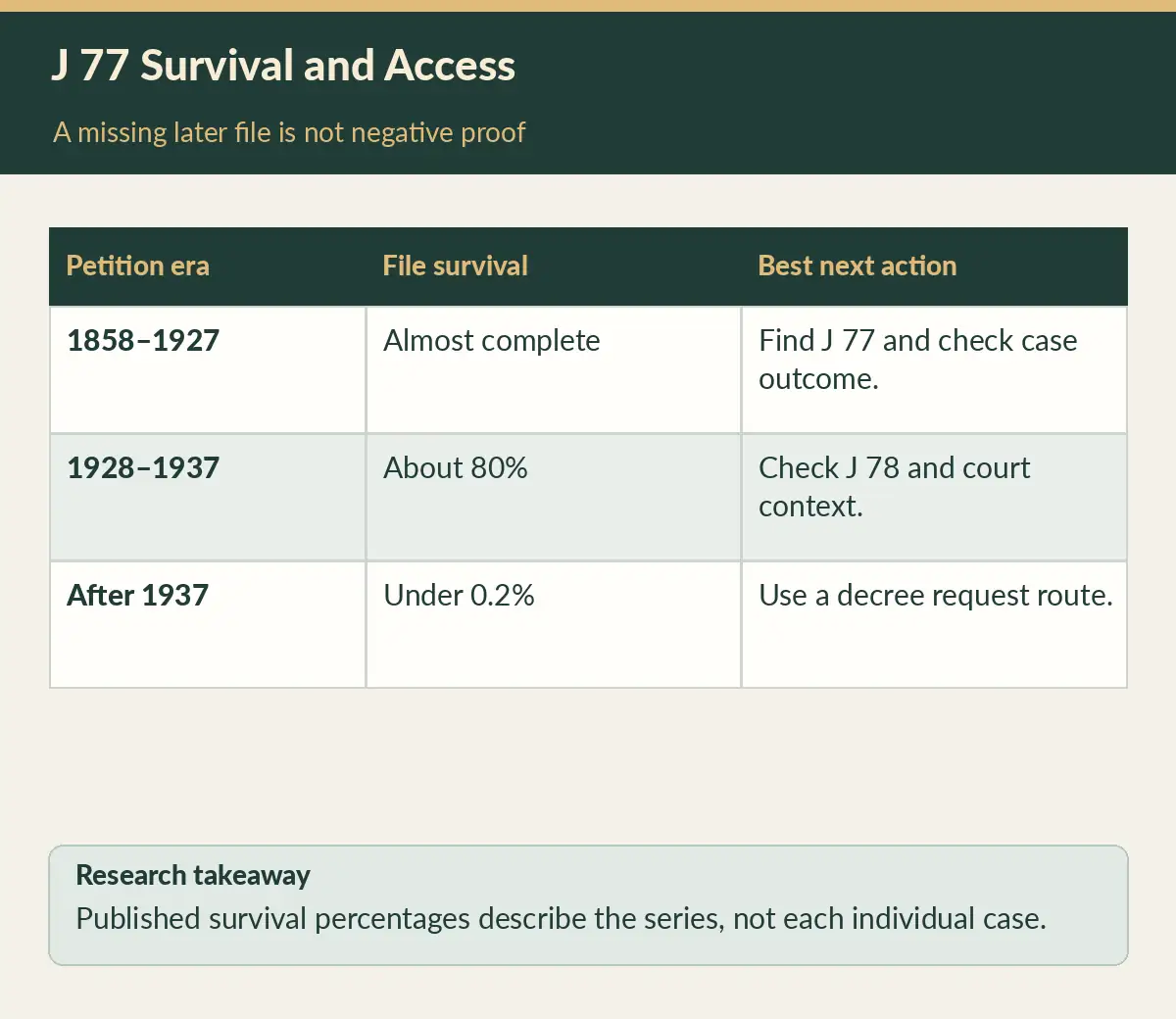
The survival profile is unusually important for this collection. The National Archives estimates almost complete J 77 survival for 1858–1927, roughly 80 percent for 1928–1937, and under 0.2 percent after 1937. Few later cases survive, and the absence of a file does not mean no divorce occurred.
The historic district registries established in 1927 have no surviving case files in this national collection. A missing file from 1945 requires a different approach from an unexplained missing 1890 file. Note the court, year and search procedure before reporting a negative result, and consult the current court-records instructions for legal proof.
Read the Petition Without Accepting Every Allegation
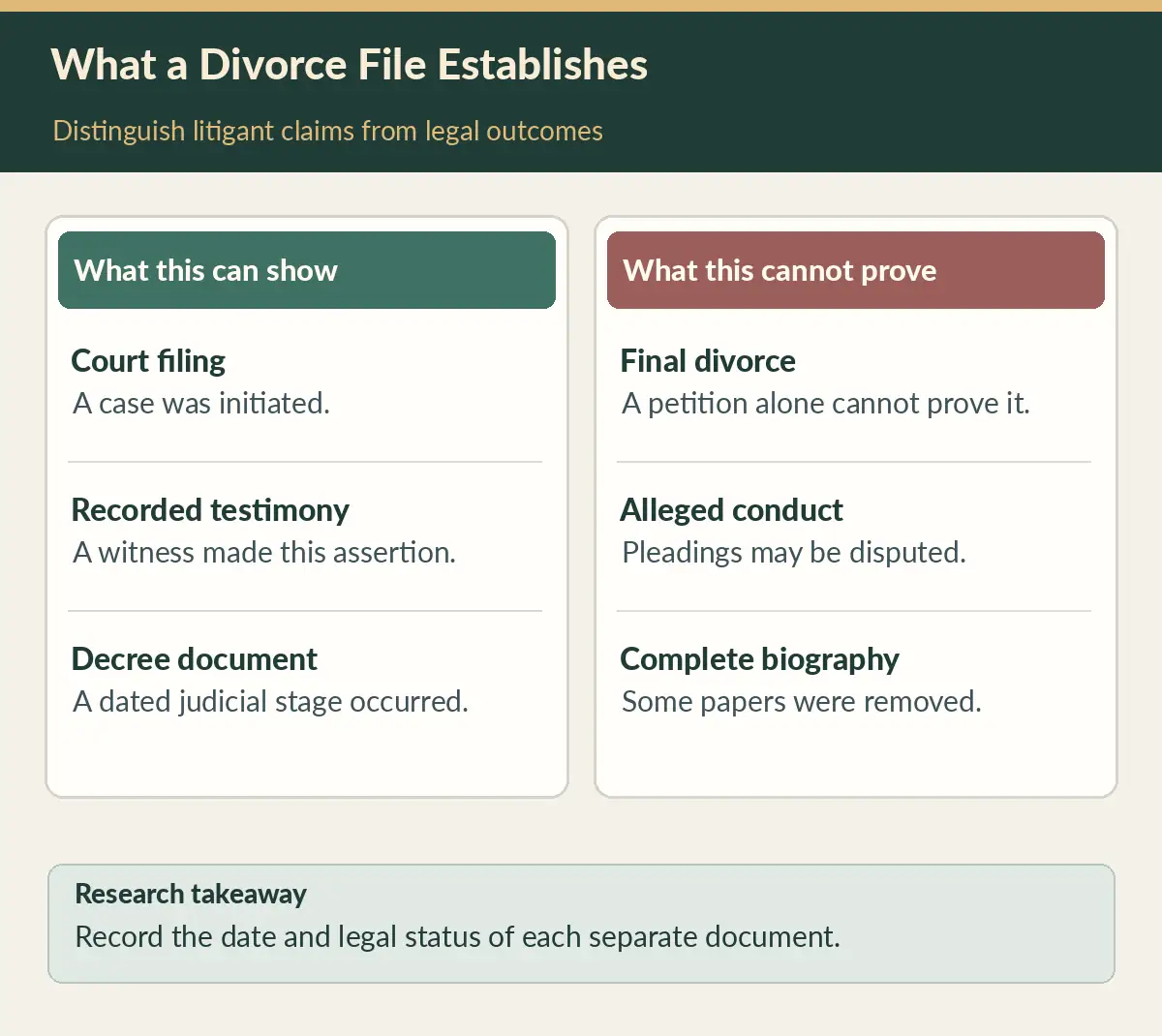
A surviving file can include a petition, response, marriage details, sometimes children’s certificates and material about the court process. Statements alleging cruelty, desertion or adultery are allegations in an adversarial legal proceeding, not independent findings of fact. Transcribe the parties’ names, their procedural roles, dates and addresses; mark disputed statements as attributed claims.
Ask whether a witness observed an event or repeated what someone else told them. Many case files were stripped of informal papers, while selected examples were retained as fuller files. Missing correspondence and exhibits are therefore not evidence that no witnesses existed or no argument was raised.
Separate Decree Nisi From a Final Decree
For each case, create distinct fields for petition filed, hearing or decree nisi, decree absolute, and later remarriage. A decree nisi is not the final decree that completes dissolution. A J 77 file may document one stage without retaining a complete final record.
The National Archives warns that the only surviving evidence of a case whose file was destroyed may be a decree held elsewhere by the court. Where legal proof is needed, follow the official current government route for copies of decree absolute rather than treating a digital petition as a legal certificate. Quote the original terminology, and resist backdating a divorce to the first appearance of the case.
Disambiguate Two Couples With Matching Names
Suppose two women named Mary Collins appear in different J 77 entries during the same decade. Write two claim records, each with the petitioner and respondent, filing year, residence, occupation if given, and marriage particulars. Then compare independent civil marriage registrations, census households, births and later marriage records.
A common surname and a nearby court date alone are insufficient to merge the cases. Pay special attention to a spouse’s maiden surname and the date and district of the underlying marriage, because those clues can distinguish namesakes. When a discrepancy remains, retain both candidates and state which additional document would resolve it.
Interpret Missing Evidence and Privacy Cautiously
Case files after 1937 rarely survive among the National Archives holdings; the guide also describes restrictions on recent cases and court-held decrees. Do not infer that a modern individual divorced from an unsuccessful J 77 name search.
Nor should historic case allegations be republished as certain facts about descendants or living relatives. A disciplined research log records exact variants tried, date spans, the catalogue filters used, and whether a source was closed, undigitized or absent. Sometimes a contemporaneous newspaper notice or civil certificate supplies an event clue, but it must be evaluated separately rather than silently inserted into the supposed court-file text.
How We Research a J 77 Divorce Claim
We start with independently documented marriage and residence information, then search J 77 under both spouses’ names across a realistic filing interval. We record a Discovery reference and consult J 78 indexing if necessary.
We identify the access route for the date and inspect the actual available file, labeling petition claims, supporting exhibits and court rulings separately. We do not state that dissolution occurred until a final decree or other competent legal record supports it. The affiliate disclosure describes our editorial relationships; paid genealogy search tools never replace citations to the originating court record.
More Records and Archives Guides
Cite the Case and Preserve the Remaining Question
A reproducible citation should name The National Archives, J 77 file reference, the named parties, relevant document date and precise page or image number, plus the delivery platform if an image was viewed there. If the result was only a J 78 or Discovery entry, say so.
List any decree date from a distinct document as a separate citation. Keep a brief findings table with the question, observed wording, source role and status: established, contested or not yet found. This prevents a copied family-tree assertion that a marriage ended in a specific year from outrunning the legal record that actually survives.
No. Check for a final decree absolute or other competent decree record.
The National Archives reports almost complete survival for 1858–1927.
Use the J 77 1858–1916 image collection and retain the original J 77 reference.
Very few national case files survive; use the relevant court or government decree request guidance.
It may report children or attach certificates, but a contested statement needs separate corroboration.