
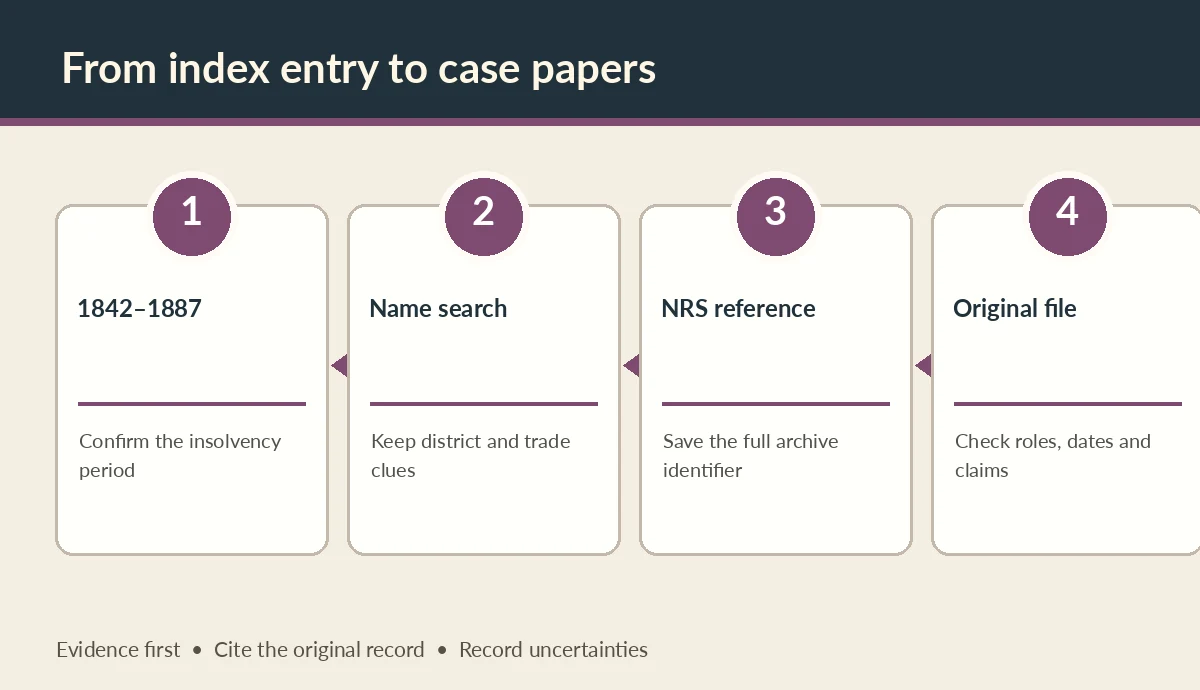
The Museums of History NSW insolvency index covers proceedings from 1842 through 1887 and can lead to archival files about debts, assets and economic networks. It is not a roster of every person who owed money, nor a complete list of surviving court papers. The index may omit cases; conversely, an indexed file can be missing or unavailable. Start with a name, approximate district and date, capture the archive item reference, and then test claims against the original case and contemporary notices. Insolvency filings reveal financial legal processes, not proof of criminal behavior or family relationships.
Understand the NSW insolvency and bankruptcy transition
The MHNSW guide distinguishes the earlier insolvency files of 1842–1887 from bankruptcy files that began in 1888. The cases fall under different archival series, so a search restricted to the wrong index can miss the relevant person. Do not project a current definition of bankruptcy onto a nineteenth-century file. For an 1888 or later event, choose the bankruptcy index and its own court chronology rather than extending the 1842–1887 index past its stated coverage.
Search the insolvency index with a location clue
Start with the name as found in an independent source and try spelling variations, initials and occupational terms where the interface permits. The index displays names, dates, places or occupations for many entries and may include a detailed archival reference. Log multiple plausible hits separately: a common surname in Sydney and the same surname in Kiama could point to different individuals. An index row establishes that a case was indexed, not that your ancestor was the person named.
Copy the full NRS reference before opening a file
MHNSW identifies the main insolvency file series as NRS 13654 and lists the physical range in its guide. Index records may display their own machine-readable or transcribed archival identifiers. Keep the reference exactly as shown—including container and case number—rather than converting it into a bare date. Ask the archive about the method of obtaining the original file, as online scans, Reading Room access and copy services are not interchangeable. For a related choice, see our guide “Victoria Insolvency Records, 1842–1928”.
Read the case papers without inventing family links
A file may list creditors, debtors, business connections, assets and statements, though surviving contents vary. The fact that two people appear on an account does not establish a kinship relationship; they may be customers, trade partners or unrelated creditors. Separate each mention by role and reported amount. Likewise, a petitioner’s account is a statement made in a legal or financial context, not an independently verified narrative of every claimed transaction.
Check the NSW Government Gazette for missing names
The official index explicitly warns that it is not comprehensive and directs unsuccessful researchers to the NSW Government Gazette within the relevant time frame. Search the newspaper or Gazette by surname, initials, occupation and district, then note the issue date and page. A notice may provide a proceeding date or reference leading back to court papers. If no file can be located after a Gazette hit, report a documented notice with a missing or unlocated case, not a fully examined court record. Our guide “NSW Divorce Case Papers, 1873–1923” goes into more detail.
Choose the NSW insolvency source that answers your question
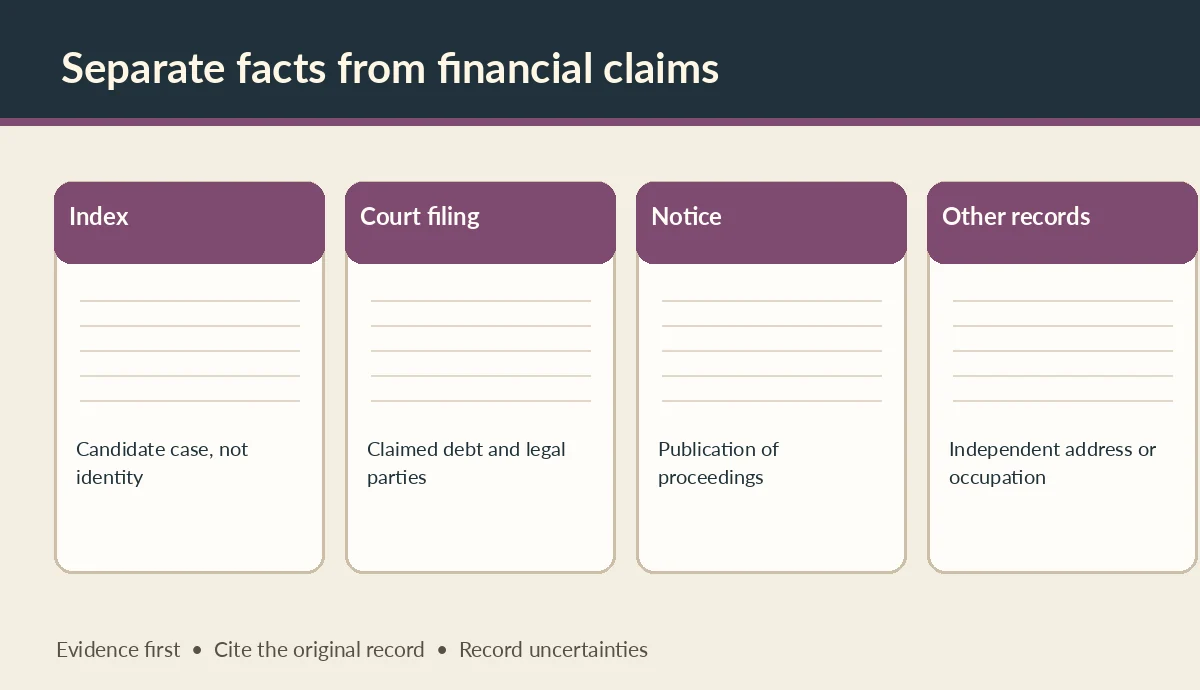
| Evidence stage | What you possess | Safe conclusion |
|---|---|---|
| Search result | Indexed name and file reference | A candidate case exists in the index |
| Gazette notice | Published legal announcement | A notice appeared on that date |
| Original case file | Dated documents and party roles | The case contains these recorded claims |
| Independent record | Address, trade or identity fact | Potential identity corroboration |

Recognize a surviving index without surviving papers
Even when the name is present, underlying case documents may not have survived. Some items are fragile, and conservation restrictions can delay access. Record the distinction between “index located,” “case reference established,” “file inspected,” and “file missing or restricted.” These states prevent the common mistake of describing a file’s supposed contents when the researcher has only read a catalog summary.
Separate event dates on the court timeline
Insolvency proceedings can generate multiple dates: application, formal order, examination, discharge, publication and later cataloging. Enter each date against its document label. The earliest available date is not automatically the date a business failed, and publication may occur after the legal event. If a family migrated or changed occupation at a similar time, describe the chronology without claiming insolvency caused the move unless an independent record supports that link.
Use an explicitly fictional namesake example
Imagine a fictional cabinetmaker William Price in one NSW district and a farmer William Price elsewhere. The index contains a case for a William Price whose occupation is briefly abbreviated. First compare the court district and date with land or electoral evidence; next inspect original case papers for addresses or associates. If the original contradicts the target’s occupation, keep the candidate as a rejected match. A familiar surname plus financial distress in family lore is insufficient to identify the indexed person.
Follow the right custodian after 1928
MHNSW states that federal jurisdiction took effect from 1 August 1928 and advises using the National Archives of Australia for relevant later proceedings. This handoff is about the 1842–1887 state insolvency search; do not send a twentieth-century federal case back into the earlier index. Check the legal event date and the institution that created the record before requesting files, and note cases whose proceedings straddled later administrative changes. For the fuller picture, see our guide “Western Australia Bankruptcy Files, 1858–1928”.
Cite the indexed hit and the file as separate sources
For the index, record the database title, date searched, exact entry and displayed reference. For the original, cite the court or creating agency, series, item, particular document and its date. As for a Gazette notice, cite the publication, issue and page. A negative search should list specific index spelling variants and Gazette issues consulted. This source-by-source audit lets another researcher replicate the path without mistaking a notice or index for direct file inspection.
How We Research Nsw Insolvency Records 1842–1887
Our method begins with the named archive’s descriptions of the collection, series and access conditions. We distinguish official finding aids from original entries and from our own inferences. We check known date boundaries and catalogue warnings before proposing a search path, and use fictional examples solely to illustrate how researchers can test ambiguous identities. Also, We do not claim to have inspected a particular ancestor’s file or to know which family stories are true. Recheck archival availability and restrictions at the time you search.
More Records and Archives Guides
Primary archival guides for nsw insolvency records 1842–1887
Museums of History NSW 1842–1887 insolvency index, limitations and Gazette fallback (mhnsw.au).
MHNSW description of NRS 13654 insolvency files, 1888 shift and later Commonwealth custody (mhnsw.au).
MHNSW separate bankruptcy index and its non-comprehensive file-survival cautions (mhnsw.au).
Editorial and affiliate disclosure: GenHis is an independent educational family-history publication. No archive listed here is claimed as a sponsor or affiliate partner. Official access rules, privacy restrictions and fees may change. Use archival records thoughtfully and do not identify living people from sensitive files. Read the affiliate disclosure for our general approach to commercial links elsewhere on the website.
The Museums of History NSW index covers 1842–1887.
No. MHNSW advises checking the Government Gazette for cases absent from the online index.
Use the separate MHNSW bankruptcy index and guide, with later federal custody checked by date.
No. The underlying file may be lost, fragile or otherwise unavailable.
No. Creditor and debtor roles establish financial claims, not kinship without other records.