
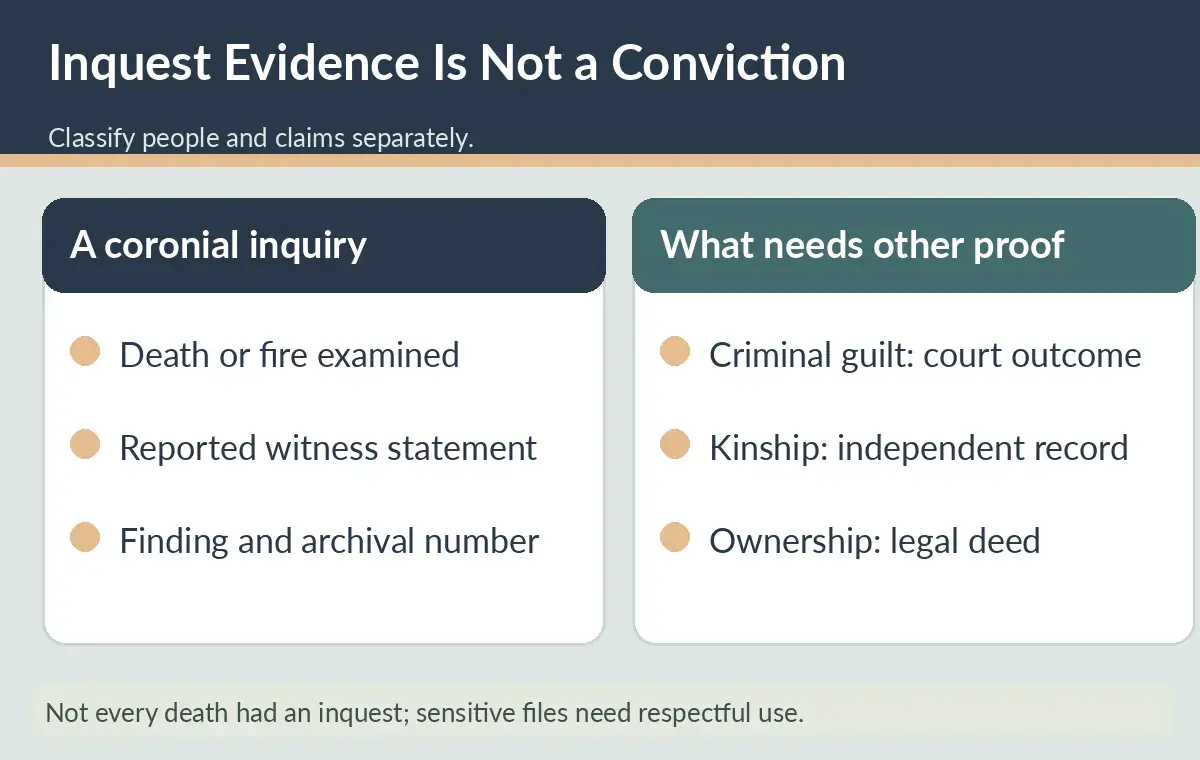
Search the NSW inquest index as a locator for a coroner’s inquiry, not proof that a full case file survives or that every death required an inquest. Museums of History NSW maintains an index for 1851 and 1916–1963 recording names or fire particulars, dates, location, coroner and references. Other years require different registers, cards, newspapers or series. An inquest examines circumstances of a death or fire; it is not itself a conviction and must not be treated as proof of misconduct by witnesses or relatives.
Start With the Death, Fire or Inquiry Date
A death certificate, historic funeral notice or newspaper report may indicate whether an inquest was held. The official guide explains that not every death resulted in an inquest and some could be dispensed with. Begin with the deceased’s full name, a probable death interval, town or district and any known location of the event. The inquiry date may fall after the death date; an exact-date search can therefore miss a real case. When researching a historic fire, search its place and description rather than inventing a deceased person’s name.
The archive offers different series for different periods. Its early 1796–1824 index is not the same as the online inquest index for 1851 and 1916–1963. Intermediate nineteenth-century register holdings are catalogued separately and are not necessarily covered by that modern search form. Choose the date-scoped path before running a surname query. A seemingly blank year may mean no online name index, rather than the disappearance of every surviving coronial register for that year.

Capture the Exact Index Entry and Its NRS Reference
The modern online index may show an inquest number, person or particulars of a fire, date, location, coroner and citation. Preserve all these fields exactly, including initials and number punctuation. The repository’s index page identifies underlying series such as NRS-345 papers, NRS-346 cards, NRS-313 correspondence and NRS-1786 files. A number that looks like a simple docket may be meaningful only in its year or series context. Without the archival citation, a name hit can be difficult to reproduce or request.
Search both likely surname variants and the relevant district. A person might be recorded with a middle name in newspapers but initials in an index. Do not assume a witness named in a newspaper is the subject of the inquest. When a fire inquiry produces a place or property field, record the address and the nature of the inquiry without assuming the resident was the owner. In each case classify the index entry as evidence that a case was recorded, not proof of the final facts alleged or of every document that once existed.
Check Whether the Original Papers Exist for That Period
The survival pattern is the critical limitation. According to the NSW archives, only about five percent of inquest papers for 1916–1939 survive. Much more survives from the 1940–1963 period, but the website still warns that some indexed files no longer exist. Earlier registers and indexes may be the only surviving evidence for particular spans. For example, its guide states that May 1859 to March 1864 lacks the main register, although index material exists. An online reference does not override such a documented loss.
For a case in 1923, record that an index hit exists and separately check the exact NRS-345 item or other series before expecting witness depositions. For a 1950 inquiry the chances of surviving papers may be better, but access must still be verified in the catalog. Where only a summary register survives, do not embellish its language into an invented witness statement. Where the file is missing, contemporary newspapers and the civil death registration can provide independent context while remaining different sources created for different purposes.

Separate Registers, Case Papers and Court Proceedings
NRS-343 registers of coroners’ inquests and inquiries span multiple historic periods and can record details such as district, date, finding and administrative action. An index to a register may have fewer fields than a full surviving volume. Case papers in NRS-345 may contain witness accounts, police or medical reports and formal findings, but their contents vary. The same inquest could also generate related Attorney General correspondence or later court proceedings. These are distinct records and should be cited separately rather than combined into a fictitious comprehensive case file.
A coroner’s finding may identify a cause or circumstance of death. It does not necessarily prove that a named witness committed an offense or that an accusation was accepted in a criminal court. If a later trial is reported, trace its case number and outcome in the relevant court records. Similarly, the presence of a person’s name in the register does not establish a family relationship to the deceased. Distinguish the deceased, witness, coroner, juror and informant roles when preparing a research table.
Request Access Respectfully and Handle Sensitive Evidence
The archives advise that some papers include photographs and descriptions of distressing deaths, so determine first whether an original file is needed for the specific family-history question. Search the catalog for digitized items or use the archives’ copy-order and reading-room options for open records. Provide the exact name, year, inquest number and NRS citation rather than an open-ended request about someone’s death. Do not republish graphic details or names of potentially living people without necessity or appropriate consideration.
Some records concerned reported deaths where a formal inquest was dispensed with; these files may be unindexed and organized by date. A negative name result therefore does not establish that there was no coronial administration. If an inquest concerns a fire at a property, the documents might distinguish owner, occupant and witnesses, but those roles must not be conflated. Where privacy or access rules limit the records, use public death notices, civil death registration and contemporaneous news, clearly marking their different levels of reliability.
Build a Source-Level Claim and a Research Plan
For every result, record the index title, search date, subject or fire, inquest date, number, NRS series and item, repository, and whether you saw the original or only metadata. Use a three-status column: ‘index entry verified,’ ‘underlying file examined,’ or ‘underlying file unavailable or not checked.’ A partly illegible entry should be transcribed as uncertain rather than completed from an unsourced family tree. A single case might have more than one version of the date in its death certificate, index and newspapers; record all separately.
Finish with one narrowly phrased task: ‘Find out whether the fictional 1930 regional death listed as a coroner’s case has a surviving file, and if not locate the corresponding register or newspaper report.’ This prevents months of searching for material that the archive identifies as largely lost. See the affiliate disclosure for the site’s general policy; this guide does not posit any paid relationship with the archive or record services.
More Records and Archives Guides
How We Research This Collection
We compared Museums of History NSW’s coronial research guide, the live inquest-index scope and NRS references, and its published note on the survival of 1916–1939 files. The research method distinguishes index metadata, historic registers, case papers and later court proceedings, and it keeps sensitive allegations separate from findings.
No. Not all deaths were subject to an inquiry, and coroners could dispense with an inquest.
The official searchable index covers 1851 and 1916–1963; other years have separate records or finding aids.
No. Approximately five percent of 1916–1939 papers survive, and other series have gaps.
NRS-343 is a set of registers of inquiries; NRS-345 contains coronial case papers with uneven survival.
No. Allegations, testimony, findings and any subsequent court judgment must be distinguished.