
Use the name index to reach a specific voyage and passenger-list image—not as the final proof of a family connection. The New South Wales assisted immigration collections cover several schemes and ports, with digitised lists dated across 1828–1896 and a commonly used names index focused on 1839–1896. The passenger may have arrived at Sydney, Newcastle, Moreton Bay or Port Phillip in a period when administrative boundaries and schemes differed from today’s map. This guide gives an index-to-image workflow, explains where schemes and dates diverge, and shows how to prove that a passenger was your ancestor rather than a similarly named newcomer.
Identify the assistance scheme before choosing an index
An assisted immigrant’s fare was subsidised or paid under a particular colonial immigration arrangement. The label is a funding distinction, not a statement about someone’s wealth, employment success or permanent residence. Start with a likely immigration decade, place of first settlement and approximate age obtained independently from local records. Then read the description of the NSW Assisted Immigrants Index and its included series. Bounty immigrants, agent lists and board lists may document different steps of the same voyage, while a digitised shipping list can contain a different level of detail from a database result. Do not assume that all assisted immigrants appear in a single continuous alphabet, or that an 1828 list must be indexed in the same way as one from 1888. For the fuller picture, see our guide “NSW Immigration Deposit Journals, 1853–1900”.
Search the NSW name index without forcing a perfect match
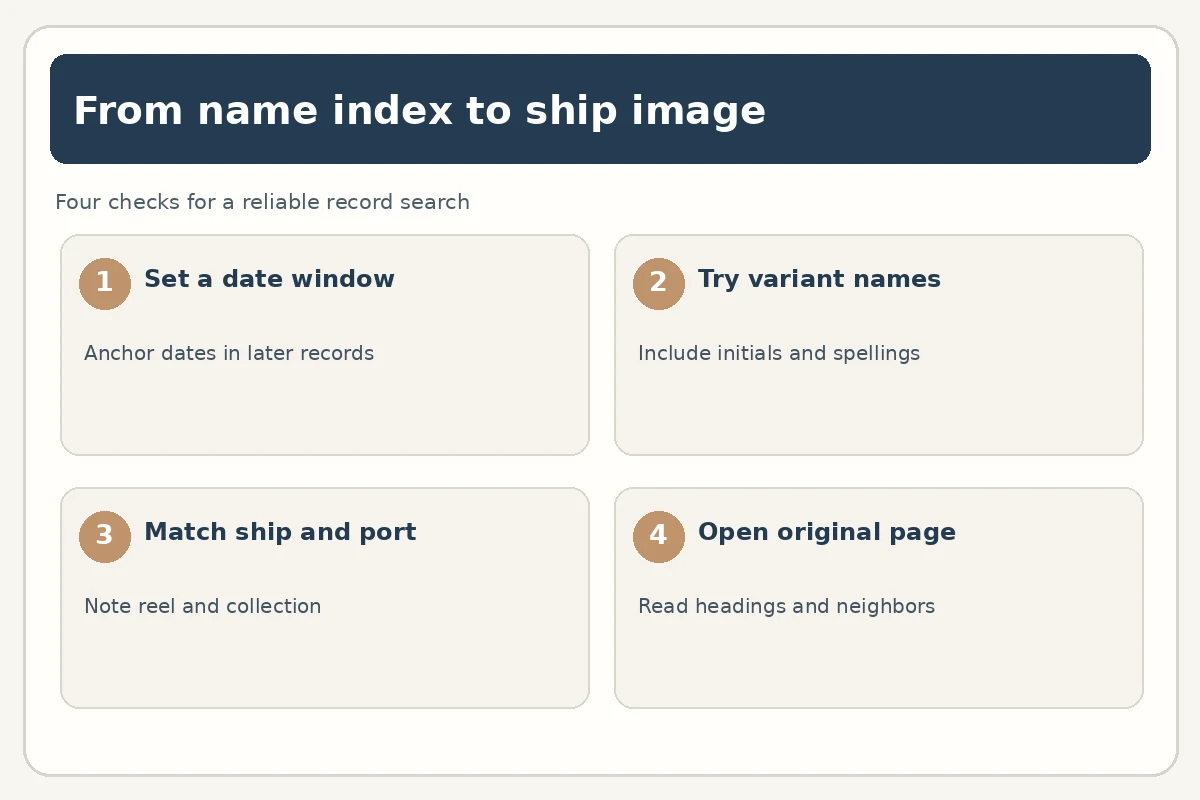
Enter a plausible surname first, then experiment with given-name variants, initials, Irish and English spellings, and alternative transcriptions. Ages recorded on embarkation and arrival papers can disagree with later census, marriage or death details. For a common surname, narrow through ship, arrival date, stated native place and traveling companions rather than treating the first indexed result as confirmed. Copy the full result exactly as displayed, including the archival series or reel when provided. A missing search result may signal an unindexed series, a differently transcribed surname, an unexpected port or a voyage financed privately rather than through a state scheme. Log each attempt and the index’s coverage statement so a negative result is interpretable.
Open the digitised list and preserve the voyage context
Use Museums of History NSW’s digitised shipping lists to locate the ship and specific voyage corresponding to your index entry. Read the first page and column headings before transcribing the individual line. Depending on the scheme, the surviving page may note age, calling or occupation, native place, literacy, religion or other administrative details; do not promise a particular field in every era. Inspect adjacent names for a plausible travel party, while remembering that shared cabin or line placement does not itself establish kinship. Save the page number, list title, reel or record-series identifier and image URL. If the entry is a derivative transcription, clearly distinguish that index from the government-held original.
Check colonial ports rather than modern state borders
A list described today as a NSW immigration source may cover destinations that later became part of different colonies. The State Library of NSW identifies assisted arrivals for Sydney and Newcastle, Moreton Bay and Port Phillip in specified periods. Those historical labels need not imply that a passenger ever settled in present-day New South Wales. A fictional case could involve a ship indexed under NSW assistance while the family’s later records appear only in Victoria. Record the arrival port as stated and search contemporary colonial maps or administrative histories before assigning a jurisdiction. Never infer a birthplace or state of permanent residence from the port of disembarkation alone. Historical route and administrative responsibility are separate questions. For the fuller picture, see our guide “Victoria Assisted Passenger Lists, 1839–1871”.
Test family-group clues with independent records
When several passengers share a surname and appear near each other, record the association as a hypothesis. Check ages and origins against any later baptism, marriage, land, directory or death record, and ask whether the group could include unrelated workers or people with a common surname. If the shipping papers name a parent or sponsor, copy the wording and identify whether it is original, later annotated or supplied by a derivative database. A fictional passenger arriving aged twenty in 1854 should not automatically be merged with a person who married in 1855; the identity test needs more than a feasible timeline. Create an evidence grid with one column for each independent record and preserve contradictory information rather than deleting it.

Differentiate an arrival date from other voyage dates
An online entry may show departure, arrival, inspection or a register-creation date; these events do not necessarily occur on the same day. Read the record’s heading and, when possible, compare its ship name and landing port against a contemporary shipping notice. Allow for weather diversions, changes in official recording practice and different ports of call. A newspaper may announce a vessel without naming every passenger, while a passenger-list page may include names not published in the press. Neither source should be silently substituted for the other. Cite each date with its precise meaning so that a descendant reading your timeline can see whether you documented a physical arrival or an administrative entry.
Build a citation that can lead another reader to the same line
Write down the holding archive, exact index title, person’s recorded name, ship, arrival port and date, and image-level location or reel. If there are two surviving list copies, cite each independently and describe differences. Keep an unaltered image or a persistent link as permitted by the archive’s terms; an enhanced reading copy should be labelled as such. In a research log, list misspellings and searches that failed, particularly when a person could appear under a changed surname. A citation such as “NSW passenger list on the internet” is not sufficient: another reader needs to know which collection and page support the claim and which details remain inferred.
Use a missing entry to revise the search, not invent a voyage
First check whether the journey fell outside the index or digitised-list ranges. Next decide whether the passenger might have paid their own fare, arrived through another Australian port, traveled coastal after landing elsewhere, or used a name not in your family papers. Consult the State Library’s unassisted-passenger guidance and relevant port lists instead of forcing an assisted scheme to fit. Historical losses, partial indexing and illegible records are genuine possibilities, but should be stated only when supported by a collection note. Mark your status “not found in the assisted index under these variants” rather than “did not immigrate.” If later family evidence identifies a ship, browse by vessel and arrival month directly. For the fuller picture, see our guide “NSW Unassisted Passenger Lists, 1826–1922”.

How We Research Historical Passenger Records
We compared the Museums of History NSW finding aid and digitised list description with the State Library of NSW port-and-scheme guide, then checked National Library series information. The diagrams are original research workflows, not facsimiles of any specific immigration register. Dates and fields are presented with scheme-dependent limits rather than as universal promises.
More Records and Archives Guides
Official Record Collections and Research Sources
Museums of History NSW offers an Assisted Immigrants Index, 1839–1896, and connects likely name matches to the digitised lists (mhnsw.au).
The same archive provides a browse route to assisted immigrant shipping list images covering several NSW record series and 1828–1896 (mhnsw.au).
State Library of NSW explains which ports and date ranges are represented, and the distinction between assistance schemes and paid passages (guides.sl.nsw.gov.au).
National Library of Australia identifies NSW assisted shipping record series and reel references useful for citing a discovered entry (www.library.gov.au).
The NSW assisted scheme figures and port labels come from archival descriptions, not from a claim that a particular ancestor reached Sydney. The diagrams are original navigational aids and do not reproduce a government immigrant page. No record custodian has sponsored this guide. Site-wide commercial relationships, if any, are listed in the GenHis affiliate disclosure.
No. Record series, date windows and completeness differ. Check the scope of both the name index and digitised shipping lists.
No. Some records involve ports such as Port Phillip or Moreton Bay; settlement needs its own evidence.
Try variant names, browse by ship, and consider unassisted or other port collections before interpreting the result.
Only if the original record explicitly says so; most relationship conclusions require later independent records.
Retain ship, port, date, series or reel, page or image reference, and the archive holding the original.