
Victorian assisted passenger lists can connect a nineteenth-century immigrant to a ship, arrival date and sometimes an intended employer. But an assisted voyage means that the colonial government subsidized passage; it does not prove a person’s first residence or later employment. The State Library of Victoria identifies a separate assisted-passenger sequence for 1839–1871, with online indexes and digitized passenger-list images through Public Record Office Victoria (PROV). From 1872, assisted arrivals were no longer maintained as a separate list. This article shows how to find the correct record, preserve ship and page references, interpret employer clues and avoid mixing assisted with unassisted or later Commonwealth arrivals.
Confirm that you need the assisted collection
The assisted records concern migrants whose passages were fully or partly subsidized by government schemes. A person who paid their own fare usually belongs in an unassisted series instead. The State Library of Victoria’s main assisted-passenger period is 1839–1871. After 1871, assisted passengers were not kept separately from unassisted arrivals, and later years need other lists. Begin with an arrival estimate from a marriage, children’s births, newspaper notice or later household source. Do not assume that a ship named in an online family tree had a Victorian destination until the contemporaneous passenger evidence is checked.
Search the PROV assisted index
Use the assisted passenger lists linked by Public Record Office Victoria and the State Library guide. Search surname variants and likely arrival years; where several results are plausible, identify the ship and arrival date before choosing a passenger. The State Library specifies that digitized passenger lists can be viewed for records in this collection. Save the full reference and image link, not just a screenshot of the abbreviated name result. If the index is silent, expand to ship-level browsing or a second repository, but log exactly what records the first search covered.

Keep the ship, book and page together
The State Library’s instructions for the historical microfiche route specifically tell researchers to note ship name, year, book and page. These are also excellent citation anchors for digital work because ship names repeat and multiple voyages may occur within one year. Record arrival port, any voyage date actually shown, and the exact page containing the person. Avoid turning a partial list into a complete manifest for an entire ship. If your candidate appears among a family group, still compare ages and origins independently before treating adjacent rows as proven relatives.
Look carefully at birthplace and occupation fields
Assisted passenger records may record name, age, occupation, religion, literacy, and ‘native place,’ but not every list carries every field. The State Library warns that native place can refer to birthplace or last residence. Therefore a listed town is a clue to investigate, not necessarily proof of birth. If an occupation or age disagrees with a later civil certificate, preserve both values and ask whether they came from different informants or circumstances. Pay attention to the column heading and original page layout so an adjacent passenger’s value is not accidentally assigned to your ancestor.
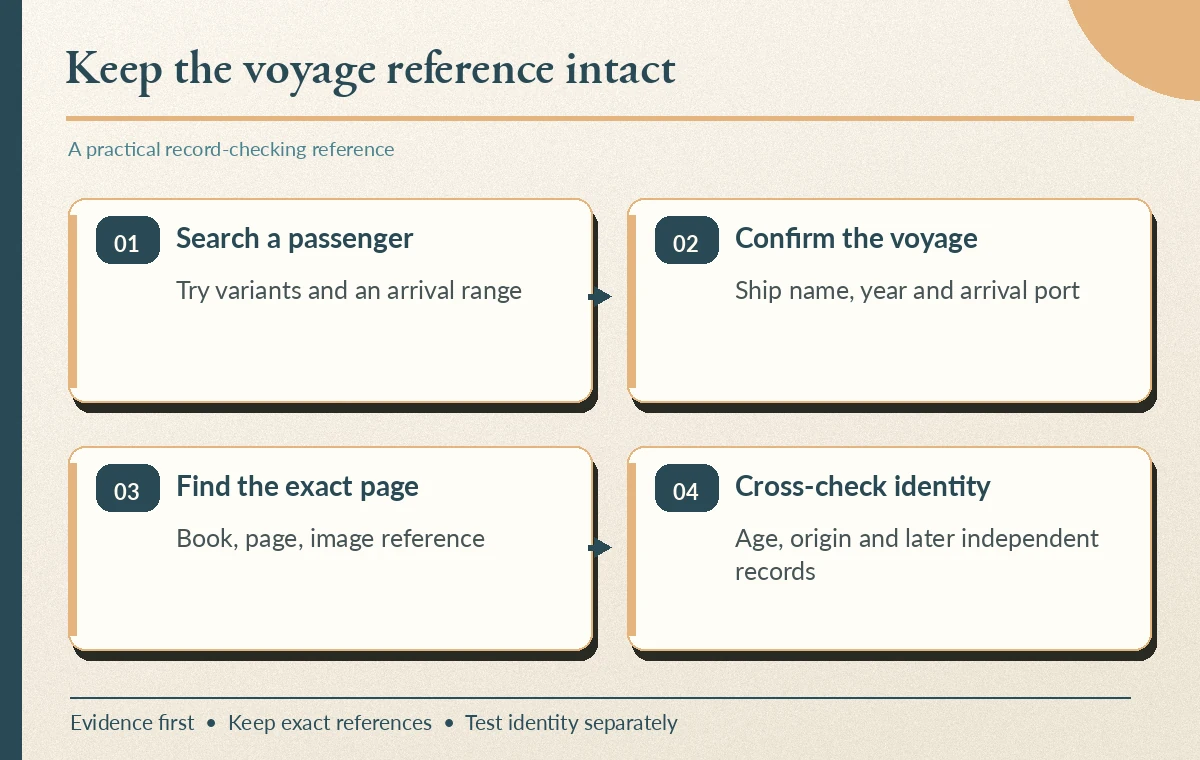
Treat employers as plans before treating them as places
Some assisted records include intended employers, periods of assignment, wages or rations, and whether a passenger accepted an appointment or left ‘on own account.’ These are especially valuable for finding early colonial work, but an intended employer is not proof that the immigrant lived at a farm or worked there for the full term. Copy the administrative wording exactly. Then test the claim in local employment papers, land records, directories, newspapers or a nearby marriage entry. Separate destination on arrival from later residence on a dated timeline rather than writing one neat but unsupported migration story.
Try the earlier Port Phillip cross-index
The State Library points researchers to a separate State Records New South Wales index of assisted immigrants arriving at Port Phillip in 1839–1851, noting that details can differ slightly between holdings. This does not make the sources interchangeable. If an early arrival is missing or misread, search the other index and compare names, ship, voyage and original list references. Before Victoria separated administratively from New South Wales, institutional custody can appear surprising to a modern researcher. Cite both repositories when they provide different descriptions of the same voyage; do not silently select the spelling you prefer. Our guide “South Australia Assisted Passage Certificates, 1862–1885” covers a related question.
Worked example: a promising employer entry
Imagine a fictional immigrant, Sarah Palmer, listed in an assisted arrival book with an intended employer near Geelong. A later newspaper notice places a person of the same name farther inland. The first entry identifies a passenger and a planned labor arrangement; the newspaper notice is an independent candidate for a later residence. To connect them, the researcher compares dates, occupation, age and other relatives in a subsequent civil record. Without this bridge, the evidence does not prove the passenger went to the named workplace, changed employment, or became the newspaper subject. The invented example illustrates the distinction.

When a ship name produces no match
Try an alternative spelling, a possible voyage year either side of the family estimate, or a ship arrival index with a known destination. Port and passenger-class differences matter: the ship may have arrived at another Australian colony or the ancestor may have paid their own fare. For arrivals after 1871, switch from the separate assisted lists to the relevant combined/unassisted holdings described by State Library Victoria. For post-1923 immigration, seek the later government record system rather than stretching the 1839–1871 index beyond its coverage. A blank search is not evidence that the migration did not happen. Our guide “Victoria Coastal Passenger Lists, 1852–1923” goes into more detail.
| Finding | What it supports | What to test next |
|---|---|---|
| Passenger and ship | A listed voyage and arrival | Identity against a later record |
| Native place | A reported place label | Birthplace versus previous residence |
| Intended employer | A proposed labor arrangement | Actual employment and address |
Preserve an identity conclusion that can be retested
Create a four-part citation: repository, collection or series, ship and voyage, and exact book/page or image identifier. Then list independently known facts about your target ancestor and compare them with the passenger entry. Mark birthplace, age, occupation and employment as separate attributed claims. A strong conclusion may read, ‘This is a probable match because the ship, age, occupation and later local marriage align, although the native-place interpretation is unresolved.’ That statement is more useful than an unsourced tree showing an exact immigrant birthplace copied from a potentially ambiguous field.
How We Research
This guide was developed by comparing official registry or archival descriptions with the public search process and testing each recommended inference against its stated record type. Dates, jurisdiction boundaries and access restrictions are attributed to the relevant custodian; examples are expressly fictional. We distinguish a source’s literal statement from an interpretation and a question needing corroboration. Online coverage, fee rules, and search interfaces can change, so recheck the authority’s current guidance before paying or concluding that a record is absent.
More Records and Archives Guides
Primary sources and archive guides
State Library Victorian assisted-passenger period, possible fields and PROV search path (guides.slv.vic.gov.au).
PROV official listing of assisted, unassisted, coastal and outwards passenger collections (prov.vic.gov.au).
PROV topical listing for Victorian 1839–1871 assisted arrivals (prov.vic.gov.au).
Disclosure and research limits: This is independent educational genealogy writing, not legal advice or an archive endorsement. This guide contains no affiliate links. Historical records may contain harmful colonial terminology, erroneous claims, and information that should not be exposed about living people. Respect current archival restrictions; see GenHis affiliate disclosure.
The State Library of Victoria identifies assisted migrant passenger lists for 1839–1871.
No. Assisted passengers had subsidized passage; unassisted passengers generally paid their own fare.
Some lists include intended employers, work terms or wages, but availability depends on the record.
The State Library says assisted passengers were no longer recorded separately from unassisted passengers after 1871.
No. The State Library cautions that native place can mean birthplace or sometimes last residence.