
New Zealand’s Wardens’ Courts administered many goldfield matters, from mining claims and water rights to site allocations and disputes. Their indexes and registers may place a miner in a particular district when civil registration or newspapers give only a broad location. Archives New Zealand says relevant records are distributed regionally, especially among Auckland for Thames and Coromandel, Christchurch for West Coast, and Dunedin for Otago. Begin with a goldfield, a realistic date range and the kind of decision you are trying to prove. A miner’s right permitted certain activity; it was not, by itself, a freehold title or evidence that someone found gold.
Identify the goldfield and the Wardens’ Court jurisdiction
Before searching for a surname, use a contemporary marriage, death, directory or newspaper report to confirm the mining settlement and approximate year. A family memory of ‘the West Coast’ can span many distinct Wardens’ Court jurisdictions and offices. Archives New Zealand arranges mining holdings through regional repositories, with Auckland, Christchurch and Dunedin among the major centers. A search for an Otago miner in Auckland-only indexes may therefore miss perfectly surviving records. Our guide “New Zealand Historic Deeds Indexes” adds more detail on this.
Write a place table with historical goldfield name, nearest court, dates at which the settlement is documented and any renamed district. A claim that moved between boundaries might appear in successive series, so follow the administrative history rather than assuming modern district lines apply. If a source says only that a person was a miner, the court route is a hypothesis to test, not a guaranteed file waiting under that surname.
Choose miners’ rights, claim files, plans, or court disputes
Archives New Zealand describes Wardens’ Courts managing mining or prospecting rights, residence and machine sites, water allocations and disputes, alongside other local functions. The categories answer different genealogical questions. A miners’ right shows permission on specified terms; a claim application or mapped claim can identify a proposed area; a dispute file records claims made by parties; and a company register refers to a corporate undertaking rather than a family partnership. For the same kind of choice in another place, see our guide “Queensland Mineral Leases, 1871–1940”.
Choose by what the family story actually asserts. If it says an ancestor ‘owned a gold mine,’ look for title or lease evidence after finding the right claim. If it says the person worked there, a mining license or newspaper report may still leave employment and profit unproved. Do not treat an application as an approved right or a complaint in a court minute as a proven description of someone’s conduct.

Search Collections with a court and a record class
Use Archives New Zealand’s Collections search and the official Employment research guide to identify the creating Wardens’ Court and available index or register series. Try locality plus ‘Warden,’ then a mining right, claim register or plan class. Some holdings have only item-level descriptions; others require a physical register search or a research-office request. Note the series code and piece or item reference before asking for help.
Search name variants within the scope of the actual register once you know its arrangement. A surname absence from a catalogue title is not a no-hit name search in the handwritten book. Capture the specific years represented. Some indexes are incomplete or preserved only for a segment of a long-running mining district, which means the exact negative-search language matters.
Use Coromandel examples to avoid ownership mistakes
Archives New Zealand’s Coromandel history shows a mining claim plan for Tokatea Star dated 1895 and explains that miners’ rights did not confer ownership. It also describes a register for the Tokatea No. 2 Gold Mining Company recorded in 1871, while noting that earlier company registers are not held. These examples show why a similar claim name or corporate name must not be merged without map and date evidence. Our guide “New Zealand Old Age Pension Registers, 1898–1920” goes into more detail.
A plan maps a claim or proposed holding, not necessarily the miner’s dwelling, an extraction total or subsequent estate ownership. Record the plan identifier, surveyed area, neighbors and any conditions. Compare two similar mine names by their locations and recorded dates. When the archive notes missing early books, describe the loss rather than inventing a continuous company history from the surviving volume.

| Research checkpoint | Document a defensible observation | Do not assume |
|---|---|---|
| Miner’s right | permission, not land title | The same-name index proves the complete event |
| Claim plan | mapped site, not proof of residence | The record proves a family relationship |
| Identity test | Match place, period and independent detail | A matching surname establishes the person |
| Coverage or access limit | Log missing years, item status and search route | A no-hit result proves nonexistence |
Trace a named miner with independent family evidence
Imagine fictional miner Thomas Reed cited in a Thames-area newspaper in 1886, with a later Thomas Reed in a Coromandel mining notice. First establish whether the places, dates and occupations could describe one individual. Then compare the court’s recorded name and role to a marriage, electoral entry, directory or civil registration. If the documents merely share a common surname, maintain separate candidate files and do not claim continuous residence.
A miner could move frequently between claims or work for a company without appearing as the claimant. Distinguish owner, leaseholder, applicant, employee, witness and litigant. An observed company name is not enough to establish a financial interest. Keep each assertion next to its source and identify which further record—company minute, contemporary directory or estate paper—would actually resolve the question.
Read restrictions and historically sensitive records carefully
Mining records may refer to Indigenous rights and negotiations, Chinese miners, labor conflict and local regulation. Treat the archive’s historic labels as evidence of the period’s official language, not an endorsement or a reliable statement of someone’s personal identity. Archives New Zealand’s citizenship and migration guidance notes Wardens’ Court records among sources relevant to Chinese goldfields history; contextual sources are essential when interpreting such entries. To go further, our guide “Victoria Mining Wardens’ Registers” shows how to find goldfields cases and claims.
Do not infer a person’s ethnic or iwi affiliation from a surname, mining district or a single administrative term. Check item-level access and reproduction conditions before posting a manuscript scan. For a claimed ancestral connection to Māori land or whakapapa, respect the limits of the particular colonial record and seek context appropriate to the community and jurisdiction rather than letting a mining map stand in for Indigenous land rights.
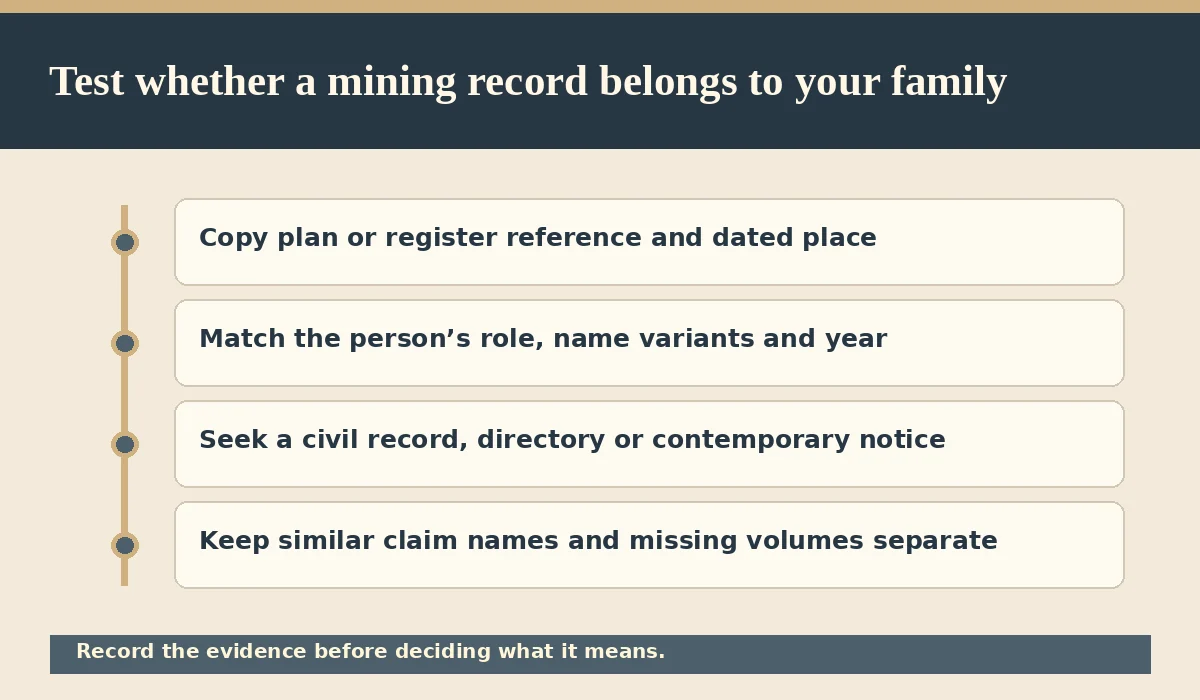
Cite claims, registers, and plans as different evidence
A reliable citation identifies Archives New Zealand, the originating Wardens’ Court, series and item code, record type, entry or plan number, date, and image or consulted location. Add a map number and survey details when the site matters. If you consulted a modern archival story illustrating a record rather than the record itself, cite it as a guide, not as firsthand evidence about your own ancestor.
Finish with a decision statement: what was recorded, which person is independently connected to it, whether the act was proposed or approved, and what remains unknown. For example, a claim-plan listing demonstrates a mapped application within its historical context, not the amount extracted or the long-term ownership chain. A well-specified next action might be opening a related register or searching dated civil events near the mining district.
How We Research Goldfields & Miners
We checked the linked sources on 2026-10-22. Source descriptions are not a substitute for inspecting a specific original manuscript. The worked identities are fictional and intended only to show how to test a record. Rights, fees, privacy rules, digitization and finding aids can change: recheck item-level conditions when requesting or reproducing documents.
More Records and Archives Guides
Original Archive Finding Aids for Goldfields & Miners
Archives NZ identifies regional Wardens’ Court indexes and registers and principal regional holding areas for goldfield records (www.archives.govt.nz).
Official Coromandel goldfields archival examples distinguish miners’ rights from ownership and identify claim-plan and mining-company-register examples (www.archives.govt.nz).
Archives NZ notes that Wardens’ Court records can be relevant to Chinese goldfields research while explaining record-specific migration context (www.archives.govt.nz).
This guide contains no affiliate links. Respect restrictions on identifiable living persons, sensitive allegations and copyright when researching or sharing historical sources. See the GenHis affiliate disclosure for our site-wide link policy.
Archives New Zealand holds them regionally, with major goldfield holdings in Auckland, Christchurch and Dunedin.
No. The Archives New Zealand Coromandel guide distinguishes rights to mine or prospect from ownership.
No. A plan locates the claim or application; residence needs separate evidence.
Surviving books can be incomplete; Archives New Zealand identifies missing early registers in a Coromandel example.
Compare court, date, precise claim location and role, then seek an independently dated family or residence record.