
Tasmanian Archives and Libraries Tasmania describe selected colonial census returns in the Tasmanian Names Index for years between 1837 and 1857. These records are not a complete named population census. Many original household returns did not survive, and the surviving material is commonly indexed under the householder. If you expect an entry for every child, worker or visitor in a household, you can be misled by a genuinely indexed head and otherwise unnamed tallies.
Understand what survived and whose name appears
The archives notes that surviving returns become more detailed from 1842. A record may contain residence, building material and household composition. Those features make the collection valuable for studying a household’s physical setting and approximate population, even when it cannot identify every occupant. Begin with the limited question the record supports: was a named householder present in a particular place on a documented return?
Search the Names Index by name and locality
Choose the census record type in the Tasmanian Names Index, then search surname variants and a plausible locality. Write down the indexed name, date, place and any archival reference. Re-run a wider search where a householder moved between parishes, an enumerator abbreviated a name or a spelling varies from a family Bible. Where a result provides a digitized image, use that image rather than making a conclusion solely from the display fields.
Libraries Tasmania lists householder census entries as incomplete for districts, and distinguishes their searchable index from original returns arranged by parish. If you do not find a name, check whether the parish and year have surviving material. A no-hit search among limited, surname-indexed returns is not a census statement that the person was absent from Tasmania.

Use CEN1 when the parish and year are known
The archives identifies Householders’ Census Returns for Various Districts, Arranged by Parishes, dated 1842–1857, as CEN1. This is a useful browsing path when the surname index is thin, the exact spelling is unknown, or neighboring householders may provide a geographic clue. Capture the parish and original page or image identifiers so that another researcher can retrace the search, even if the digital service later changes its display.
A chronological or parish grouping is a filing arrangement, not proof that adjacent entries share a family relationship. Check the return itself for a residence description, named head and the questions on that year’s form. Do not import columns from a modern census template. The relevant historical form determines which household attributes were actually enumerated and how its classifications were defined.
Read the dwelling and composition fields literally
Surviving returns can distinguish construction material such as stone, brick or wood, and may describe household make-up. A householder name is an explicitly written identity. Numerical counts are evidence about people at that location, but without additional names they cannot identify a specific spouse or child. If a return totals three women, do not choose three female relatives from your tree and treat them as the occupants.
Read the form’s sex, age or other categories from the actual return. Government categories reflect the period’s recording system and should not be treated as modern statements about identity. Record counts exactly as entered, check that subtotals reconcile, and annotate unclear marks separately. Distinguish a building characteristic or landlord from a family member; a material or occupant count does not establish ownership of the property.
Compare census observations with independent events
A useful cross-check is a land grant, rate record, parish baptism or contemporary directory from the same locality. Compare event dates rather than merely overlapping decades. The census may offer a bounded snapshot; a baptism may identify parents months later, and a deed might name a separate owner of the site. Each record supports its own claims. A person with the same surname next door may be a relative, but the census alone will rarely establish that relationship.
Write a two-column reconciliation: what the census states, and what the comparison states. Preserve disagreements in place-name spelling, household size and dates. If two households with the same head’s name appear, seek a trade, address, independent land reference or linked named record before selecting one. Use a cautious conclusion such as “plausibly the same household” when the available evidence does not support certainty.
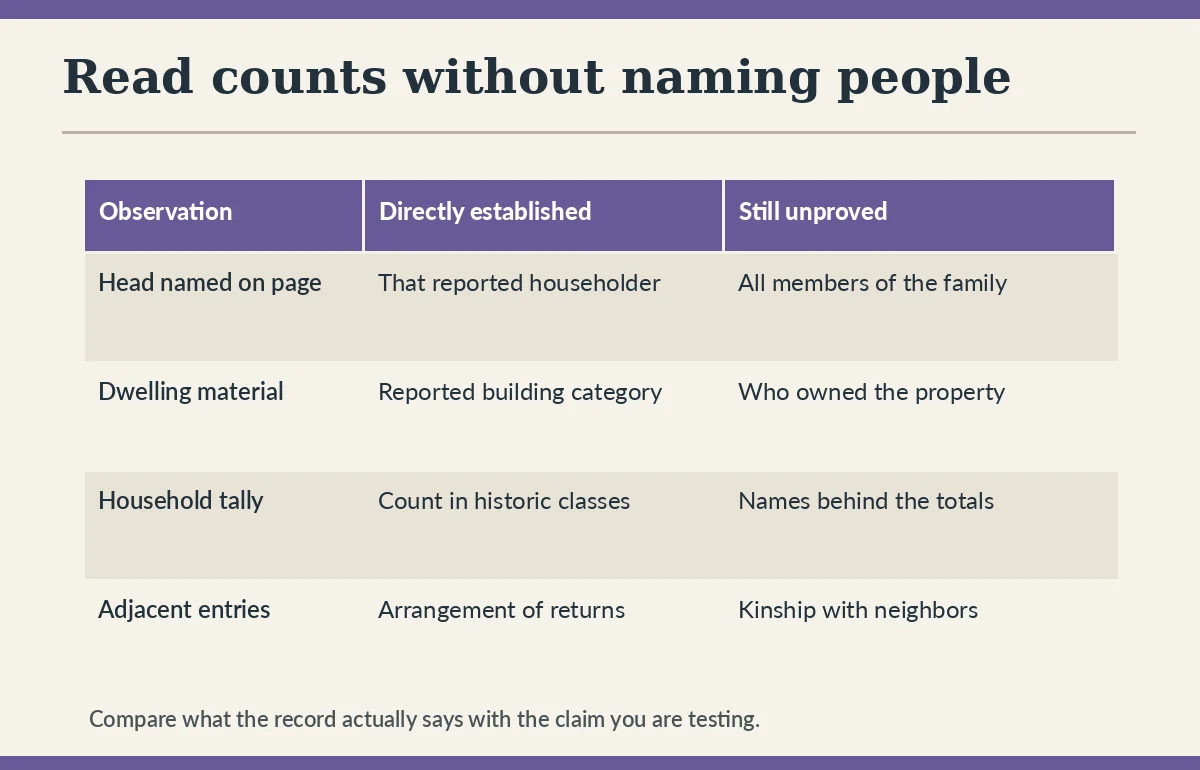
| Observation | Directly established | Still unproved |
|---|---|---|
| Head named on page | That reported householder | All members of the family |
| Dwelling material | Reported building category | Who owned the property |
| Household tally | Count in historic classes | Names behind the totals |
| Adjacent entries | Arrangement of returns | Kinship with neighbors |
Work a fictional householder-and-tally comparison
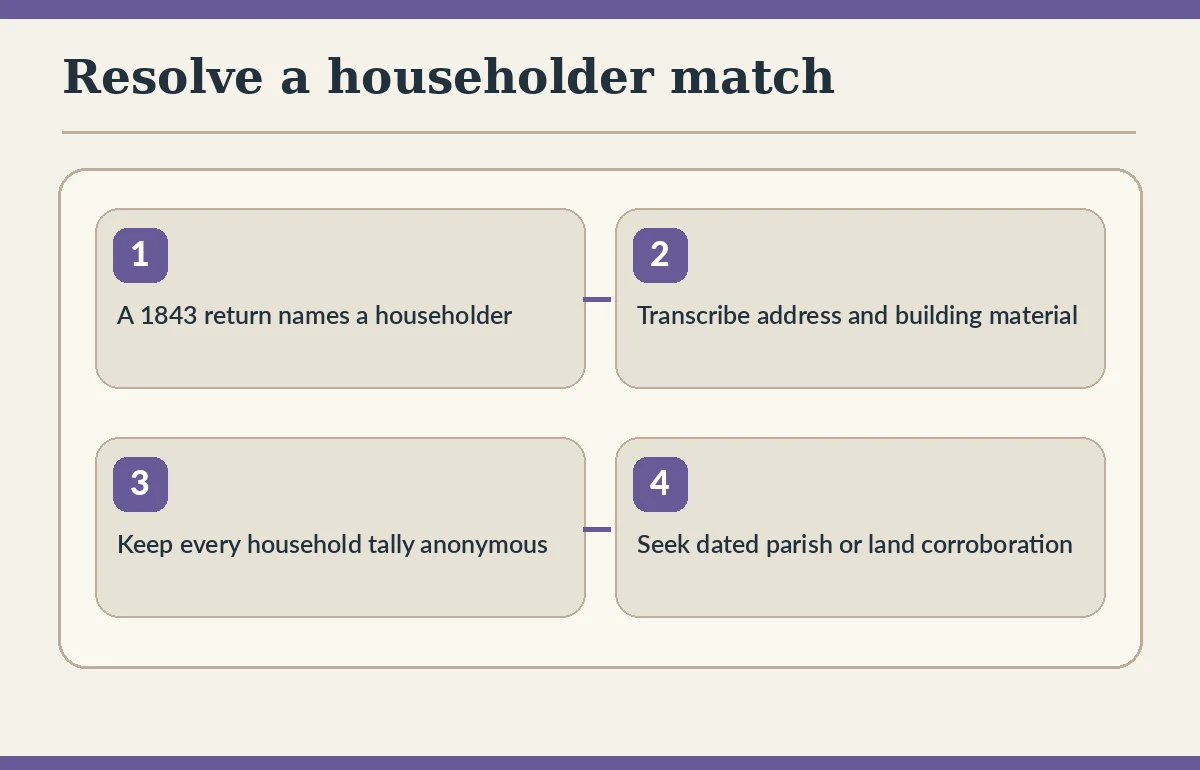
Imagine a fictional 1843 return naming Sarah Bennett as householder, with a wooden dwelling and a tally of five people. This is an illustrative example, not a historical transcription. Your family notes list a Sarah Bennett with a spouse and four children. The count is compatible, but it does not prove that those exact five people occupied the dwelling. It may count visitors, servants or different household members.
Next look for a dated baptism or land record naming Sarah in the same parish and compare a second census return if one survives. If the household’s 1848 tally changed, that fact alone cannot prove a birth, death or migration. Only a named and independently supported record can identify which person entered or left. The valuable output is an evidence worksheet with surviving observations and explicit unknowns.
Cite the exact return and acknowledge the gaps
A practical citation includes Libraries Tasmania or Tasmanian Archives, the census collection or CEN1 identifier when applicable, the parish, return date, name as recorded, page or digital image locator and date consulted. An indexed result alone should be described as an index result, especially when the original image has not been inspected. Keep spelling variants and negative searches in the same log.
The collection was created in a colonial context with classifications that may be intrusive or discriminatory; quote them accurately when necessary and avoid rewriting them as modern categories. Respect the distinction between named householders and anonymous individuals. In publication, a household sketch can be engaging while clearly stating the substantial uncertainty about unnamed occupants.
How We Research Tasmanian Census Records
We compared the archive’s own descriptions of this collection and its finding aids on 2026-10-22, mapped known time and coverage limits, and distinguished administrative observations from genealogical inferences. The worked names are fictional and explicitly illustrative. The steps describe how to verify a record rather than claiming we inspected an ancestor’s personal file. This guide is educational, not legal or professional archival advice; confirm access conditions and source images with the repository before relying on an individual record.
More Records and Archives Guides
Archive Collections and Finding Aids for Tasmanian Householders
Official descriptions of CEN1, selected returns and limited survival (www.libraries.tas.gov.au).
Official householder search guidance, dwelling details and census limitations (www.libraries.tas.gov.au).
Tasmanian Names Index collection scope for census records (libraries.tas.gov.au).
Editorial disclosure: This independently prepared research guide contains no sponsored recommendations or affiliate purchase links. View the GenHis affiliate disclosure for the site-wide link policy. Avoid publishing sensitive information about living people; copyright and archival restrictions may apply.
No. Surviving returns usually index householders and contain anonymous household counts; coverage is incomplete.
The Tasmanian parish-arranged Householders’ Census Returns collection for various districts, 1842–1857.
Original returns are lost for many places and years, and some surviving records may require place-first browsing.
No. A count establishes a reported number, not the identities of the people counted.
Identify the archive, collection, parish, census date, image or page and the exact wording observed.