
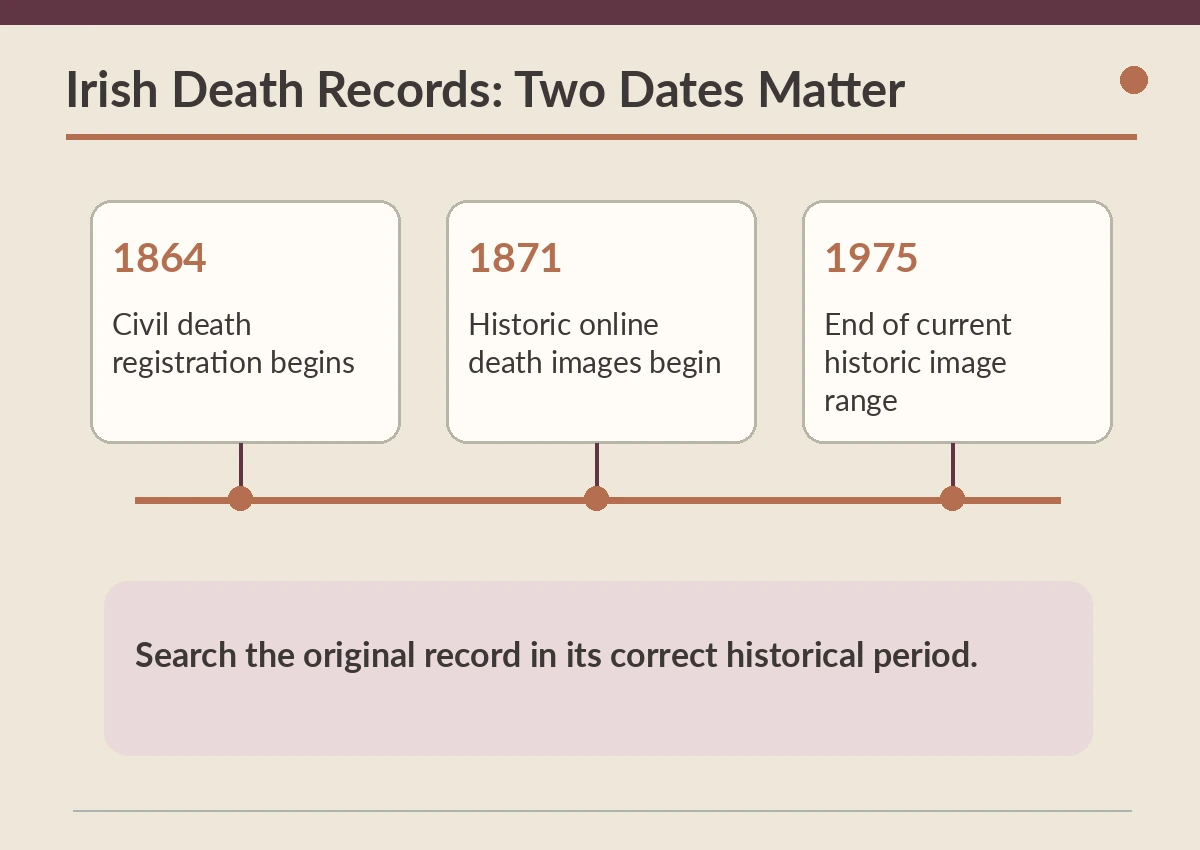
Civil death registration in Ireland began in 1864, but that does not mean every 1864 death register image is currently displayed online. The official IrishGenealogy FAQ gives the publicly available historical death-image range as 1871–1975 and says earlier death images dating back to 1864 are still being added. A searchable result can identify a registration, not necessarily an individual beyond reasonable doubt. The practical route is to note the year and registration district, inspect the full entry when available, and seek an appropriate copy if the image is missing.
Separate registration beginning from image availability
For an Irish death thought to have occurred in the 1860s, begin with the 1864 statutory-registration boundary, not with the modern online image date limit. Historical web coverage is explicitly described as deaths from 1871 to 1975 at the time this guide was checked. Earlier relevant registers can exist even though they are not yet offered as images. A missing online preview is therefore not a reason to replace the death date with 1871 or to assume the death was never registered.
The historical range also reflects public access policy and the site’s changing digitization program. Capture the exact coverage statement and the date you checked it; do not promise that a particular later year will appear permanently or that every historic page is flawless. For more recent deaths, lawful access rules are different. This article addresses deceased historical subjects and does not recommend bypassing restricted records or researching living people without a justified purpose.
Find a candidate through name, date and registration district
Use the official IrishGenealogy civil records search with several plausible surname spellings and a date window around the reported death. In Irish records, the district named on an index describes the civil registration administration, not necessarily the village or exact place of death. Copy the full index information, including the entry reference, age if shown, and registration district. Compare those details with the county or parish supported by other evidence rather than using modern county names as a substitute for historic registrations. Our guide “GRONI Death Records” covers a related question.
Try the spouse, child, informant or neighboring residence as a follow-up research clue. If several people share a name, do not select one merely because the district seems near a family town. Search a death notice, burial entry or probate index to obtain a second piece of identification. Earlier registration systems may contain spelling inconsistencies, and an index might omit details held on the image. Expand the date range if an exact date from an obituary produces no index hit.
Read the full civil death entry as separate claims
A complete historical Irish death registration can record date and place of death, name, age, occupation, marital condition, certified cause, the informant’s description and the date of registration. These are different facts, often supplied by different parties. Transcribe the cause of death carefully without presenting an old medical term as a modern diagnosis. Record the informant’s relationship or qualification exactly rather than converting it into a proven parent-child link.
For example, an informant might be a neighbor, hospital official or relative. An age at death reflects what was reported; it is not a birth registration. Occupation and address may be strong identity clues, but an index alone cannot reproduce the full wording. The government’s GRO search-room guidance explains how copies may be located when enough identifying information is available. Preserve the death date separately from its later registration date.

Route a missing original image to the correct next step
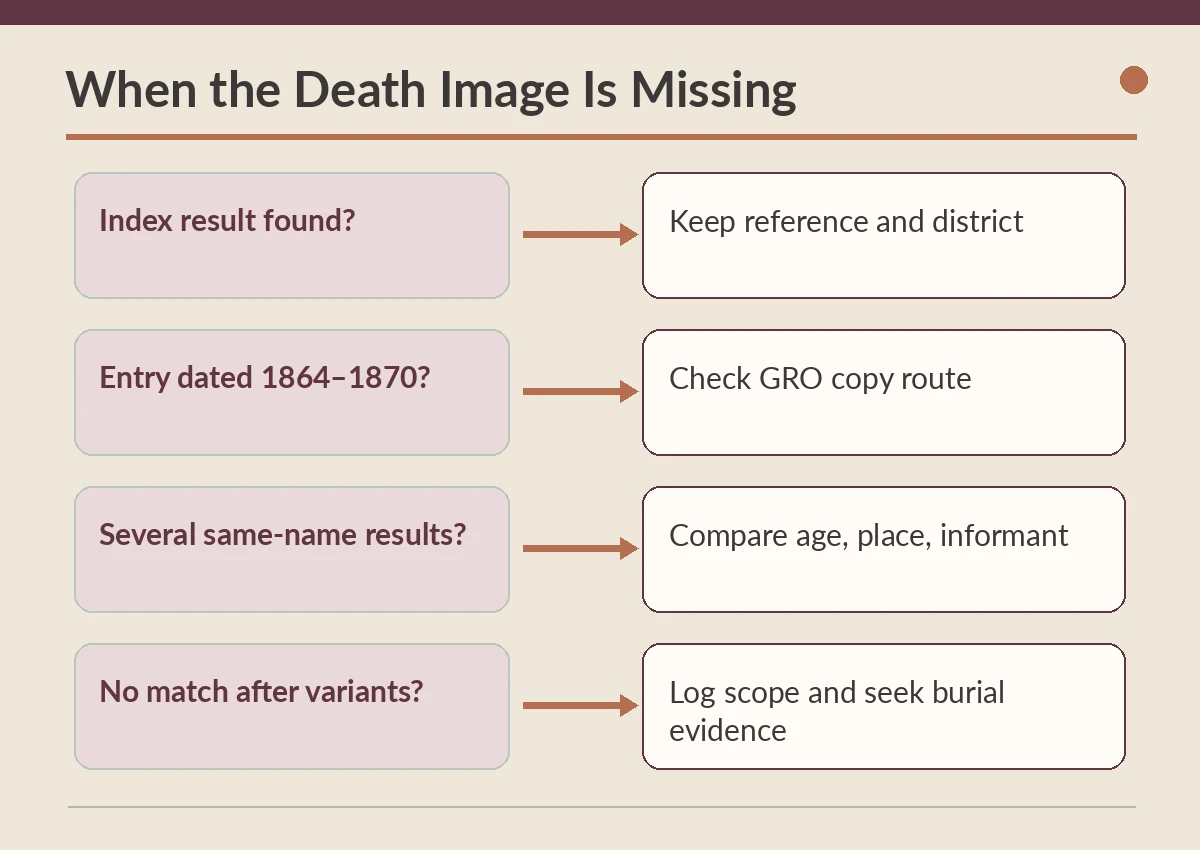
When a candidate death is in the 1864–1870 interval, first record the official image-coverage limitation; do not click randomly through unrelated years to manufacture an equivalent document. Search the civil index as far as it is available and capture all identifying fields. The General Register Office can provide research copies where a specific register entry can be identified. Requirements and fees can change, so check the current GRO instructions before placing an order.
If no matching index entry is located, verify you have the right registration district, historical administrative area and likely death period. Consider later or earlier registration, missing information and surname variations. Parish burial registers, newspapers, estate records or cemetery entries may point to the right locality, but do not confuse a burial date with the date recorded as death. Keep copies of the failed searches and the boundaries of each database searched. For a related choice, see our guide “Ayrshire Death Records”.
Test two same-name deaths without forcing a match
Create a simple comparison with three columns: claim, what the record actually states and independent record to check. In an illustrative case, two candidates named Patrick Murphy die in different districts in the same year. Age alone rarely settles the question. Compare occupation, marital condition, place of death and named informant against a city directory or an earlier census, then test which identity remains consistent. If both fit, leave both candidates open.
An old memorial may place a person in a family grave without proving that the civil death entry with a matching name belongs to that person. Conversely, a government death entry identifies a registered death but may provide imperfect family detail. Evaluate each claimed parent, spouse or residence separately. A well-cited uncertainty statement is more accurate than a fabricated precise death date or an invented ancestor connection.
Log the search and distinguish facts from inference
For each attempted lookup, write the search spelling, year range, district filter, collection, result reference, availability of a register image and the next source. If the image is present, cite the actual registration entry and your access path; if only an index is shown, cite that index as an index. Do not call an unviewed page a certified register transcription. If ordering a copy, store the order reference separately from evidence returned later.
Note that historic Irish civil registration spanned the island, while later jurisdictions and custodians can differ. Do not assume a particular modern office holds every record for every period. Start with the official online guidance, then confirm the creating registry for the historical locality. Negative evidence requires a demonstrably relevant and reasonably complete record set; gaps in digitization and index transcription prevent an absolute conclusion from a single unsuccessful search.
More Records and Archives Guides
How We Research Irish Death Registrations
We checked the government-backed IrishGenealogy coverage FAQ, civil-records help and General Register Office research-room guidance. We compared the legal start of death registration in 1864 with the currently displayed historical images beginning in 1871, and separate a searchable index reference from a full registered entry. The examples are methodological hypotheticals, not sourced biographies. We do not infer the identity of a deceased person from surname alone.
GenHis prioritizes government and institutional archive sources. There are no paid product recommendations in this guide; see our affiliate disclosure for our editorial and relationship policy. The procedures described here are reproducible research guidance, not evidence that any particular person has been identified.
No. It began in 1864. The official online historic death-image series presently starts in 1871, and earlier images are being added.
Not necessarily. It names an administrative registration area; the original entry can provide a more precise place.
Not reliably. Age is reported information and should be compared with birth, baptism and other records.
Consult the General Register Office’s current search-room and research-copy instructions, using a sufficiently precise index reference.
Compare date, age, occupation, place, informant and independent family or local records; preserve uncertainty if neither can be excluded.