
For Newfoundland family research, start with the three nominal censuses of 1921, 1935, and 1945. They can place people in a community and help compare family groups over time, but they are not the same as the Canadian Dominion census series. Library and Archives Canada points researchers to volunteer indexes and digitized collections, while the original returns remain at The Rooms in Newfoundland and Labrador. Search a community and year before judging a name match. A surname indexed in a neighboring settlement could belong to a different family, and the wording of historical identity categories should never be converted into an unverified modern personal label.
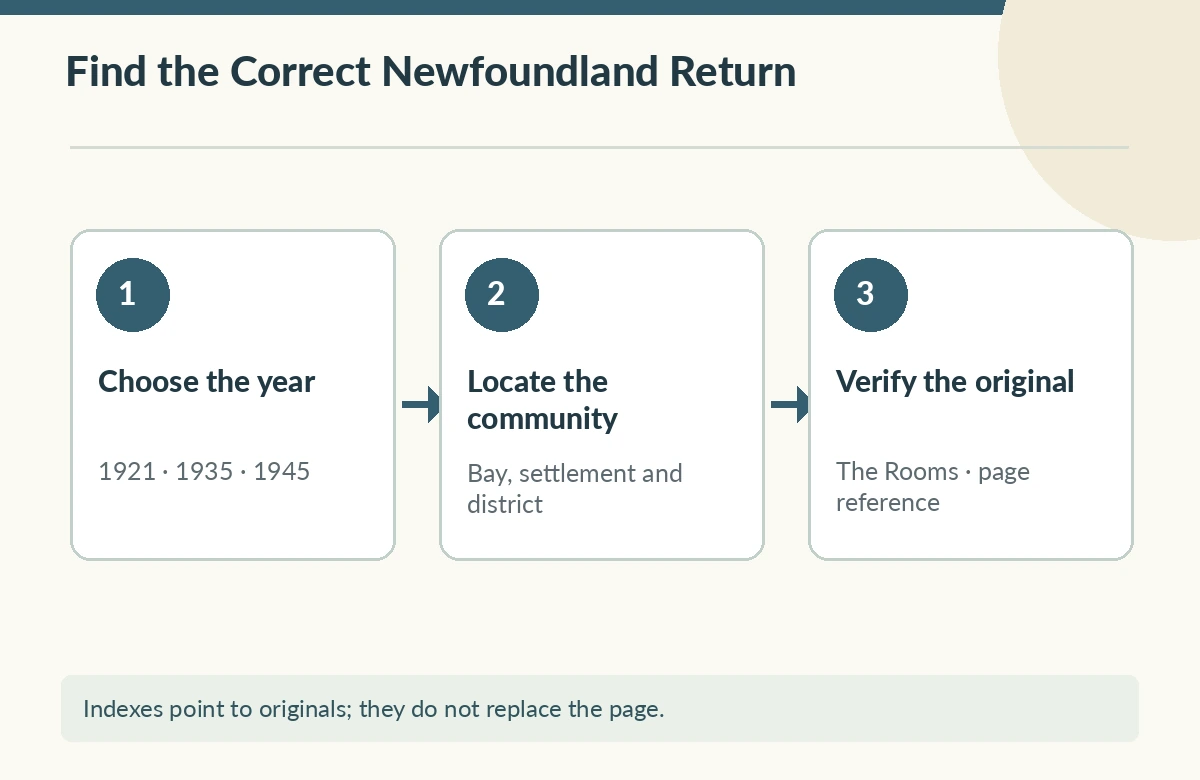
Choose 1921, 1935 or 1945 before searching names
Library and Archives Canada identifies 1921, 1935 and 1945 as Newfoundland census years and distinguishes the records from the Canadian censuses. A household found in 1921 can be compared with one in 1935, but a missing 1945 entry might indicate a different community, transcription issue or household change. Establish one target year and an approximate age or family grouping, then record all alternate settlement names. The dates are especially useful for evaluating reported ages and later changes in household composition. Do not insert a fictitious Canadian 1931 Newfoundland enumeration merely because Canada took a census in that year.
Identify the fishing community or settlement first
The Rooms recommends knowing where a person lived for its nominal census searches. Coastal geography matters: a small community may be indexed under a bay, island, district or changed settlement spelling. Use church, civil, fishing, directory or family correspondence evidence to find the likely community at the census date. Save alternate spellings and nearby place names, and note whether an ancestor might have been seasonally away. Searching the correct surname in the wrong harbor can produce plausible but misleading matches, particularly in communities where the same family names recur through generations.
Use volunteer transcriptions as a route to the original
LAC explains that volunteer indexing of the 1921, 1935 and 1945 returns is available through Newfoundland’s Grand Banks and that images may also be available via commercial and FamilySearch collections. Treat a transcribed result as a location aid. Write down the actual census year, community or district, household sequence and all names shown; then compare the original page whenever accessible. Transcribers may normalize handwriting, omit uncertain notations, or separate adjacent household lines incorrectly. A successful search is the beginning of the evidence audit, not proof that every indexed fact is accurate.
Ask The Rooms for the correct nominal census record
The Rooms preserves the original Newfoundland nominal returns and provides an archive request route for census searches and reproductions. A practical inquiry includes full name, specific 1921, 1935 or 1945 year, settlement, nearby district and any index reference already found. State whether you need a citation, image, official copy or assistance locating a community. Costs and copy procedures may change; consult the archive service rather than promising that a particular original is freely downloadable. Never request a copy by surname alone when a place and year can narrow the search.
Compare households rather than copying family roles forward
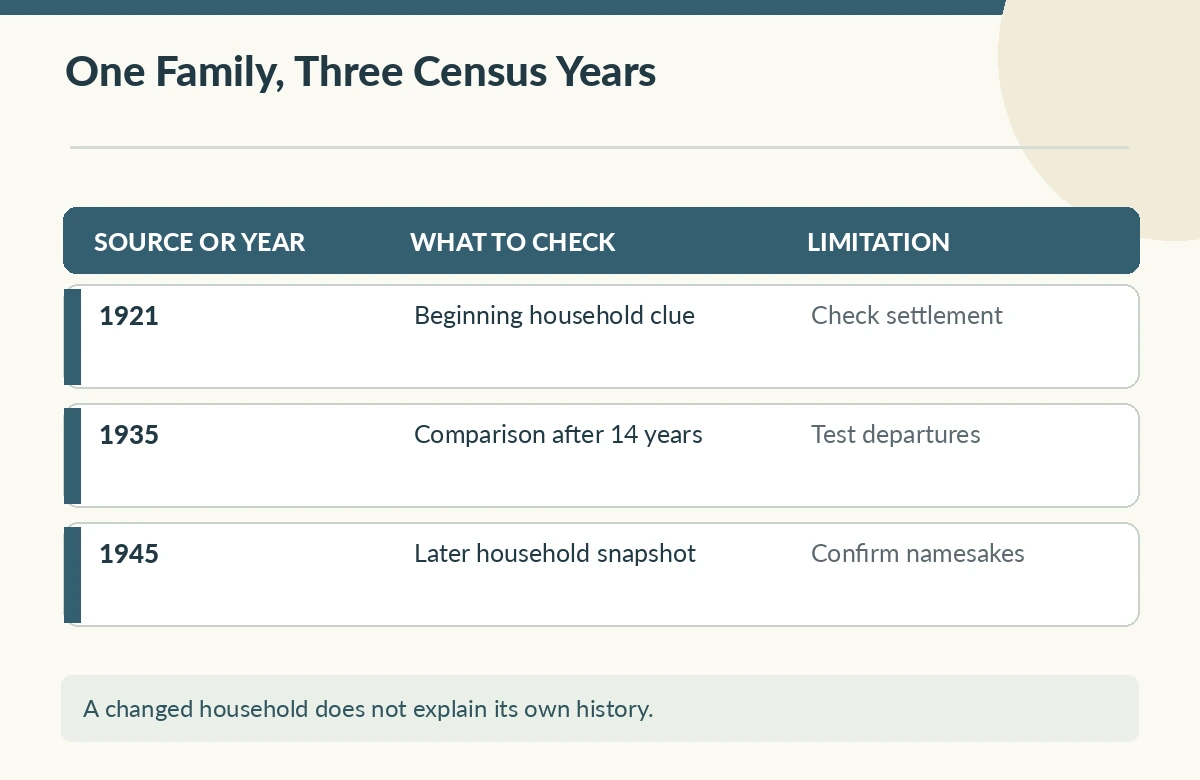
Transcribe each person listed in the target household, including variations in age and reported place, but do not assume adjacent names automatically indicate legal or biological kinship. A child shown in 1921 may appear in another household in 1935 after marriage or employment; a person with the same name may be a cousin instead. Create one row per census and preserve the year-specific evidence. When the age moves inconsistently between returns, look for baptisms, marriages, or burial registrations to test competing explanations rather than silently repairing the dates.
Handle historic Indigenous fields with care and context
The Rooms notes that the 1921 nominal census asked a question using a historic term for Mi’kmaq identity, the 1935 schedule sometimes used “Nationality,” and the 1945 return used “Racial Origin.” These are administrative labels in records of their own time, not reliable modern determinations of ancestry or membership. Record the original heading verbatim only where necessary for source analysis, note missing or inconsistent responses and do not infer an identity from an unexplained blank. Current community identity and tribal or Indigenous nation membership cannot be assigned by a census mark. For a related choice, see our guide “Alberta Historical Death Records”.
Know why Labrador returns follow different routes
LAC notes that Labrador appears in other historical Canadian enumerations, including a Labrador district within Quebec in 1871 and a Labrador sub-district in 1911. That history creates a jurisdiction trap when someone says an ancestor lived in “Newfoundland and Labrador” across several decades. Search by the actual census year and the administrative location used then, not the modern province label alone. If tracing a Labrador family, place earlier and later returns on a dated map and record the source jurisdiction in each citation. Do not treat absence from an island settlement index as a negative result for Labrador. A similar decision comes up in our guide “1831 England and Wales Census”, which explains how to find rare named local returns without false matches.
| Research question | Record-level test | Claim not yet established |
|---|---|---|
| Correct person? | Compare locality, dates and associates | Same surname means same identity |
| Record coverage? | Check year and exact archival series | No index hit means no event |
| Dates or status? | Preserve original fields and informant | One date explains every process |
| Family links? | Seek another independent source | Adjacent names prove kinship |
Use a year-by-year comparison to test migration
Imagine a surname recorded in a northern fishing settlement in 1921 and a southern port in 1935. Compare occupations if available, spouse or child names, approximate age, and evidence of shipping or employment before claiming a move. If the 1945 return has a similar household, note which details were recorded by the enumerator and which are later interpretations. A variation in name spelling can support further inquiry, but an identical surname does not establish that households in two communities are related. Record a next-search action for each unresolved link.

Cite community, year, source version and custodian
A reliable citation states Newfoundland nominal census year, community or district, page or household, The Rooms as original custodian, and the provider of the image or transcription actually consulted. For an archive staff copy, include the supplied reference and retrieval date. Keep screenshots or transcriptions separate from interpretation notes and do not republish restricted personal details unnecessarily. A meaningful unsuccessful search log should list years, community variants, collections used and whether the issue was no index result, missing image or uncertain local coverage.
More Records and Archives Guides
How We Research Newfoundland Census Records
We compared Library and Archives Canada’s general census guide with The Rooms genealogy and records-access information. We distinguish custody of originals, access through indexes or images, and historic census categories. The proposed cross-year identity checklist is a research method, not a claim that a specific named family has been verified. Direct research references: Archival research guide. Record coverage and access. Additional official instructions.
The archives and collection links here are research references, not sponsored endorsements. No paid service or unconfirmed affiliate arrangement is recommended. See our affiliate disclosure for site-wide details.
The principal Newfoundland nominal censuses used here are 1921, 1935 and 1945.
The original returns for those years are held at The Rooms; LAC describes where indexes and digital copies can be found.
Settlement spellings, district placement, handwriting and incomplete indexing can each affect results.
No. The labels are period administrative statements and should not be treated as independent determinations of identity.
The Rooms provides a nominal-census search and copy request route; include year, name and community.