
The 1864 Georgia militia enrollment lists are not the 1860 federal census and are not proof of Confederate military service. They are surviving enrollment documents for certain white males, generally ages 16 through 60, who were not already serving in Confederate or state forces. The Georgia Archives’ Adjutant General collection, RG 022-01-004, provides a district-first route to images. Start with the county and militia district, transcribe every stated field, then compare a candidate with independently dated residence and service evidence.
Identify the County, Militia District and Source Image
Georgia organized its 1864 survey under a state law passed on December 14, 1863, for reorganizing the militia. The Digital Library of Georgia identifies the creating office as the Adjutant General and its surviving records as RG 022-01-004. Search the collection by county, then district, rather than assuming its alphabetic order matches a modern surname index. A district number is a record locator, not a full address or an enduring civil boundary. Save the collection title and the district exactly as cataloged, including spelling and image identifier.
If you only have a common surname, reconstruct the person’s 1860 or 1870 county from independent evidence first. A county-based browse is often more useful than searching every possible John or William across the state. When an index or transcription supplies a name, return to the scanned enrollment page. Distinguish the clerk’s manuscript, a later card, and any modern searchable transcription; those layers can contain different errors and should not share an invented citation.

Understand Who the Law Intended to Enroll
The original collection describes an enrollment of free white males between sixteen and sixty who were not serving in Confederate or Georgia state military service. That limited population is central to any interpretation. An absent woman, child, Black resident, or currently serving soldier is not evidence of migration, death or avoidance of registration. Enslaved people were excluded by a racialized legal system, and these lists must never be used as a comprehensive household census or a representative count of everyone living in a district.
The age interval is an eligibility rule, not an assurance that every eligible man appears in every surviving image. Boundaries, record loss, reporting omissions, local circumstances, and a man’s status on the survey date complicate a negative search. Record an unsuccessful result as a search of a named county and specific militia district at a stated date. Do not write ‘he was not in Georgia in 1864’ merely because the index returns nothing.
Transcribe Age, Occupation, Birthplace and Exemption Exactly
A surviving row may provide the enrolled man’s name, age, occupation, birthplace, exemption or military-related remarks; the wording and completeness vary. Copy an age expressed in years and months without immediately rounding it to a modern birth year. Note whether ‘born’ refers to a state, county or other jurisdiction, and preserve the spelling in the document. An exemption can describe an occupation, disability or another locally recorded status. It does not necessarily explain what the man did during the remainder of the war.
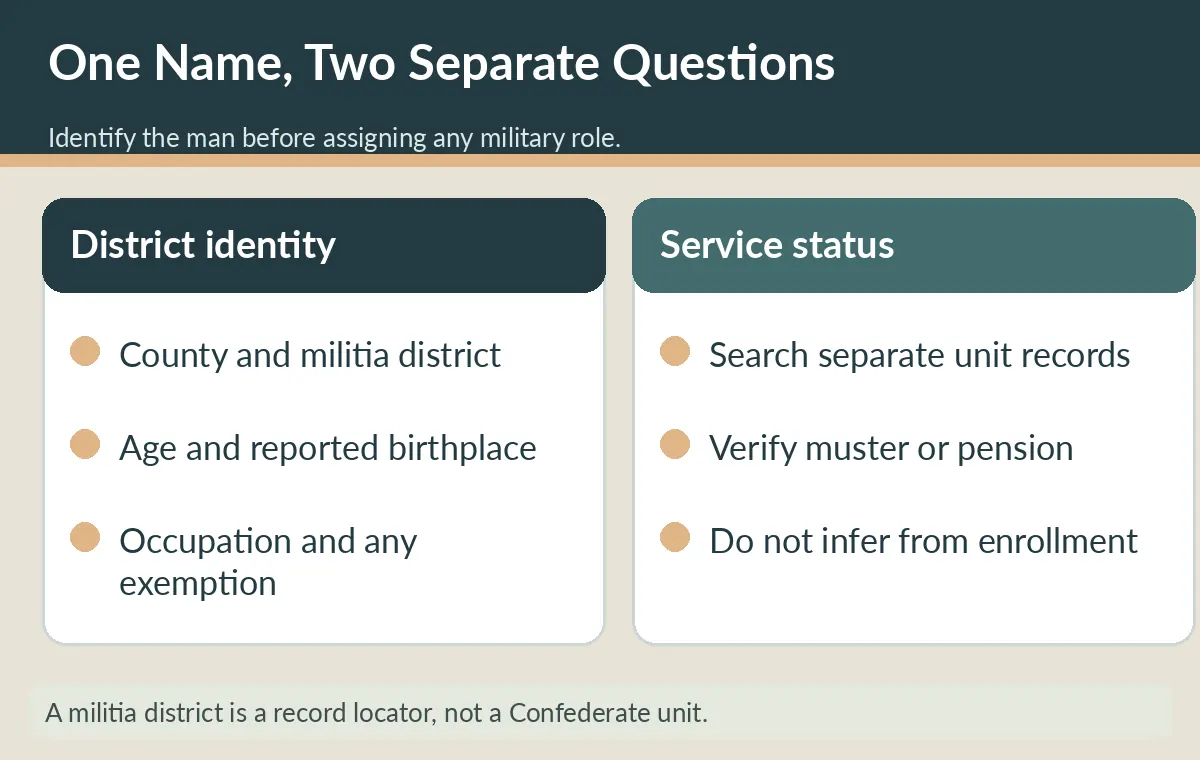
Make a two-column transcription: literal entry at left, proposed interpretation at right. For example, a person recorded as a miller and exempt should not be labeled an enlisted soldier or a proven noncombatant for the entire conflict. For two same-name residents, compare the precise age, birthplace and occupation before considering family associations. A different county of birth is a clue to investigate, not by itself conclusive evidence of a different person.

Do Not Convert Militia Enrollment Into Military Service
The enumerator’s purpose was to identify potential local manpower, not to certify campaigns, battles, ranks, enlistment dates or pensions. Even if an entry records a gun or horse, it describes a reported resource rather than an incident of combat. A man might have been enrolled but later exempted, might have served in another capacity, or might never have entered a formal unit. Separate each claim in your notes: ‘appears in an 1864 militia enrollment,’ ‘subsequently joined a company,’ and ‘performed a particular service’ require different evidence.
To investigate actual military participation, pursue original service, muster, pay or pension records with appropriate jurisdiction and unit details. The enrollment row may help distinguish namesakes, but do not infer a Confederate unit from the militia district alone. Preserve ambiguity about wartime choices and coercion. This collection was produced under a government defending slavery; its categories should be identified as those of the record-maker, not repeated as neutral descriptions of everyone in society.
Correlate a Georgia Candidate Across Three Dates
Build a dated comparison around 1860, 1864 and 1870. The federal population census may report a household and birthplace, the militia list may report occupation and age, and a postwar record may locate the family again. These records were created for different purposes and have different informants. Residence in the same county, a matching occupation and a plausible age collectively strengthen an identification, yet neither identical surnames nor nearby lines create a parent-child relationship.
A fictional example demonstrates the problem: two men called James Carter may both be listed in one county, but one is a nineteen-year-old laborer and the other a forty-eight-year-old farmer. A descendant’s 1870 farmer cannot safely be assigned the younger candidate solely by surname. Record both names, the exact district numbers, all conflicting details and a next check such as land tax, church register or probate file. Avoid claims about real people without the corresponding documents.
Cite the 1864 Original Without Inventing Coverage
The Digital Library of Georgia collection search identifies the repository and gives a path into the individual enrollment scans. A defensible citation names Georgia Adjutant General militia records, record group 022-01-004, year 1864, county, militia district, any officer or page marker actually visible, collection host and date accessed. If the page has an image-level ‘Cite as’ field, preserve that information rather than making up a roll number.
The official catalog’s scope statement is evidence for what was intended to be collected; it is not a promise of full state survival. Include a link to the GenHis affiliate disclosure for transparency; this research guide does not assert a commercial relationship with the Georgia Archives. A useful final conclusion may be ‘probable district match, service unproved,’ followed by the next specific service or household record you intend to check.
More Records and Archives Guides
How We Research This Collection
We used the Georgia Archives collection description and its DLG catalog and image-finding structure, noting the creator, eligibility rule, record group and individual district-level citation requirements. We did not claim to inspect a real ancestor’s entry, equate exemption with lifelong behavior, or treat excluded populations as absent residents. The namesake example is explicitly fictional.
No. It was a state militia enrollment conducted for a different legal and administrative purpose.
No. Enrollment is not the same as a verified muster, service or pension record.
The stated legal enrollment targeted free white males ages sixteen to sixty who were not already serving.
Keep the county, militia district, page or image identifier and RG 022-01-004 where supplied.
No. Verify district and name variants, eligible population and surviving record coverage first.