
Scottish ancestry research follows its own record system. Civil registration of births, marriages and deaths began in Scotland in 1855, distinct from the 1837 start in England and Wales. ScotlandsPeople, operated by National Records of Scotland, provides access to indexes and many record images for statutory registers, historic censuses, church records and other sources, subject to account, fee and privacy rules. For events before 1855, select the appropriate church tradition and surviving parish registers; for later events, begin with the civil entry. This practical guide identifies which Scottish source can establish an event and where its evidentiary limits lie.
Place the family on the Scottish record timeline
Start with an event date, locality and the spelling from your strongest source. Scottish counties, parishes, burghs and registration districts do not always map cleanly onto current administrative names. Identify where an event occurred at the time, then locate the correct registration district or ecclesiastical parish. A marriage certificate recorded abroad may say ‘Scotland’ without a parish; this is a geographic clue rather than permission to search every similarly named person as the same ancestor. Build a date range from independent records before opening a record portal.
Separate three questions: What document could directly record the event? What index currently covers that place and year? What additional source can test identity? A census may locate a household at an address; a statutory death entry may identify parents as reported by an informant; a baptism register may record an infant and witnesses. Neither document automatically proves that a similarly named person in another town is identical. Keep one research question per search and note the evidentiary strength of the result.
Search Scottish statutory registers from 1855
National Records of Scotland confirms that compulsory civil registration began in 1855. Search the statutory birth, marriage or death index through ScotlandsPeople using variants and age or place ranges. Depending on record date and service rules, an eligible image or official extract may be available, sometimes subject to charges. Do not equate a searchable index with a free original image; confirm current costs and closure limits on the official site. Examine the actual entry before asserting relationships, especially when multiple people share a name. If you want the full process, read how to find Irish ancestry records using civil, church, and local archives.
Record the registration district, entry number and year shown by the service. Birth entries may identify parents; marriage registers can reveal reported ages, prior status or parental names; death entries can contain useful family statements supplied by informants who were not eyewitnesses of earlier events. Field layouts change by year, and some data can be incorrect. Treat reported parents and ages as statements needing corroboration, not a guarantee of biological identity. A certificate may be precise about registration while uncertain about the family history it reports. Our guide “Ayrshire Death Records” adds more detail on this.

Choose historic church registers before 1855
The Old Parish Registers contain baptism, marriage and burial material associated principally with the established Church of Scotland. Their survival and detail vary by parish and period, and they cannot be assumed to cover everyone living in Scotland. A missing baptism in a parish index may reflect gaps, alternate congregations, illegible leaves or an incorrect estimated date. Locate the actual parish and inspect the register image, surrounding entries and book dates. Record a stated baptism date separately from a birth date if the register does not give both.
Scotland’s religious record landscape includes Roman Catholic and other non-established church collections with different custodians and survival patterns. ScotlandsPeople includes several church register categories, but not every possible denomination, parish or event is represented equally. National Records of Scotland provides separate guidance for Catholic parish registers and release restrictions. When family tradition suggests a denomination, use it as a search hypothesis rather than an identity test. For a pre-1855 marriage, also distinguish proclamations of banns from an actual ceremony where wording requires it. For the fuller picture, see our guide “Scottish Kirk Session Minutes”.
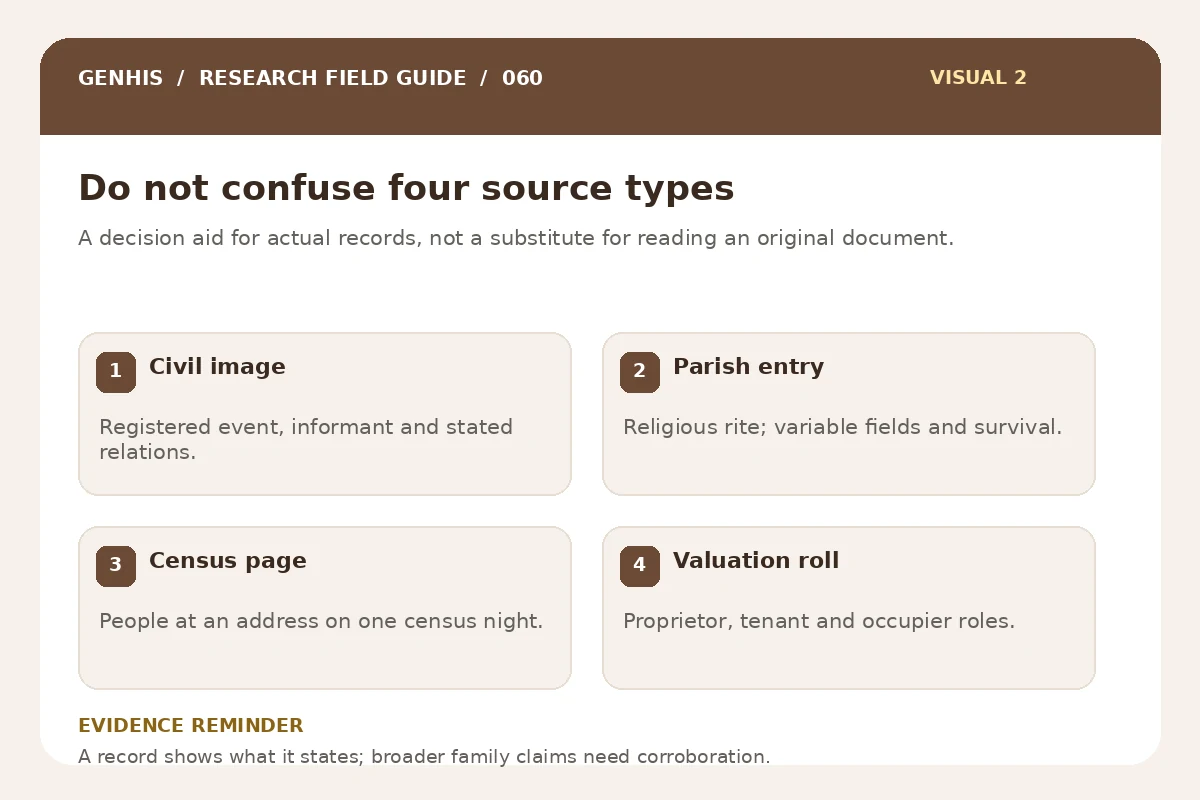
Use 1841 through 1921 Scottish census returns
Historic Scottish censuses from 1841 to 1921 are accessible in the ScotlandsPeople research system, with the relevant 100-year closure period for later returns. Search an approximate age, name and residence, then inspect the digital image and neighboring entries. The 1841 census generally rounded adult ages downward to multiples of five, though exceptions occur; do not turn one age into an exact birth year. Later returns provide more detailed birthplace and household fields, but written relationships are still information recorded at the time rather than proof of biological ties. If that is your next decision, our guide “Scottish Birth Registers from 1855” explains how to find parents and check original entries.
The 1911 and 1921 Scottish censuses should not be assumed to have identical image formats to England and Wales. National Archives guidance notes the Scottish returns were copied into enumerator books, not preserved as the same separate household schedules. If an apparent family disappears in one year, try spelling variants, nearby parishes, name diminutives, institutions and possible movement into England or overseas. A no-result screen is not a negative finding until the year, locality, name variant and survival limitations have been checked.
| Decision point | Recommended research action |
|---|---|
| 1855 onward | Begin with statutory civil registers. |
| Before 1855 | Search denomination-specific parish sources. |
| 1841–1921 | Use open historical census returns. |
| Known address | Test ownership or occupancy in valuation rolls. |
Switch to valuation rolls for address clues
Scottish valuation rolls can identify property, proprietor, tenant and occupier, making them useful when a household is known by street or village but hard to find by surname in a census. National Records of Scotland lists indexed selections from 1855 onward, with some years digitized; consult current ScotlandsPeople coverage rather than assuming every year is searchable. Capture the property description, year and all named roles. An occupier is not automatically an owner, and a rental relationship is not a family relationship.
Use a valuation address to formulate a testable link to a census household, death entry, trade directory or business record. If a property changes hands, seek an independent reason before assigning death, emigration or inheritance to the former named occupier. Spelling of streets and parish boundaries may vary over time, so consult maps and adjacent directories. A dated sequence can narrow search geography even when it does not independently name a spouse or child. Keep property and person evidence as separate citation lines.

Resolve a common-name Scottish candidate without guessing
Imagine two fictional women named Margaret Campbell born within five years of each other in different Scottish parishes. A statutory marriage record may narrow a candidate by occupation, residence or reported parent names, while an earlier census adds neighbors and household context. Do not select the first Margaret in a name index based solely on approximate age. Build parallel timelines for both, including conflicting clues, and look for a fact that distinguishes them, such as a spouse, witness, street or an unusual occupation.
Name changes, patronymic practices in earlier material, Gaelic and English language forms, and inconsistent spellings can widen the search. Do not force a Scottish person into a specific cultural or ethnic identity because of a surname, place or DNA percentage. A denomination given on one record may differ from later practice. The aim is documentary identification of a person across events, not cultural classification. If the two candidate lines remain equally possible, report the unresolved question instead of joining them.
Make a Scottish citation and plan the next lookup
For statutory registration, record the event, date, registration district, entry or record number, image and provider. For parish registers, capture parish, congregation or denomination, book span, page, event and image reference. For censuses, include census year, place, page or book reference and exact household details. For valuations, note year, property and the named role. An index hit needs its own citation if that is the only material actually examined; never label it as a register image you did not view.
Finish by selecting a specific record that can resolve uncertainty: a different parish baptism, the original marriage image, an earlier census neighbor or a property roll for a known address. Note missing coverage and current access rules separately. Preserve source screenshots only where terms permit and avoid sharing identifying data about people who could still be living. A documented Scottish family line should communicate direct statements, reasoned inferences and unknowns just as carefully as any other genealogical reconstruction.
How We Research: map dates, documentary scope, and uncertain conclusions
We compared 2026 National Records of Scotland research guides with the current ScotlandsPeople source descriptions for statutory records, church registers, census returns and valuation indexes. The Margaret Campbell candidates are hypothetical. Prices, eligible images and privacy dates must be rechecked with the custodian at the point of access.
Authoritative sources and collection-specific limitations
nrscotland.gov.uk — institutional source. National Records Scotland states 1855 start of statutory registration and custodial access.
www.scotlandspeople.gov.uk — institutional source. ScotlandsPeople categorizes statutory, church, census and valuation record collections.
www.scotlandspeople.gov.uk — institutional source. ScotlandsPeople gives 1841–1921 census dates, adult age rounding and search details.
www.nrscotland.gov.uk — institutional source. National Records Scotland details selected valuation roll indexes and named property roles.
nrscotland.gov.uk — institutional source. National Records Scotland describes Catholic parish register collection and closure periods.
More Records and Archives Guides
Privacy, disclosure, and responsible interpretation
Historic Scottish records can include ages, family statements and religious descriptions supplied by informants. They do not justify revealing modern relatives, genetic inferences or uncertain parentage as established facts. ScotlandsPeople and the Scottish archives are independent institutions; citing their services does not imply a partnership with GenHis. Read the GenHis affiliate disclosure for site policy.
Compulsory Scottish civil registration began in 1855; older event research usually uses church and related records.
Start at ScotlandsPeople, operated by National Records of Scotland, and check record type and current access rules.
Historical censuses for those years are available through Scotland’s People, subject to the applicable release and search arrangements.
Check record survival, an adjacent parish, alternate denominations, other dates and variants instead of assuming no baptism occurred.
They distinguish proprietor, tenant and occupier roles; read the actual entry and test title claims independently.