
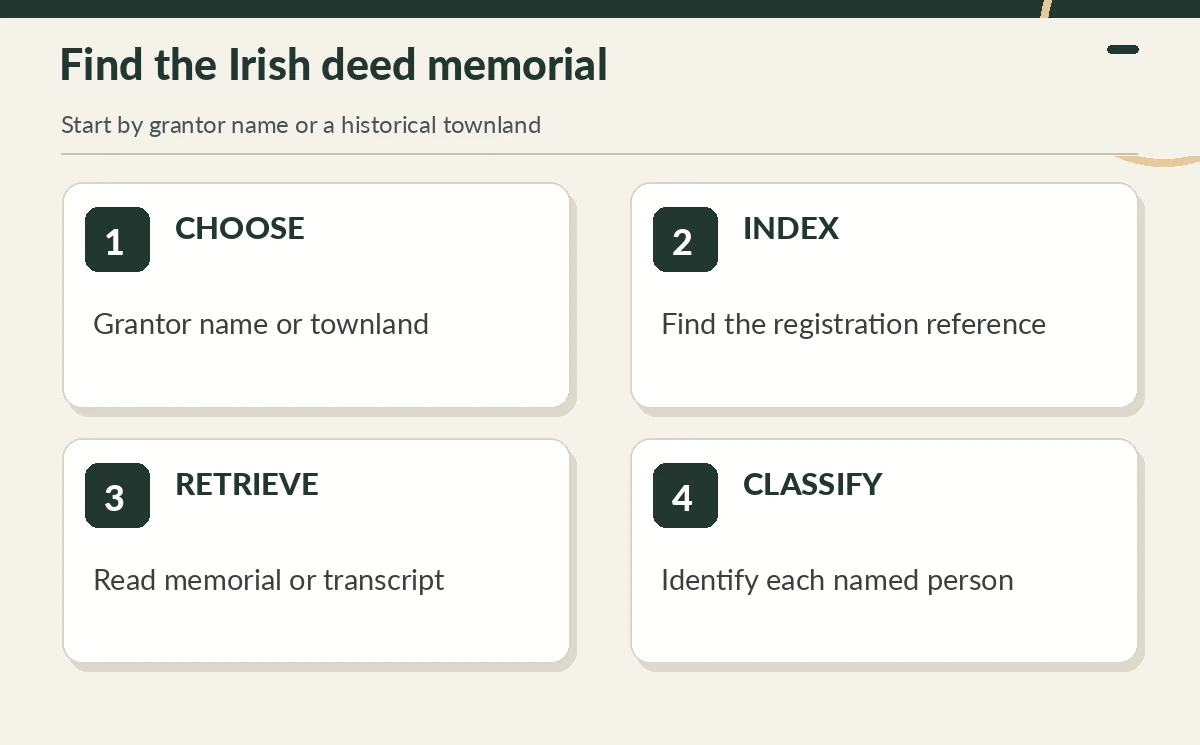
Irish Registry of Deeds records can expose names, relationships, tenancies and property transactions that never appear in surviving census returns. Registration began in March 1708, but not every deed was registered. Start either with the grantor’s name or with a known townland; find the reference in a Names Index or Lands Index, then retrieve the associated memorial or transcript. Crucially, a memorial is a registered synopsis of a deed, not the original deed and not automatic proof of the final legal effect of a transaction. Keeping these three levels separate prevents a promising property clue from turning into an unsupported family connection.
Know what a memorial records and what it leaves out
Tailte Éireann explains that a memorial summarizes the principal details of a deed submitted for registration. It can include parties, deed date, type of transaction and a property description. The Registry returned the original deed to the lodging party rather than retaining it. The associated transcript books contain clerks’ copies of the memorials. A useful family name could appear as a party, witness or named life under a lease, but the nature of that role must be read from the document, not guessed from name proximity.
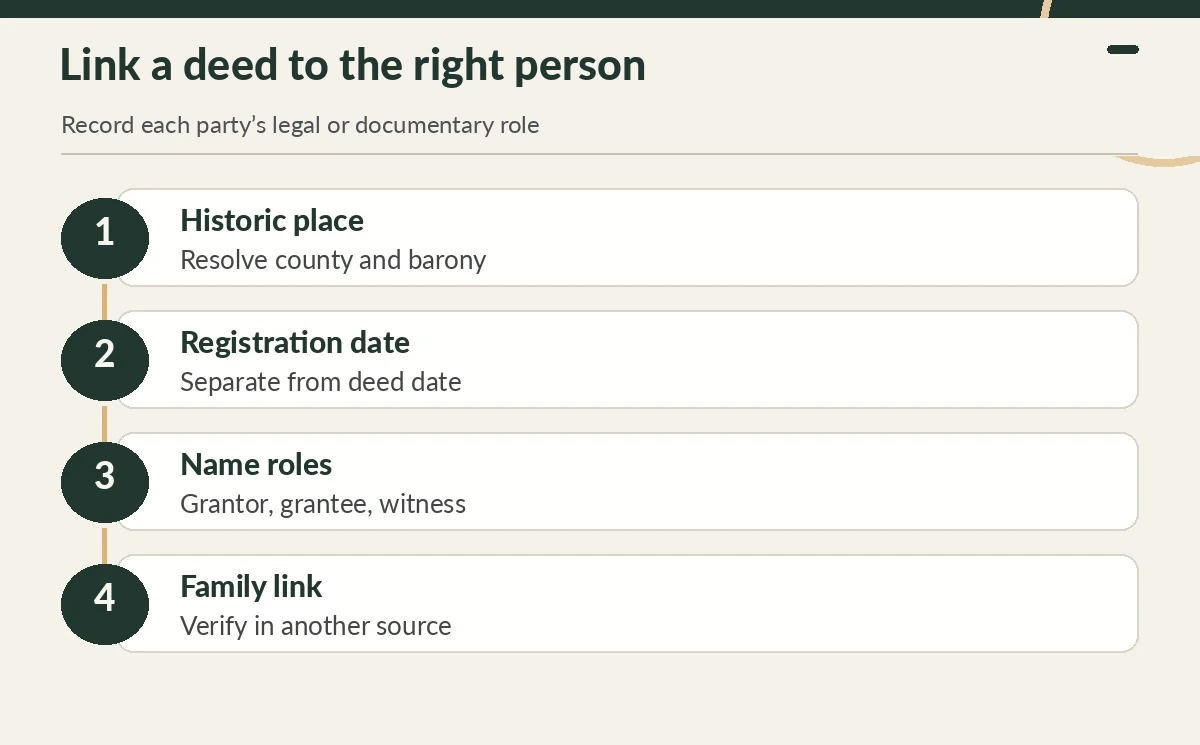
Registration was not compulsory in the original legal scheme. Therefore a person’s absence from the Registry of Deeds does not prove they never owned or leased property. The registration date can also be later than the actual deed date. Begin your note with two distinct fields, “date of deed” and “date registered.” An apparent gap in one year may belong to a delayed registration, so widen the search period and keep historical county and townland spellings.
Choose a Names Index search only when you have a grantor
The historical Names Index is an alphabetical index of grantors, meaning the people or entities disposing of a property interest. It is not an index of everyone named in a deed; someone receiving property, witnessing a deed or mentioned as a family member may have no standalone entry. When you know a plausible grantor, inspect the appropriate chronological index volume and copy the registration number as written. Search plausible first-name forms and spelling variants, but avoid assuming that a matching common surname identifies your ancestor.
Write down the grantor, any grantee shown, the date and all cross-references. For older entries a book, page and memorial number can identify the matching transcript. Check the complete three-part locator instead of relying only on an abbreviated note. If a grantor seems unlikely, test the geographical description and other named people against tax records, valuation material or an earlier lease. A namesake holding land across the county need not be the person in your own family tree.
Switch to the Lands Index for a known townland
If a place is firmer evidence than a surname, use the Lands Index. Tailte Éireann states that the historical indexes cover Irish registered property transactions from 1708 to 1946, with Dublin extending to 1949. For early volumes dated 1708–1832, start with the county and townland; for 1833 onward, follow county, barony and townland, or the city, parish and street for urban entries. A modern address can point to a different historical unit, so locate the correct barony before browsing.
Lands Index entries are arranged alphabetically only by the first letter of the townland or street name. Read the whole letter section, across multiple pages, rather than expecting a modern full-word alphabetical sequence. Record alternate historic names and check index continuation notes. If a line lists multiple parties or the abbreviation “ORS,” investigate the full memorial before asserting there were only two people involved. Boundary changes and delayed registrations are especially likely to produce false negative searches.
| Finding aid | Search key | Critical limit |
|---|---|---|
| Names Index | Grantor surname | Not all people in deed |
| Lands Index | County + townland | Alphabetized by first letter |
| Transcript book | Memorial reference | Copy of synopsis, not deed |
| Original memorial | Registered deed summary | Not proof of present title |
Retrieve the transcript and distinguish the parties
Use the number from the index to retrieve the corresponding transcription book or memorial. Transcription books cover registered memorials between 1708 and 1960. An abstract may help route searches for 1833–1969, but an abbreviated abstract is not equivalent to the memorial. Tailte Éireann states that the original deed was not kept by the Registry, so a copy of a memorial cannot replace an original conveyance in a legal chain-of-title examination.
As you read, classify each name as grantor, grantee, witness, named life, tenant, occupier or another role actually stated by the text. Look for descriptions such as “son of” only when the wording genuinely appears. A fictional example: a memorial mentions Thomas Kelly as a witness and Michael Kelly as a lessor. Their surname does not establish a brother relationship. To prove that link, find independent parish, probate or settlement material with a connecting statement.

Navigate free images, appointments and copying fees
Tailte Éireann reports that its records from 1708 to 1969 can be consulted by appointment at Henrietta Street, Dublin. As described in its current archive collections guide, inspection of an original memorial carries a stated fee, while other pre-1970 records can be consulted without that original-memorial inspection fee. Historical Names and Lands Indexes and transcript books to 1929 were also microfilmed and some images are available through FamilySearch, the National Library of Ireland and other repositories. Verify a particular online catalog’s viewing restrictions before travel or payment.
Do not assume a digital image means the entire record series is fully name-searchable. Many books require page-by-page browsing from an index locator. Tailte Éireann lists certified copying services, but fees can change, and copies for genealogical information are not automatically certified evidence of current title. Check the fee schedule and your intended use before ordering. Preserve a link and the archive’s formal reference, rather than pasting only an online viewer URL that may expire.
Build a property-and-person evidence chart
Use columns for county, historic townland, deed date, registration date, grantor, grantee, exact role, book, page, memorial number and unresolved questions. Compare an index result against the transcription, not another unverified online family tree. If a person appears in several deeds, put the transactions in chronological order and note where the party changes from landlord to tenant, borrower or witness. Do not infer transfer of freehold title from every lease or mortgage.
End by stating the narrow archival fact: a memorial registering a specified deed identifies particular parties and describes particular land. Then explain separately whether any genealogical relationship is proven by the wording. When the memorial does not establish the ancestor’s identity, search valuation revisions, parish registers, probate documents or estate papers. A no-result index search means only that nothing was found under the checked headings and years; it cannot certify that no deed existed.
How We Research Irish Registry of Deeds Memorials
GenHis starts with the official archival description and distinguishes an index, the original record and any inferred family claim. For this guide we examined the repository instructions, stated date coverage, available search fields, documentary limits and relevant historical terminology. The sample identity checks are hypothetical and not records of identified ancestors. This is historical research guidance, not a guarantee that every record survives, is indexed or is free to obtain.
More Records and Archives Guides
Official archives and collection guides for Irish Deed Memorials
Official record coverage, index types, memorials, transcript books and access (tailte.ie).
Also, official instructions for Lands Index arrangement, coverage and historical spellings (tailte.ie).
Official copying and search procedures and fee context (tailte.ie).
Editorial disclosure: This guide includes no paid recommendation or verified affiliate partnership. See the GenHis affiliate disclosure. Record holdings, image availability, access restrictions and prices can change. Verify them with the cited repository before ordering documents; protect information about living people and present uncertain family conclusions as hypotheses.
The first memorial was registered in Dublin in March 1708.
It is a grantor index; other named parties may not be indexed under their own names.
Use the Lands Index by historical county, barony and townland or street.
No. The Registry retained the memorial or transcription, while the original deed was returned.
No. Registration was not compulsory, and many historical transactions may not be indexed or preserved.