
CUST 111 is a useful starting point for an ancestor thought to have served in the Irish Revenue Police in the nineteenth century. The National Archives identifies these records with the period 1830–1857 and points to a name-search facility. A matching name can point to a record worth reading, but it does not by itself establish every posting, length of service or relationship to a family. The practical task is to identify the right officer rather than turn a plausible index result into an unbroken career.
Irish Revenue Police must not be treated as a synonym for all customs, excise or civil policing in Ireland. Before searching, write down the claimed occupation exactly as recorded in a census, marriage record, newspaper or family document. The National Archives guide to Excise and Inland Revenue officers separates the Revenue Police CUST 111 from Irish Excise appointments in CUST 110 and employment records in CUST 119. That distinction determines where a search belongs.
Choose Revenue Police or Excise before searching
A nineteenth-century source describing someone as a revenue officer may refer to different administrative arrangements. CUST 111 concerns Irish Revenue Police material, while CUST 110 covers Irish Excise appointments from 1824 to 1833 and CUST 119 contains employment, recruitment and dismissal records for 1824–1844. The date ranges overlap; they are not successive stages of one universal personnel file. Do not infer that an appointment in CUST 110 necessarily generated an entry in CUST 111.
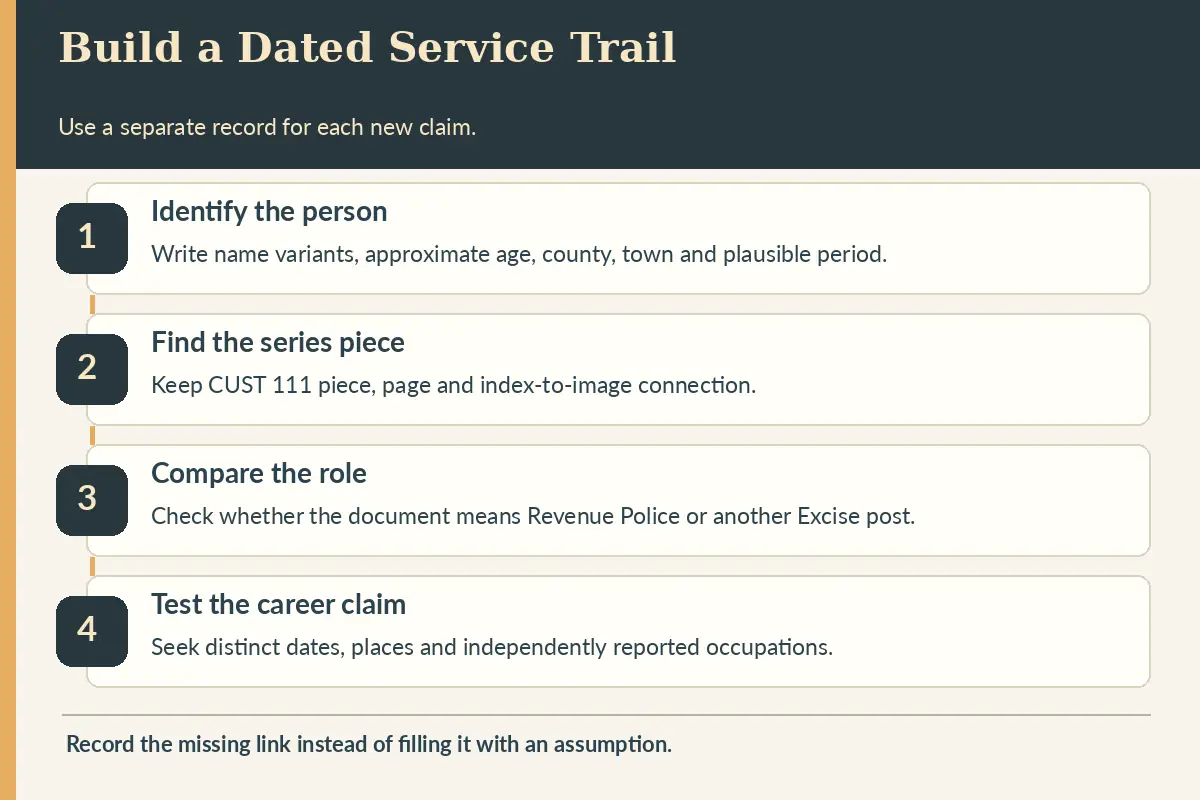
Make a three-column worksheet: the historical description of the job, the specific record sought, and what would confirm the identification. If an 1841 address names a particular county, keep that county as a test rather than silently converting it into a confirmed duty station. The same person may have moved or the family may have recorded a broader occupational label. A negative search in one series is not a negative search in the other.
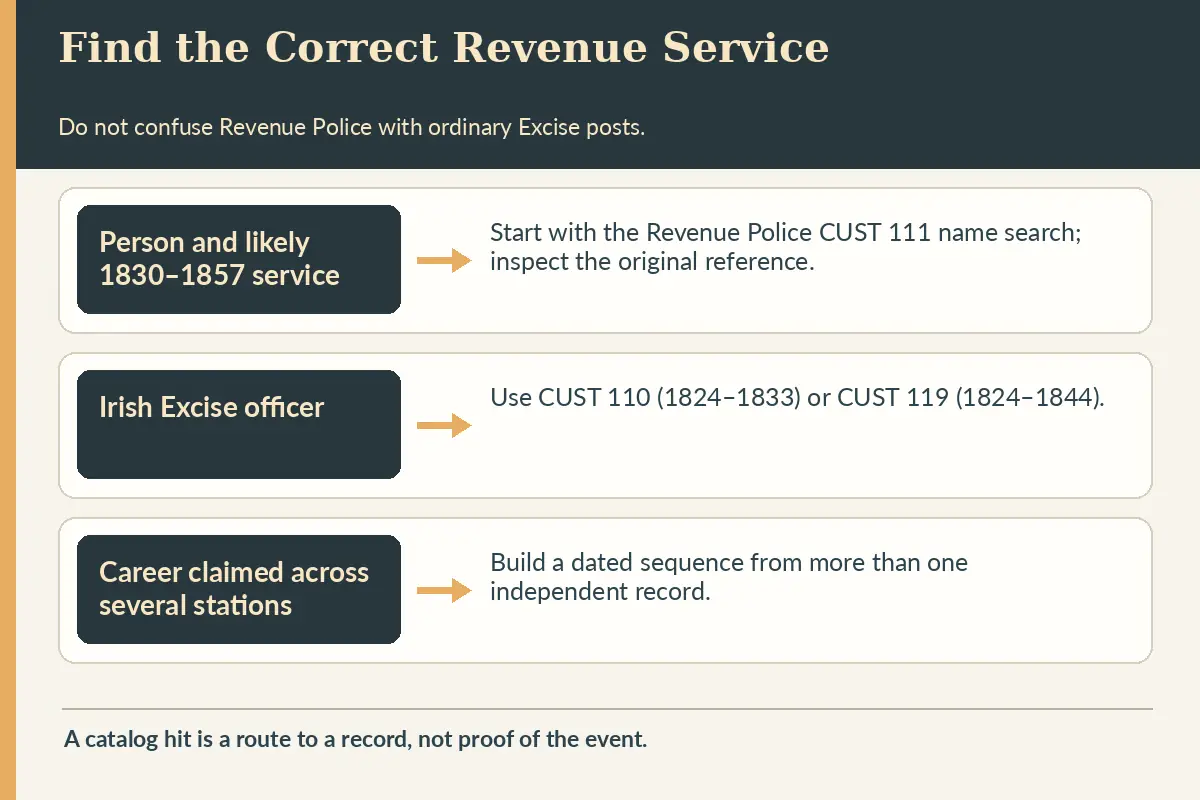
Start with the name index but recover the original
Begin with a surname and forename, spelling alternatives and a reasonable date window. The National Archives guide directs researchers to an online name search for Irish Revenue Police records, but different vendors may show transcribed fields, images or only index extracts. Note the source of each field: an original document, an index transcriber or your own inference. A derivative database result can contain errors, especially for Irish surnames or initials.
Save the full CUST 111 reference and, where available, a page, folio or frame number. Search Discovery for the archival context and check whether the entry is a series, piece or item. If the image is not directly accessible, record a precise request for a copy or a Kew visit. Never cite a database search-result page as though you inspected a manuscript that you have not seen.
Match an officer to a household cautiously
Suppose two men named Patrick Byrne appear in a search. A county association and nearby service year are useful but insufficient to merge them. Compare occupation as stated in dated civil or church records, age estimates, spouse or child relationships and any evidence of transfers. Write a conflict table, including contradictions: one man may have remained in another district when the second was reported at a station.
Police administrative documents can refer to a person by surname, rank or title with little family detail. A household source gives relatives and residence, but may not identify the employing department precisely. The stronger identity argument comes from independent records converging on the same date, place and occupation. If no distinctive attribute links the officer to the household, preserve the candidate as unconfirmed instead of choosing by surname frequency.

Build a chronology of postings, not a fictional résumé
Make each claimed career event a separate row: date as written, place spelling, document type, named officer, action recorded and complete citation. A promotion reference, disciplinary entry or pay mention may refer to different kinds of events. Even when an administrative record proves a particular posting on one date, it is not evidence that the officer stayed there without interruption. Do not fill a gap by drawing a continuous arrow across several unrecorded years.
To test movement, consult appropriate local newspapers, civil records, parish records and later pension or service materials as independent avenues where the individual and dates fit. TNA explicitly warns there is no universal index for the Revenue and Excise services. Keep an unsuccessful search log so a future researcher can distinguish a genuinely reviewed volume from a database that was searched only by one spelling.
Understand what a record gap means
The existence of CUST 111 does not imply complete nationwide coverage of every Irish Revenue Police officer. A record can be absent, incomplete, unindexed or inaccessible through the particular online search used. The exact survival and access conditions must be checked at piece level. It is unsound to turn “not found” into “did not serve,” especially when initials, transcription errors, transfers and departmental labeling may explain the silence.
A useful final finding distinguishes directly supported service from context. For example, state that a cited source places a named officer in an administrative entry on a particular date, while residence and kinship remain supported by separate civil or church evidence. If the two strands do not meet, say so. This honest limit is far more valuable than a highly polished but unsupported family story.
More Records and Archives Guides
How We Research and Verify These Records
We first review the National Archives research guidance for the collection’s official purpose, record ranges and known omissions. We then review Discovery search methods, which distinguish an indexed name from a piece description and an item actually examined. For a difficult claim we ask what an original document could establish directly and which different source would be needed to prove residence, identity, a decision or subsequent action.
Our diagrams are original editorial explanations, not reproductions of historical manuscripts. Dates are kept as stated by the archival custodian; uncertainty, gaps, and alternative searches are visible rather than hidden. Our affiliate disclosure explains the site policy. None of these archival routes depends on a paid endorsement.
The National Archives describes Irish Revenue Police records for 1830–1857; confirm dates for the specific piece.
No. Test county, time, occupation and independent family records before identifying him.
No. They concern Irish Excise appointments and employment; do not assume a one-to-one match.
No. Catalogue descriptions and name indexes vary; browse the relevant pieces and any original images.
Preserve CUST 111 piece, page or image detail, repository, date and the specific fact observed.