
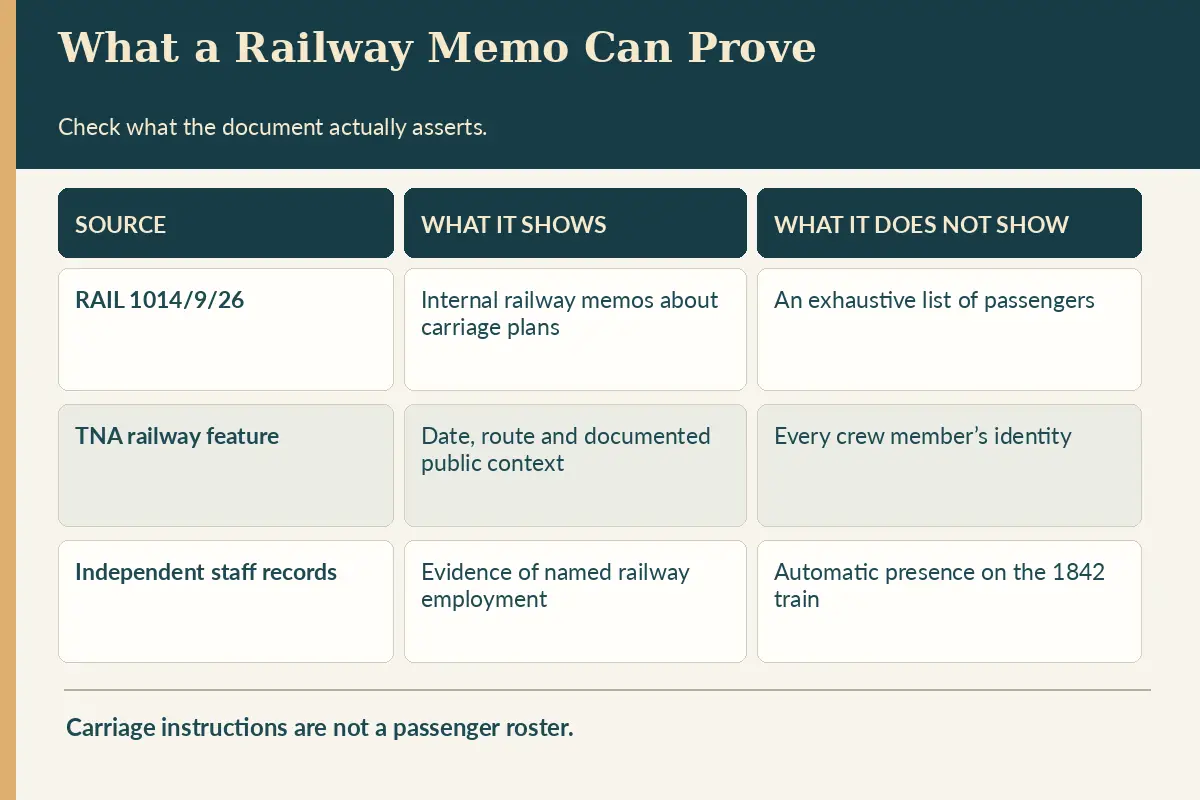
The National Archives identifies RAIL 1014/9/26 as internal Great Western Railway memoranda concerning carriages prepared for Queen Victoria’s first railway journey in 1842. This is an unusually precise case study for interpreting railway sources. The journey took place on 13 June 1842 from Slough to Paddington. The archive’s feature says the train was hauled by *Phlegethon* and that Isambard Kingdom Brunel rode in the cab. These points describe the event, but the memorandum collection is not a complete list of passengers, guards, porters or workers involved.
Read the National Archives railway collection feature for the named reference and historical context, then distinguish what the 1842 documents actually say from later summaries. A letter arranging a carriage may be dated before the journey. Its date proves correspondence was sent, not that the planned arrangement occurred unchanged.
Treat planning memoranda as evidence of plans
Internal railway letters can preserve instructions about special coaches, timing, station facilities, correspondence between managers and preparations for distinguished travelers. The provenance of those records matters: they were created to operate a railway, not to produce a complete social record of everyone present. Record the writer, recipient, date, purpose and any attachments. If a letter says a carriage was requested, report a request. A dispatch saying an arrangement was confirmed supports a stronger but still specific conclusion.
A descendant may have heard that an ancestor drove the first royal train. That claim cannot be established merely because a family member later worked for the Great Western Railway or lived near Slough. Separate three propositions: employment with the company, presence at a relevant station and participation in the journey. Each needs a contemporary or otherwise reliable source about the same person.

Reconstruct the journey with the correct chronology
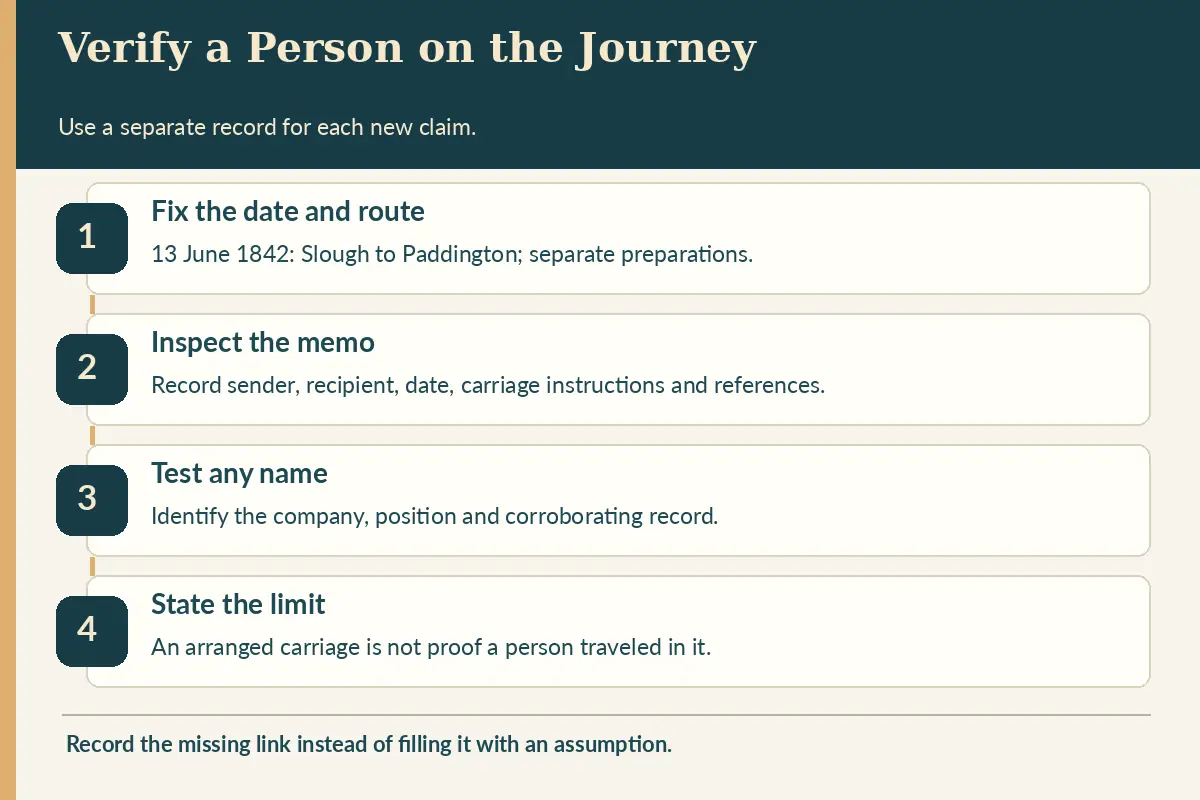
TNA records 13 June 1842 as the journey date and states that Queen Victoria boarded at Slough for Paddington. The collection feature gives the approximately 25-minute trip and identifies the locomotive as *Phlegethon*. Keep these event facts separate from each memorandum’s date. If a planning letter is headed 10 June and another is headed 12 June, those would be dated preparations, not independent evidence of travel on either day. Do not assign exact hypothetical memo dates without reading the originals.
Use a timeline with columns for document date, stated plan, event date and source. If sources conflict about minutes or carriage details, preserve their wording rather than force agreement. Railways were evolving rapidly, and a modern reconstruction may combine official records with retrospective reports or diaries. Label a retrospective account as such.
Separate the Great Western Railway from its employees
The TNA railway-workers research guide explains that surviving staff files are uneven and that the company, occupation and place of work are important search keys. A station worker recorded years later cannot be placed on an 1842 special service through employment alone. A family account may conflate the driver of the locomotive, a manager who planned the trip, a station official and someone who witnessed the departure. Their evidentiary routes are different.
Start with employment registers or other company records for the specific occupation. Search dated newspapers or station records for participation, and distinguish a printed honorific or role from the full legal identity of a namesake. If only the generic description “GWR employee” is documented, use that description. Precision about uncertain roles is better than a dramatic false certainty.
Verify named participants without manufacturing a roster
The archive’s overview names Brunel in the locomotive cab. It does not follow that every person employed by the railway appears in the archived memos. If the original papers do name an attendant or official, transcribe the name precisely and check context: a person receiving instructions is not necessarily aboard the train; a man ordering supplies may have worked in an office elsewhere. Compare documents made independently, not multiple summaries copied from one original.
The temptation to add the name of a driver based on a later popular account is especially strong. Treat any such claim as provisional until a contemporary document or a clearly attributed reliable history supports it. The researcher should be able to show whether the source directly states the individual operated the locomotive or merely suggests it by association.
Write a family or local-history account that can be checked
Cite RAIL 1014/9/26 in full and record the particular letter or page where possible. You may use a route sketch or timeline to tell the story, but label your diagram as an editorial reconstruction rather than a surveyed contemporary plan. Keep event facts, institutional correspondence and personal identity evidence in three distinct notes. When an image is a stylized illustration, never describe it as a scan of the original.
If you have an ancestor near Slough or Paddington in June 1842, the event provides strong local context but not proof that the individual watched it. A station entry, diary, payroll with relevant duties or direct named contemporary account would be needed to tighten that claim. Preserve unanswered questions as research targets rather than silently supplying plausible witnesses.
More Place and Jurisdiction Guides
How We Research and Verify These Records
We first review the National Archives research guidance for the collection’s official purpose, record ranges and known omissions. We then review Discovery search methods, which distinguish an indexed name from a piece description and an item actually examined. For a difficult claim we ask what an original document could establish directly and which different source would be needed to prove residence, identity, a decision or subsequent action.
Our diagrams are original editorial explanations, not reproductions of historical manuscripts. Dates are kept as stated by the archival custodian; uncertainty, gaps, and alternative searches are visible rather than hidden. Our affiliate disclosure explains the site policy. None of these archival routes depends on a paid endorsement.
13 June 1842, from Slough to Paddington, according to The National Archives.
Internal Great Western Railway correspondence about carriage arrangements for the royal journey.
No such claim is supported by the archive feature; read individual documents for what they name.
Not without direct name-and-role evidence linked independently to your ancestor.
The National Archives identifies Phlegethon; a full footnote should cite the archival feature.