
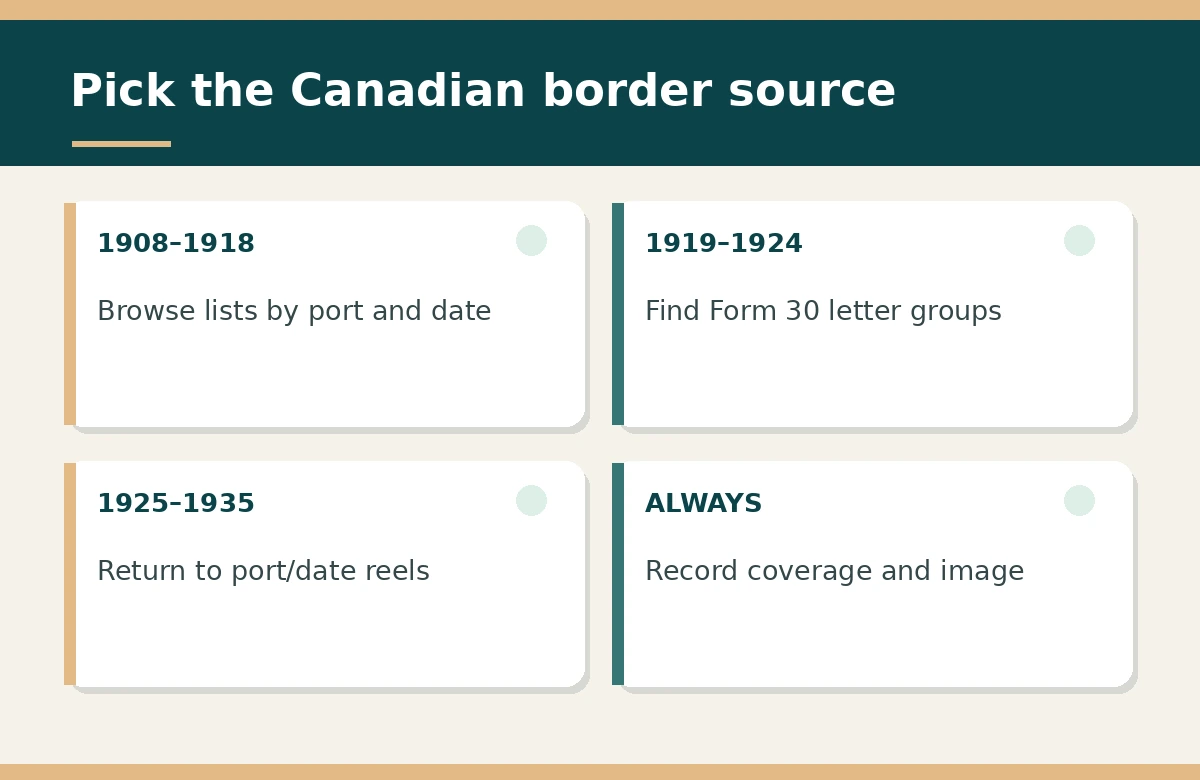
Canadian border-entry records cover selected arrivals from the United States into Canada beginning in 1908. The correct search strategy depends on the year: port-and-date lists for 1908–1918, individual Form 30 records for 1919–1924 and lists again from 1925–1935. Many records require browsing digitized reels rather than searching a name index, and a missing entry is not proof a crossing never occurred.
Separate land entries from ships and departures
Library and Archives Canada (LAC) identifies these border entries as records of people entering Canada by land from or through the United States. They are not a universal history of every journey or a Canadian outgoing-passenger list. A traveler arriving at Halifax or Québec by ship belongs initially in the passenger-list search; a person traveling by railway or road across the U.S. border belongs in this guide. Some families moved in more than one direction, requiring sources in both countries.
Before April 1908, the Canadian government did not systematically record these border entries. After that date not every crossing was registered. LAC cautions that the surviving material is only about 50 percent complete and describes exemptions and unrecorded crossings. The percentage is a coverage warning, not a probability that any named person must have a surviving form.
For 1908–1918, browse by port and date rather than demanding a surname result
The 1908–1918 records consist of border-entry lists, usually arranged by crossing point and date. Use family correspondence, a later census, a naturalization document or an employer record to narrow the entry route. Then locate the appropriate microfilm reel in LAC’s list and scan the digitized frames. A broad name search may miss these records because much of this material is not searchable by name in LAC’s current tools.
Column headings changed during these early years. Some forms include name, citizenship or birthplace, last address, occupation and destination; later versions may include travel or money details. Read the heading on the particular frame rather than copying values into a modern uniform template. An apparent destination is what the person reported on entry, not evidence they remained there for years.
For 1919–1924, use the quasi-alphabetical Form 30 sequence
LAC explains that individual Form 30 documents replaced the larger border-list sheets from January 1919 through December 1924. Forms are arranged in letter groupings that are not simply a perfect global alphabet; some frequent surnames receive separate groupings. Browse the relevant group and neighboring frames. A family may be represented by separate forms for adults and children, or children may appear on another family member’s reverse.
Many Form 30 microfilm images present the back of the form before the front. Pair both images using the filming order and matching identity fields. Do not attach a reverse simply because it is the next thumbnail. LAC reports that originals were destroyed after filming, so a faint microfilm image may be the surviving representation rather than a preview of an obtainable original.
| Source or period | What it can show | What it cannot prove |
|---|---|---|
| 1908–1918 | Border port and crossing date | Large entry lists |
| 1919–1924 | Surname-grouped microfilm | Individual Form 30 |
| 1925–1935 | Border port and crossing date | Lists; occasional early Form 30 |
For 1925–1935, return to port-and-date lists and check exceptions
In 1925 Canada returned to larger border-entry lists, again arranged chiefly by crossing location and date. LAC warns that some Form 30 records still appear in the first months of 1925. If a January–March candidate cannot be found on the list, check whether a Form 30 reel also applies. Use the historical port name and the specific date range, and retain the reel and image number once a match is located. If that is your next decision, our guide “St. Albans Border Crossing Records” explains how to find index cards and manifests.
LAC says only selected surnames in the 1925–1935 lists are searchable in its Collection search, particularly surnames beginning with C and some beginning with Z. A failed name-index query for another letter may only mean the record is unindexed. Third-party indexes may help discover a reel, but verify the image and list headings at the original custodial source.

Test identity across borders with a two-location timeline
Imagine a fictional family said to have moved from Michigan to Ontario in 1922. Form 30 is the first Canadian record type to seek, not the 1908–1918 port lists. Gather names, ages, earlier residence, intended destination and family companions. Then compare these claims with U.S. census residence, Canadian census or later civil records. A name alone is weak evidence where travelers have similar ages and common surnames.
For a person who alternated seasonal work in the United States and Canada, a border entry may describe one crossing rather than permanent immigration. LAC explains that some returning Canadians were excluded from registration. Treat blank fields and variants as incomplete information, not automatic proof of deception or a different identity. For each candidate, retain both the American origin and stated Canadian destination.
Write a no-result report that respects LAC coverage limits
Use a three-column log: time window and likely port, repository or reel searched, and exact outcome. Record whether you checked the appropriate type of record, and whether the year’s form has an index at all. Search nearby crossings only when the family geography makes them plausible. Avoid the sweeping conclusion that a person never entered Canada because a first-pass name search failed.
If the Canadian evidence remains absent, pivot to U.S. arrival lists, work histories, family letters, city directories or Canadian census schedules. A useful conclusion might be: “No entry was located in the consulted 1922 Form 30 grouping, but LAC warns of incomplete registration.” That sentence is much more accurate and reproducible than a false claim of no migration.

How We Research Canadian Border Entry Records 1908 To 1935
GenHis bases this guide on the listed original-archive research pages and documented descriptions of the collection. We checked the period, repository arrangement, terminology, access limitations and the distinction between an index or transcript and the original manuscript. Fictional examples are used only to demonstrate method; they are not real archival citations. We do not claim to have opened a named ancestor’s record, and all conclusions require independent identity verification.
More Records and Archives Guides
Official repositories and primary collection guides for Canada Border research
LAC era-specific arrangement, limited completeness, microfilm browsing and Form 30 rules (canada.ca).
LAC field changes and descriptions of different border entry forms (bac-lac.gc.ca).
Canadian maritime arrivals and differences from land crossings (canada.ca).
Editorial disclosure: This educational archive guide contains no paid recommendation or verified affiliate arrangement. See the GenHis affiliate disclosure. Historical records may contain outdated or discriminatory language; report it as an attributed historical statement, not a present-day judgment. Costs, accessibility and indexing may change, so confirm current conditions with the institution before requesting records.
Many LAC records must be browsed as digitized microfilm; index coverage differs by period and surname.
Form 30 generally recorded land immigrants individually from 1919 through 1924, with some forms extending into early 1925.
No. LAC reports substantial gaps and unregistered crossings; document the exact records searched.
For 1908–1918 and again for 1925–1935, the principal organization is crossing port and date.
No. They are entries into Canada; consult other jurisdictions for evidence of later departures.