
Norway’s 1865 census was taken on December 31, 1865. Searchable entries can connect a person to a farm, clerical district, occupation and household, but similar farm names and changing patronymics can produce false matches. Start in Digitalarkivet with the person and historical location, inspect the underlying census forms and reconcile the main property-level list with the detailed individual list wherever both are available.
Fix the census date and the old Norwegian locality
The National Archives’ scanned 1865 census uses December 31, 1865 as its reference date. Begin with a known town, parish or farm in that period rather than a current municipality label. Rural records are often organized through county, clerical district, parish and farm; urban records can follow streets and buildings. Historical administrative divisions changed, so a town name inherited by a modern district may direct you to the wrong census book.
Keep the original Norwegian spelling of each place in your notes, even if you use an English map for orientation. A family can be entered under a farm name that later became a surname, moved to a neighboring farm or appears with a spelling variant. The locality is a critical second identifier when given names and patronymics are common. For the next step, our guide “Norwegian Parish Registers” explains how to read ministerial books and clerk copies.
Search Digitalarkivet with a deliberately wide first pass
Digitalarkivet’s 1865 search interface offers personal criteria such as first and last name, occupation, birth place and family position, along with residence and property fields. Begin with only the strongest facts: a given name, an approximate age or birthplace and the likely county. Then narrow by residence or occupation. Do not enter a fixed modern family surname if an ancestor may have used a patronymic or farm designation.
An alternative transcript search from the University of Tromsø historical registers includes farm name and birthplace and reports nationwide transcription for 1865. This can rescue entries missed by a single search implementation. The two online search tools do not represent independent historical witnesses when they describe the same original enumeration; treat a second index as a way to find the image, not corroboration of the facts on it.

Connect the Hovedliste to the named Specialliste
The census materials include a Hovedliste (main list) summarizing buildings, households or farm-level counts, and a Specialliste (individual list) naming residents and their characteristics. A property-level tally is not itself a full roster. Follow the district or special-list number and farm or place label from the main list to the detailed sheet. Compare the household count with the visible people before assuming an index shows every resident.
FamilySearch’s collection description notes that the forms can include age, marital status, occupation and birth place, while rural records also collect agricultural statistics. Do not transfer the farm’s livestock or acreage figures into a claim that one indexed person owned the farm. An enumerated farm or residence is a locality claim; legal title or tenancy requires deeds, assessments or other separate evidence.
| Source or period | What it can show | What it cannot prove |
|---|---|---|
| Hovedliste | Buildings, farms and totals | Not an individual list |
| Specialliste | Named residents and details | Not a deed or pedigree |
| Church register | Birth, marriage or movement event | Independent event check |
Compare family position with actual kinship evidence
A household entry can distinguish family position or relationship terms, but these are census descriptions and may not prove biological parentage. Read everyone on the page, including laborers and visitors, and transcribe any terminology whose meaning might change in translation. Different household numbers on the same farm can represent distinct domestic units, so do not join all nearby names into a single family automatically.
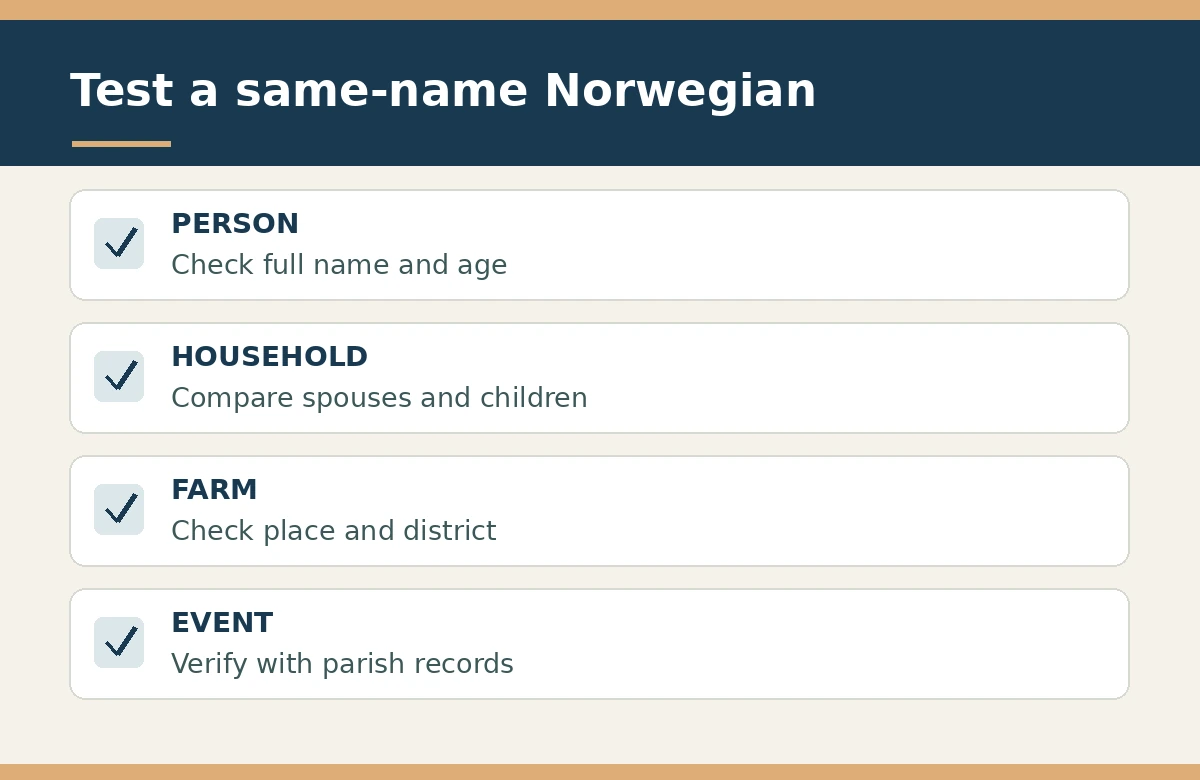
For a fictional example, suppose two Ole Andersen entries both report birth around 1835. One lives with a household in a coastal parish and works at sea, while another lives on an inland farm. Their common name is a weak match. Check the original birth parish, spouse or children, work, household position and later church records before choosing either one as the target ancestor.

Use birthplaces and farm names to build a migration hypothesis
A person’s reported birthplace can point to a different parish than the place of residence. Treat it as the next parish to search, not a full proof of movement or a birthplace certificate. A farm name in the 1865 list may describe where the person lived in 1865, not a fixed inherited surname. Compare moving records, baptismal books and later 1875 or 1900 censuses to reconstruct an individual timeline. For a related choice, see our guide “Denmark 1845 Census”.
Record a chain of locality references: 1865 census county, clerical district, parish, farm, household and person; then birth and marriage registers with their own identifiers. If the census birth year differs slightly from a baptism record, keep both statements and consider the reported age’s precision. Never change a person’s birth parish only because a different-index spelling makes the search faster. For the fuller picture, see our guide “Norway 1900 Census”.
Close with an image-based citation and one remaining question
The Digitalarkivet search hit and the scanned enumeration are related but different objects. Save the permanent image or transcript link, the enumerated parish or district, the farm or address, household or person position and your access date. Where only a transcription is available, say so. A complete citation allows a second researcher to read the historical writing and audit your interpretation.
If no match appears, run a locality-first browse through the scanned 1865 source, then try name variants and nearby parishes. Do not claim nonresidence simply because a surname search failed. Write down which geographic units and variants were searched and decide whether the next step should be parish baptism registers, a moving record or another named census.
How We Research Norway 1865 Census Digitalarkivet
GenHis bases this guide on the listed original-archive research pages and documented descriptions of the collection. We checked the period, repository arrangement, terminology, access limitations and the distinction between an index or transcript and the original manuscript. Fictional examples are used only to demonstrate method; they are not real archival citations. We do not claim to have opened a named ancestor’s record, and all conclusions require independent identity verification.
More Records and Archives Guides
Official repositories and primary collection guides for Norwegian 1865 research
media.digitalarkivet.no — Norwegian National Archives scanned 1865 census and enumeration locality structure.
digitalarkivet.no — Digitalarkivet person, residence and property-based search fields.
rhd.uit.no — University of Tromsø historical census database: 1865 full transcript and farm-name search.
1865 census main list, special list and form-field context (familysearch.org).
Editorial disclosure: This educational archive guide contains no paid recommendation or verified affiliate arrangement. See the GenHis affiliate disclosure. Historical records may contain outdated or discriminatory language; report it as an attributed historical statement, not a present-day judgment. Costs, accessibility and indexing may change, so confirm current conditions with the institution before requesting records.
The census reference date was December 31, 1865.
Yes. Digitalarkivet and historical census tools offer place or residence search fields; preserve spelling variants.
The Hovedliste summarizes a property or place, while the Specialliste contains individual population details.
No. A farm is a residence or locality clue, not sufficient evidence of kinship.
Inspect its scan or underlying source locator and compare with independently recorded parish births, marriages or movements.