
The 1865 New York state census can connect a named household to separate postwar marriage, death, and military information. Search one locality, inspect each surviving schedule, and test the identity with other dated sources instead of treating all schedule entries as one proof.
Why the 1865 return is more than a headcount
New York took a state census shortly after the Civil War. The population schedule identifies individuals, and additional schedules collected a variety of information, including marriages, deaths, and military matters. FamilySearch describes ten schedules filed for localities, but researchers should not assume that every type is accessible for every county today. A census page can locate a household; a separate marriage or death entry can create a new lead. Treat each schedule as its own document, with its own questions, coverage, reporting interval and information quality. One name in one schedule does not automatically establish an event in another. For a related choice, see our guide “Jersey Marriage Registers”.
Find the 1865 locality before judging a name index
Anchor the search to a town, ward, or county using evidence from a military document, directory, tax roll, the 1860 federal census or a church record. Write down boundaries as they were at the time. Search a household head and then other members, since spelling and handwriting can produce indexing errors. A county’s presence in a search interface does not guarantee that every town, subdistrict, page or extra schedule survives. The New York State Library offers a county-by-year microfilm availability table that can help narrow an offline or browsing search. Our guide “1925 New York State Census” adds more detail on this.
Transcribe the population page as a group
Locate the actual manuscript image, then copy each person in the household in sequence, not only the indexed target. Capture the original place and page identifiers, the person’s written name, age, birthplace and occupation where legible. Where a relationship is not stated or is ambiguous, do not supply a parent-child claim from a modern tree. A household may include servants, apprentices, extended kin or boarders. Note neighbors and other same-surname households as separate candidates. These details can distinguish two families of the same name when the index offers little beyond a surname.

Use the additional schedules as separate questions
The 1865 enumeration can lead to returns relating to events and military service, but each additional series needs an exact description. For a suspected marriage, ask which schedule covers the locality and the reported interval. For a death, compare the person’s age and residence with a burial or probate record. Also, for military service, treat a state-census notation as a lead to military files rather than a substitute for an original service or pension record. Do not assume someone served merely because their family lived in a town that supplied a regiment.
Understand the year-ending-June reporting window
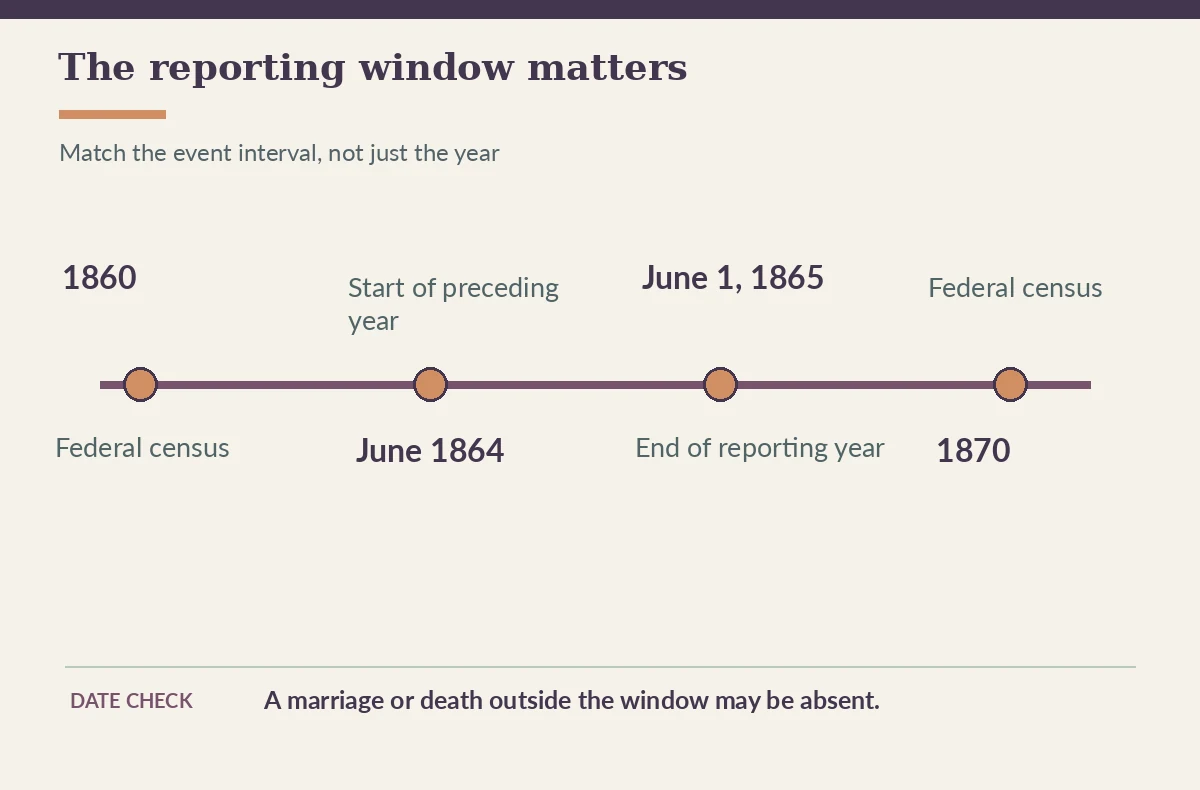
A marriage or death schedule associated with the 1865 census is tied to a specific reporting interval, not to all marriages or deaths in 1865. Guides describe the preceding year ending June 1, 1865. If the event you seek occurred outside that interval, a nonappearance may be entirely expected. Some events may also have been overlooked or reported incorrectly. Record the schedule’s printed instructions when available; do not infer the precise event date from a retrospective index label. A church register or civil record may supply a different date and more precise information.
| Source question | Archive evidence | Important limit |
|---|---|---|
| What is available? | Population household | Marriage or death |
| What is not proved? | Military clues | Needs separate independent evidence |
| Next useful search | Read original page or register | Cite the exact locality and item |
Check county survival and original custody
The New York State Library emphasizes that original pre-1915 state census manuscripts are held at county level, not at the State Library itself. Surviving microfilm and online images are access paths to those documents, not evidence that every original exists. Use the library’s county table and contact the county clerk or relevant custodian if a page appears missing. Some 1865 records have been destroyed. Label a confirmed record loss differently from a negative search in an incomplete surname database. If the locality is unknown, trace it first in other dated records.
Use 1860 and 1870 to test household continuity
The 1860 and 1870 federal censuses bracket the state enumeration, but they do not provide a guaranteed straight-line family history. Track the same people with age ranges, births, occupations and neighbor clusters rather than a strict one-year arithmetic rule. If an adult disappears by 1870, a death schedule may be relevant only if the person died during its reporting interval. War service, remarriage, migration or a changed household arrangement are competing hypotheses. A deliberate comparison should list what each return actually says and what document could distinguish the alternatives.
Keep military service notes from becoming identities
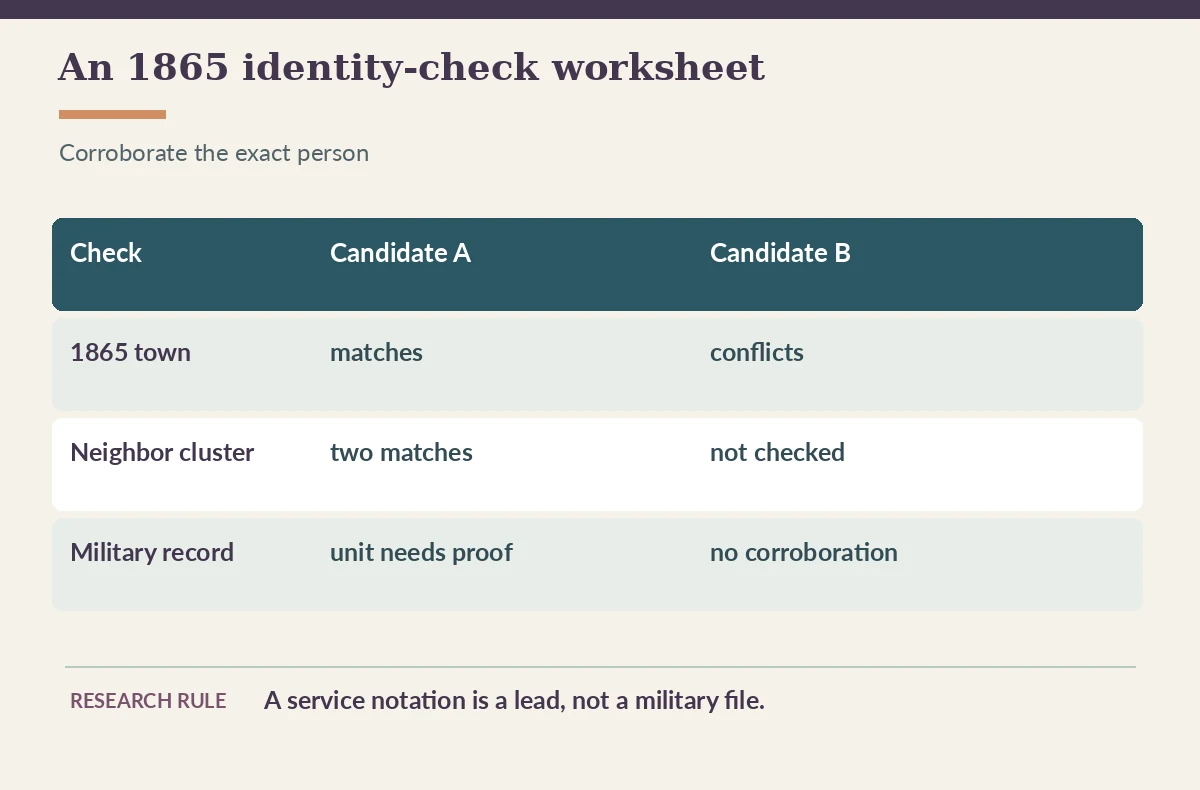
More than one person of the same name could have served in the Civil War. The census may point to a branch, enlistment locality or reported service, but your next step is a relevant muster roll, compiled military service record, discharge or pension application. Check age, residence, unit and relatives, where present, and keep Confederate or Union categories tied to the correct repository and source. A schedule notation can be inaccurate or secondhand. If a soldier is named as deceased, investigate death evidence separately instead of treating an unverified index association as a casualty report.
Build a source-specific proof table for competing candidates
Create one row for each candidate household and columns for town, spouse, named children, occupation, neighboring family and independent source. Insert exact page citations and mark conflicts explicitly. The decisive factor might be a distinct neighbor or trade rather than an age that varies by two years. The supplemental schedule adds a separate observation, not a second vote proving identity if both entries derive from the same informant. If the only link is a common name, leave the claim unresolved. Search nearby households, church records and land records to test where the household actually lived.
Preserve a retrievable 1865 New York census citation
Record state, year, county, town or ward, schedule type, page or image, household or entry, repository and online collection used. Cite the population schedule and each supplemental schedule separately. If the online result includes a name-index spelling that differs from the page, preserve both. Keep access restrictions and apparent gaps in a research log with the date and search parameters. For the next action, select a concrete unresolved question—marriage date, soldier identity, death or residence—and identify the independent record most likely to answer it.
More Records and Archives Guides
How We Research 1865 New York State Census
We used the New York State Library county census table to check local availability and custodianship before following the FamilySearch 1865 collection into supplementary schedule descriptions. A reporting interval for marriages and deaths is not the same as a year stamped on a website. The schedule comparisons in our illustrations are research scenarios; no military assignment or family link is asserted as a discovery. Image pages, county clerk holdings and search filters must be checked for a specific town. This independent source-selection discussion contains no affiliate partnership. Read our affiliate disclosure.
No. It was a New York state enumeration taken between the 1860 and 1870 federal censuses.
No. Records and supplementary schedules have uneven survival; check the specific county and town before asserting coverage.
It may report an event within the year ending June 1, 1865, but check the original entry and corroborating church or civil record.
No. It is a clue that should be tested against a military service, pension, or discharge record.
The New York State Library says originals are held at county level; library microfilm and online images are separate access routes.