
Wisconsin’s 1875 state census names household heads and tallies unnamed residents. It is useful for placing a head in a community, not for proving which spouse or child was counted. Compare the manuscript with person-level federal and later state records.
What the 1875 Wisconsin return actually names
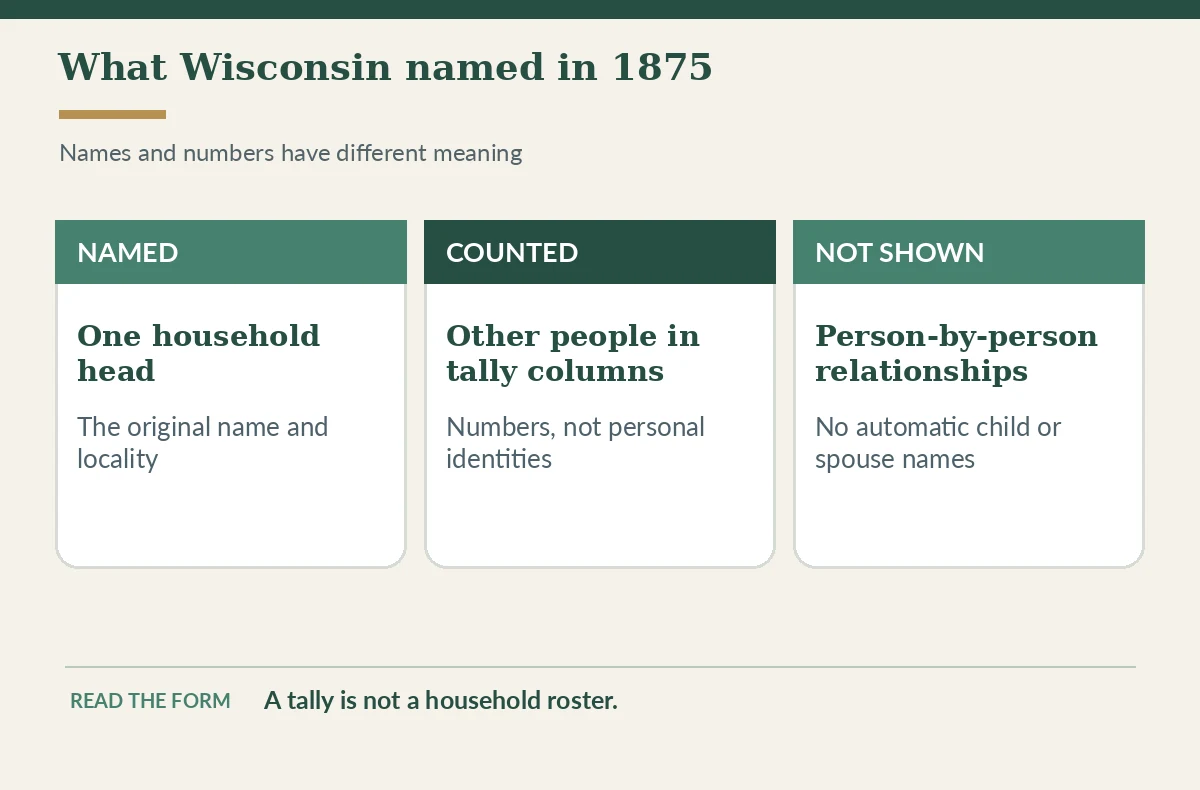
Wisconsin conducted a state census in 1875. Its searchable population schedule names the head of each household while the remaining information is statistical. That is the core interpretive limitation: a count of residents is not a roster of spouses, children or hired workers. FamilySearch provides an index and images for this particular year. The Wisconsin Historical Society explains that the nineteenth-century enumerations before 1905 generally recorded household heads rather than naming everyone. This return is valuable for placing a named head in a community, but it cannot by itself establish which relatives lived under that roof. Our guide “Wisconsin State Census Records” goes deeper into why the 1905 names matter.
Search the name of the likely head and nearby neighbors
Begin with a known Wisconsin community or county and the names of adults documented around 1870 and 1880. Search variant spellings and initials, especially for names transcribed from handwriting. If you cannot find a woman after a spouse died, search under her own name as a possible household head; do not assume all heads were men. Local residence matters more than a perfect name match. When a head appears in an online index, open the source image to confirm the original spelling, locality, page and adjacent entries. A plausible namesake elsewhere in the state is a different candidate.
Transcribe the tally columns without adding people
Copy every heading literally and keep the household figures beside the named head. Printed categories represent how the census administration classified people; they are not independently verified biological or cultural identities. Some older forms use racialized labels that require historical context rather than uncritical repetition as modern facts. If a manuscript count is faint, record it as uncertain. Do not replace an illegible tally with the household size implied by a later census. An otherwise plausible count does not prove that any particular child or spouse was present in 1875. The return supplies an aggregate observation.
Separate household size from a family pedigree
Imagine a record that names one head and tallies five additional people. That tells you how the enumerator reported that household under the form’s categories; it does not supply five personal identities. A tempting family-tree shortcut would be to fill the five slots with a known spouse and four children from 1880. That is only a hypothesis. Deaths, births, migration, domestic workers, step-relatives or a temporarily absent relative could change the household between 1875 and 1880. Write a candidate list with independent sources and give each proposed occupant a status of documented, plausible or unknown.
Use the 1870 and 1880 federal censuses as brackets
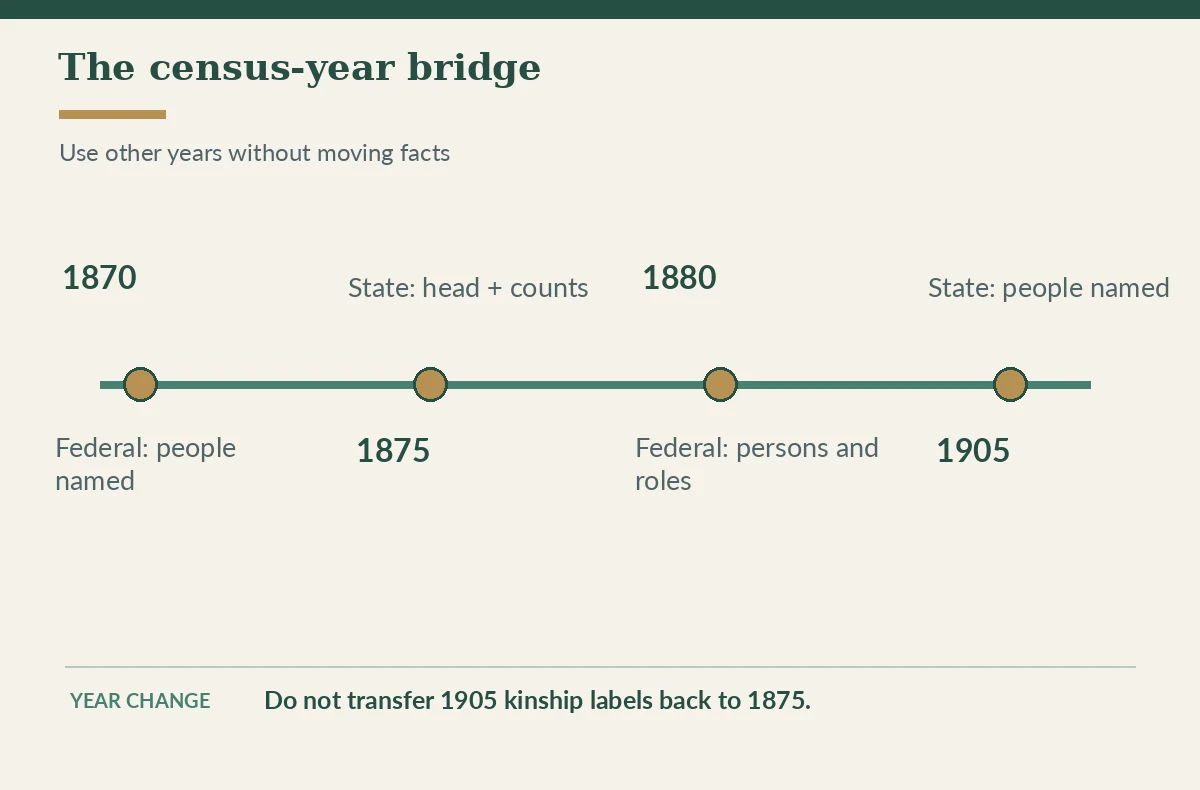
Make a three-column comparison: 1870 named individuals, 1875 named head plus tallies, and 1880 named individuals with relationships. Compare addresses or localities, neighbors and occupation where available. The 1875 enumeration can narrow when a household moved to Wisconsin, particularly if it is absent at that address in 1870 and present later. It cannot alone assign the move to a specific month or prove all members traveled together. If two families share a surname, compare every available adult, not just the oldest male. Retain discrepancies rather than adjusting the numbers to fit a preferred family.
| Source question | Archive evidence | Important limit |
|---|---|---|
| What is available? | Household head | Others are tallied |
| What is not proved? | Kinship remains unproved | Needs separate independent evidence |
| Next useful search | Read original page or register | Cite the exact locality and item |
Compare 1905 only after respecting the form change
Wisconsin’s 1905 state census named individual residents and collected a different set of person-level information. It is useful for later continuity, but a 1905 relationship label cannot be projected thirty years backward into an unnamed 1875 household. A child shown as a son in 1905 may not have been born in 1875, and a daughter may have married and left. Record the question and source year beside every extracted fact. The lesson is not that nineteenth-century tallies are useless; rather, they answer a narrower question about the household head and the number of persons counted.
Distinguish missing pages from an unproductive name search
Before reporting that a person was not counted in Wisconsin in 1875, document what was actually searched. Did you search a name index, browse the expected township, or check the image sequence for lost or poorly filmed pages? Was the person likely a named head at all? If an adult lived in a parent’s or employer’s household, the index may contain no personal entry for that adult. Search the documented head instead. Check official archival holdings and alternate local records for the same county. Negative evidence is strongest only when a source was expected to name the person and survives for that place. Our guide “1840 Iowa Territorial Census” covers a related question.
Use tax rolls and land deeds as independent residence checks
The state census household entry can be linked to county land transactions, property-tax lists, city directories or church registers. Each has its own coverage: a property taxpayer need not occupy the property, and a deed purchaser need not live in the county. Agricultural regions may have land description records, but the census itself does not guarantee a farm or legal title. Cite every added record separately. A known neighbor on an adjoining census line can help distinguish same-name households when a tax roll or deed also places those people near one another. Keep the geographic reasoning explicit and avoid inferring kinship from proximity alone.

Make a reproducible table for the household claim
A practical extraction sheet contains the indexed head name, exact manuscript spelling, county or town, page, the tally by printed category, nearby heads and a retrieval citation. Beside it add one field titled “persons not named.” That field should not be silently filled with inferred identities. If you identify a likely child from an 1880 census, record the matching argument in a separate evidence column. When counts conflict, consider enumerator error, movement, different counting rules and transcription faults before asserting that your family timeline is wrong. A clear worksheet is more useful than a single confidence score.
Decide what the 1875 census is good evidence for
The manuscript can support the statement that a named head was recorded in a particular Wisconsin locality with an associated household tally. It does not prove a child’s birth date, marriage, all household relationships, or ownership of land. If your real question is a parent-child connection, prioritize a birth, baptism, probate, guardianship or later census record that explicitly describes a relationship. If the question is where a head lived between federal census years, the 1875 return may be an excellent bridge. State the claim narrowly and retain a link to the original image and its historical counting categories. For a related choice, see our guide “1865 New York State Census”.
More Records and Archives Guides
How We Research 1875 Wisconsin State Census
The FamilySearch 1875 Wisconsin census description says it names only household heads. We contrasted that with Wisconsin Historical Society census guidance to avoid attaching modern person-level names to nineteenth-century counts. The examples show why aggregate figures are not a list of children, and why the 1905 enumeration answers different questions. We have not calculated or invented a historical household: all example tallies and proposed checks are explicitly hypothetical. Name-index availability should be verified with the image provider. There is no paid recommendation in this article; consult our affiliate disclosure.
No. It names household heads while the remaining population information is statistical.
Not from the tally alone. Use other records that name children and document any relationship inference separately.
FamilySearch provides a collection of indexed names and images; confirm any access requirements and read the page headings.
The 1905 census names individuals and provides person-level details; the 1875 record is head-only.
No. A non-head resident would not ordinarily appear as an individually indexed person in this enumeration.