
MH 67 is a National Archives route to correspondence and minutes of joint hospital boards, covering 1903–1961. It is most useful when the historical question concerns hospital administration, premises, services, staffing decisions or the public authority responsible for an institution. It is not a nationwide name index of patients and does not imply that every hospital admission survives in London. Start by identifying the hospital’s historical name, town, local district and approximate year.
Begin With the Hospital Board, Not a Patient Name
The official public-health guide notes that central hospital holdings often concern administrative matters. It separately directs researchers to local archives. In other words, even an MH 67 record specifically naming a hospital may give insight into a building expansion or board decision without supplying the names of people treated there. Frame the question before opening the catalogue.
Distinguish MH 67 From MH 48 and MH 90
Choice of series depends on creator and date, not simply the word hospital. The National Archives identifies Local Government Board correspondence organized by county and district councils in MH 48 for 1868–1935; joint hospital board correspondence and minutes in MH 67 for 1903–1961; and representative correspondence involving regional hospital boards in MH 90 for 1941–1969. These date spans overlap, but the records are not successive individual patient ledgers.
The 1948 creation of the National Health Service marks an administrative change, not a universal cutoff for all local books. A municipal hospital’s case notes may remain with a successor body or local archives even where a policy file at Kew exists. Enter the responsible body and date beside each record reference. A file referring to a regional board is evidence of administrative context, not automatic proof that a patient was admitted to the named institution.

Find the Institution Under Historical Names
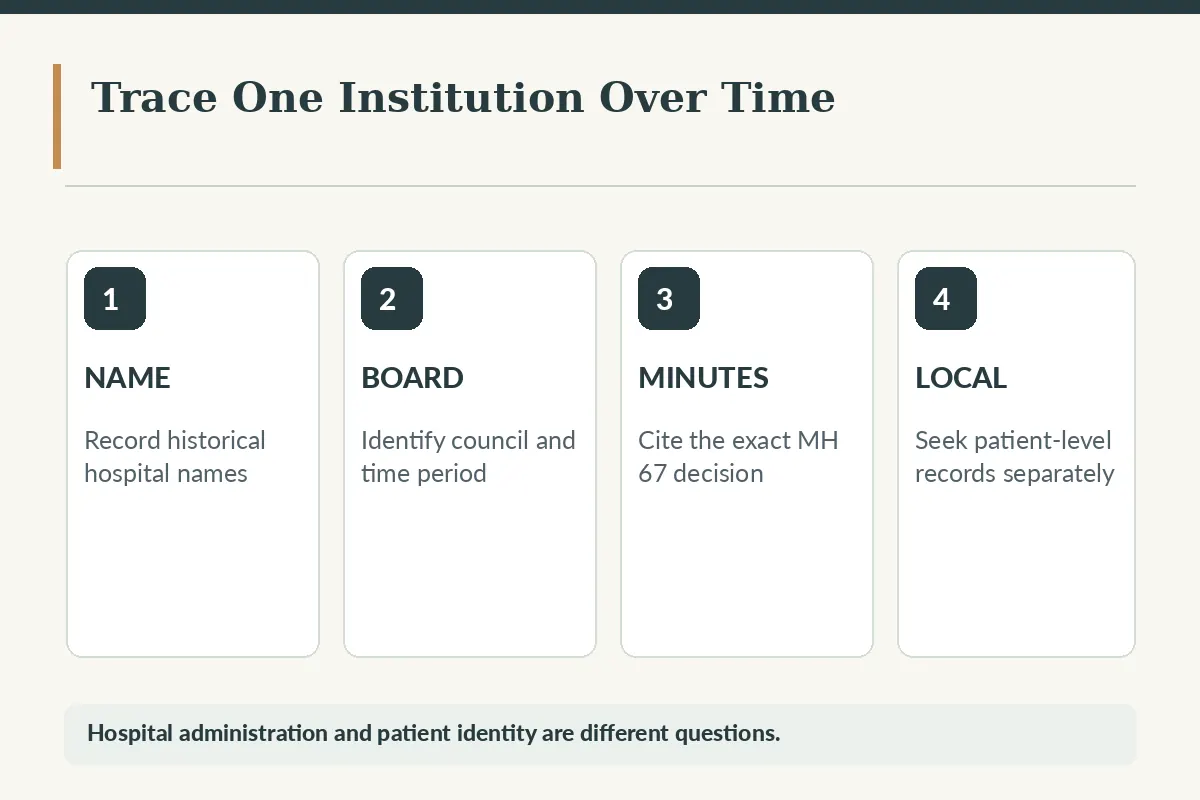
Search Discovery by the hospital name, joint board title, county, district and dates. A board may be described under a group of local authorities or an institutional title different from the label on a modern hospital website. Record each former name as a search term rather than treating it as a distinct hospital. Identify the county and council boundary that applied at the event date, especially when mergers changed administrative responsibility.
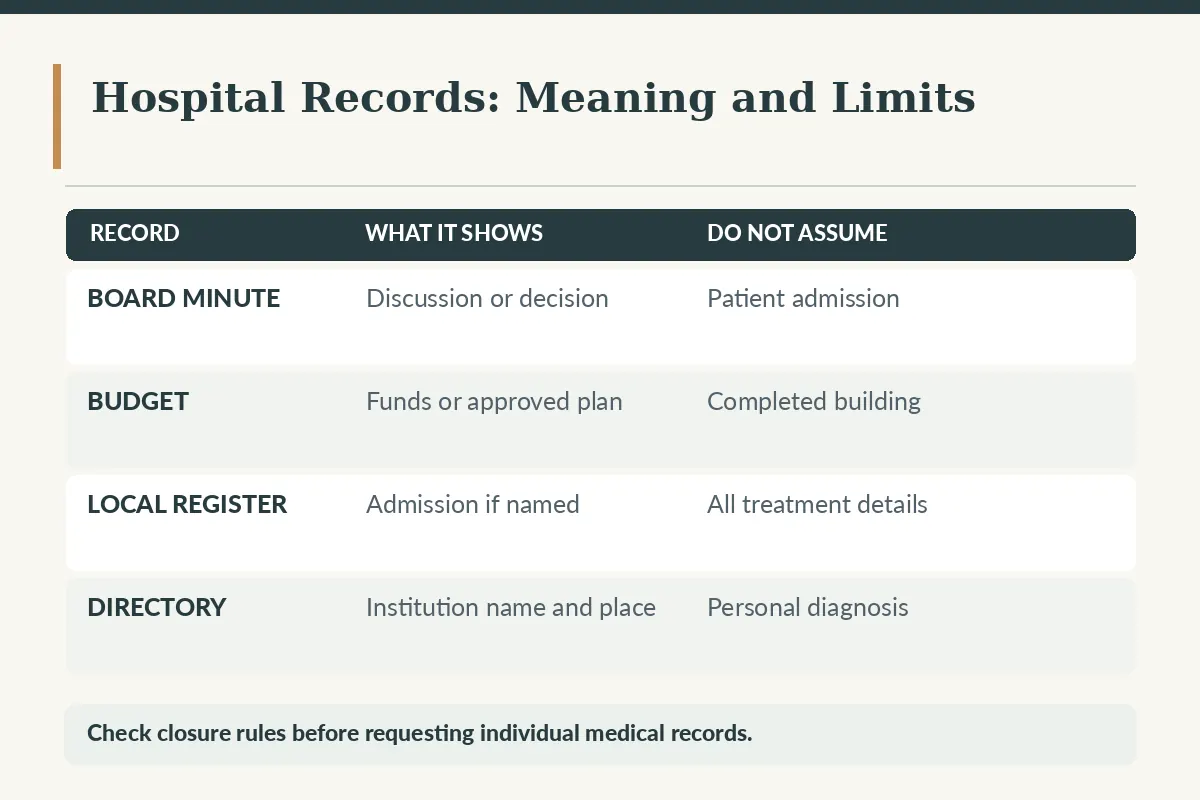
Check whether an online catalogue description names correspondence, a minute book, a report or another form of paper. Read the series-level scope before assuming that a file includes a named committee meeting. For the same hospital, consult the local archive catalogue and any surviving historic directories. Directories may confirm an institution’s name and function in a particular year but cannot establish the care received by an individual.
Read Minutes as Decisions, Not Proof of Treatment
An MH 67 minute may document a proposal, a recommendation, a committee vote, a budget, a staffing issue or a completed administrative action. These are different evidentiary states. Copy words such as proposed, approved, completed and referred accurately. A decision to enlarge a ward does not establish that work was done on schedule. A report of a fever outbreak does not identify every affected resident.
Where names appear, classify the person’s role: board member, official, contractor, applicant, employee or patient if explicitly described. A signature on a letter may identify an author or clerk rather than a witness to every underlying event. For patient-related research, local admission registers and case notes are different record types with separate access rules and possible confidentiality restrictions.
Follow Local Custody and Privacy Requirements
The National Archives cautions that many hospital records are held locally. After establishing the historical authority, use the relevant county archives, local studies service or successor hospital archives to identify admissions, births, deaths or staff registers where any survive. Ask the custodian for the collection identifier and available date span; do not send identifying medical details about a living person in an unsolicited public query.
Information about patients can be sensitive even in historical collections. A catalogue may describe a closed file without giving an entitlement to view its contents. Respect any closure rules and do not infer a diagnosis from a hospital’s specialist label, a person’s residence nearby or a family anecdote. Lack of access is not evidence that admission never occurred.
Build a Two-Custodian Research Table
Make a first row for national administration: series, board, file title, decision date and what the meeting actually says. Make a second row for the institution’s own records: repository, admission or staffing reference, event date, name and recorded details. If the second record is absent or closed, leave the identity claim unproven. This prevents a central board minute from being upgraded into proof of an individual’s medical history.
When the institution changed name, ownership or function, record each transition and its evidence. A later hospital directory may reflect a different body than one recorded in 1910. Verify the chronological succession through dated board reports, local authority records or reliable institutional histories. Cite every piece or catalogue record independently, even when two descriptions come from the same repository.
More Records and Archives Guides
How We Research MH 67 and Local Hospital Holdings
We establish the historical institution and board first, then decide among MH 48, MH 67, MH 90 and local archives by the responsible record creator and event date. Each relevant item is read for its administrative action, not as a proxy for an admission register. We record the status of a plan separately from the date it was implemented and do not invent missing patient fields.
Our notes identify the archive, piece, meeting or correspondence date and any applicable access restriction. The research method and any outside paid resource are distinct; see our affiliate disclosure. Where no patient-level source is available, we report a hospital history finding rather than making a personal-health claim.
No. Its principal described content is board minutes and correspondence, not a comprehensive patient index.
MH 48 holds related Local Government Board correspondence arranged by local authorities and may cover earlier administrative matters.
No. Many hospital records remained with local custodians or successor institutions.
An approval is not enough by itself; look for records showing implementation or completion.
No. Respect access rules and avoid inventing diagnoses or admissions from unrelated administrative records.