
ADM 27 records payments allotted from sailors’ wages in 1795–1812 and 1830–1852. Match pay-book details before asserting a family link. Consult the National Archives research guidance for custody and coverage. See the GenHis affiliate disclosure before choosing any commercial access service.
Start With the Two Surviving Allotment Periods
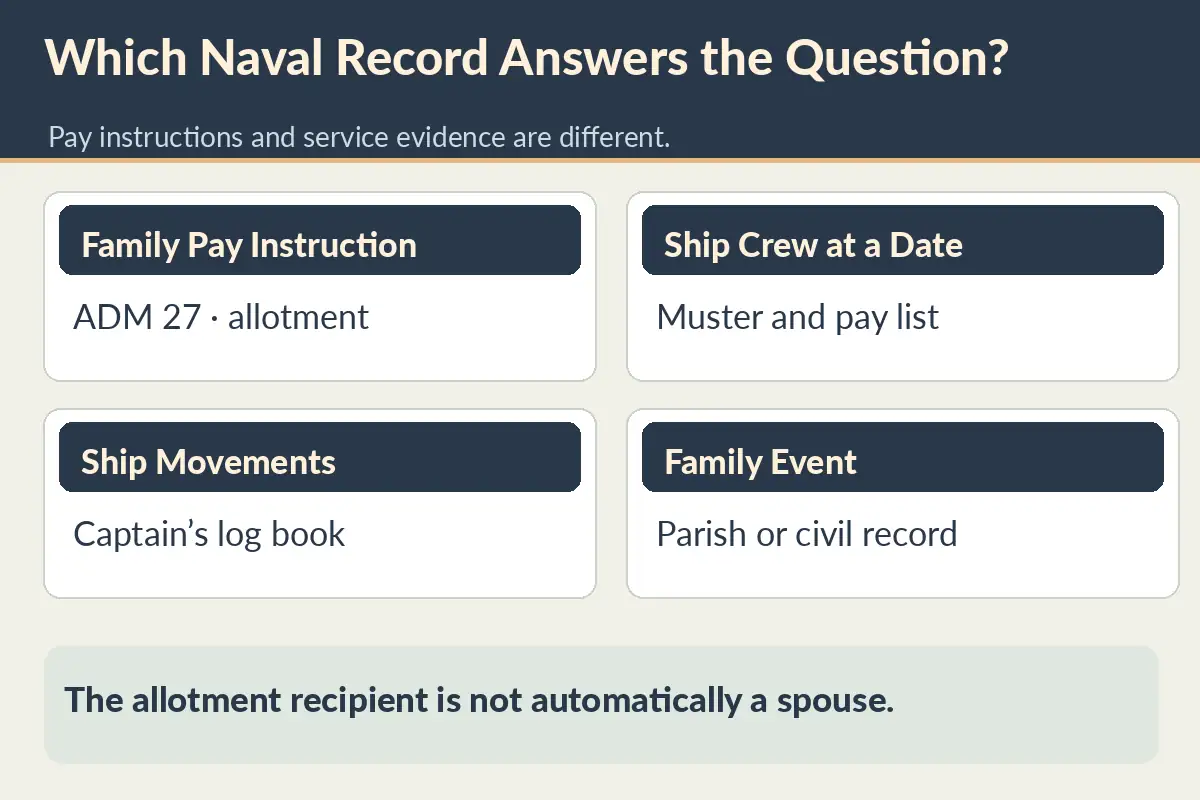
ADM 27 preserves Royal Navy allotment registers for 1795–1812 and 1830–1852. An allotment directed part of a rating’s wages to a named person ashore; it was an administrative pay instruction. The National Archives distinguishes these periods from the continuous service record system introduced in 1853. Search a person’s surname alongside a known ship and approximate date rather than treating ADM 27 as an uninterrupted century-long roll.
Before the search, write down the candidate sailor’s name variants, one vessel, a plausible period aboard and any documented residence of the family. Dates outside the two published ranges need another record class. A negative search of ADM 27 for 1816, for instance, says nothing about whether the man served or supported anyone at that time; it is a coverage mismatch, not negative evidence about the individual.
Use the Vessel and Pay Book Number to Identify a Sailor
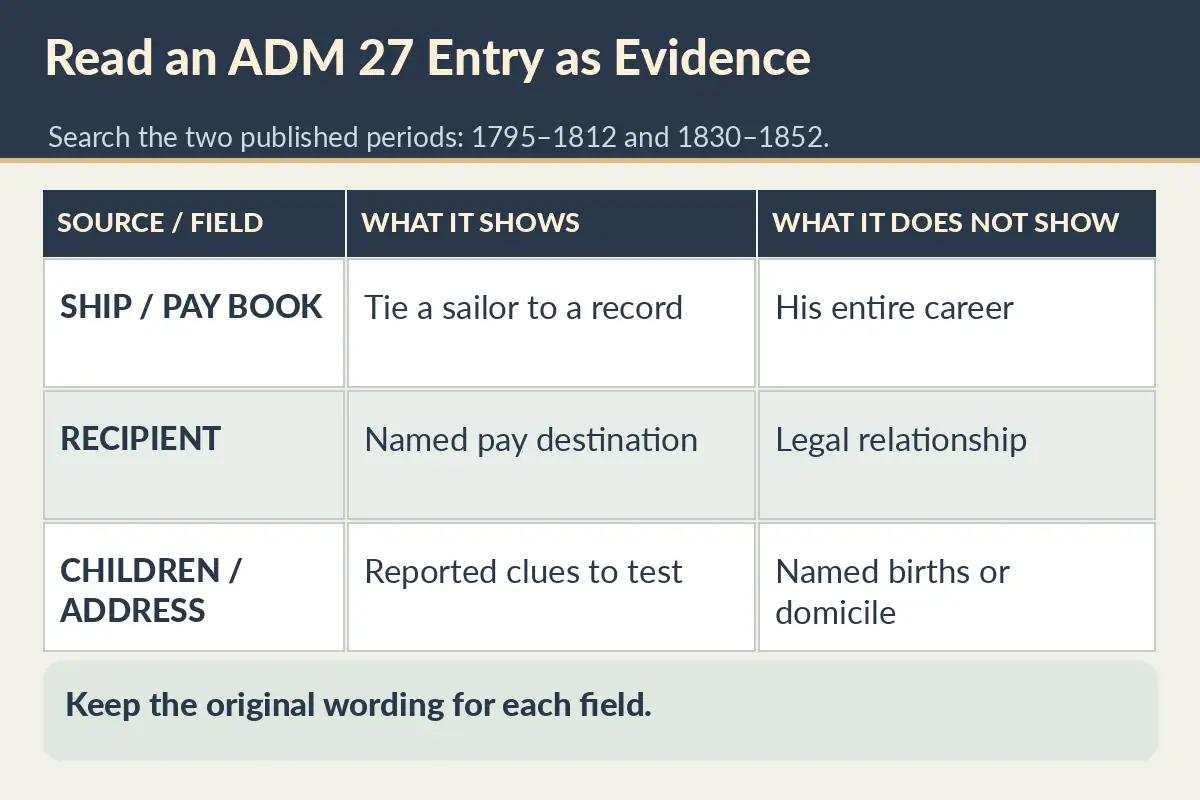
The National Archives lists the ship, date of allotment and pay-book number among the details potentially present in ADM 27. These are the strongest controls when common names produce several candidates. Capture the name precisely as entered, the ship, the relevant date, the pay-book number and the image or piece reference. Two men called William Harris could be aboard different ships in the same year, so their beneficiaries must never be combined on name alone.
If only a free catalogue description is visible, distinguish that summary from an inspected register image. The National Archives points to paid searching of digitized entries at Findmypast while free catalogue descriptions may give useful pointers; payment is not a reason to assert the contents of an unseen page. Use a ship muster or pay book to corroborate the sailor’s posting and mark any conflict about ship or date for further work.
Read Recipient, Children and Address as Separate Claims
An allotment may give the first name of next of kin, number of children and place of residence, according to the archive’s guide. Those details can identify a household worth investigating, but the name of a recipient is not a marriage certificate or sworn family statement. The register’s exact relationship wording matters; do not add “wife,” “mother” or “daughter” unless the original entry says so and independent evidence supports the claim.
Make separate columns for sailor, allotted recipient, stated relationship if any, reported children, address and date. Addresses may reflect where money was sent rather than where the sailor lived. A count of children is not a list of births, and another family with the same surname can occupy the same parish. Test identities with contemporary baptisms, marriages, local rate records or household evidence appropriate to the period.
Distinguish an Allotment Date From a Voyage Timeline
An allotment date does not establish a ship’s departure, arrival or the sailor’s presence at a battle. Naval captains’ logs and ship log books describe voyages and conditions, while the allotment register concerns pay. A sailor might change vessels, allotments or family arrangements between separate entries. Create parallel rows for payment instructions and independently recorded ship movements rather than drawing a single unbroken service route from an isolated ADM 27 hit.
For ship movements search the National Archives guide to log books and use the original vessel name and date range. A captain’s daily journal is primarily a record of a ship, not an automatic named list of its entire crew. The crew connection still requires a muster, pay list or service document. When ship names are reused, identify the specific vessel and commander or rating before making the cross-reference.
Check Alternative Service Records and Survival Gaps
Royal Navy ships’ musters, ledgers and pay books can complement an allotment in ADM 27, but their date coverage and arrangement differ. The research guide lists multiple Admiralty muster and pay series and notes that information can be vague, especially for early records. A person appearing in a muster without an allotment could still have dependants. Equally, an allotment record is no guarantee that a later service certificate survived.
If a pay book number is legible, record it exactly, including later corrections. Check the correct ship within a narrow date span before expanding to alternative vessels. A researcher should also preserve variant spellings and rank descriptions and avoid treating an apparent absence from name indexes as evidence that a sailor was never enlisted. Catalogue hit, original entry and verified personal identity are three separate evidentiary stages.
Write an Auditable Finding About Family Support
A defensible conclusion states that ADM 27 recorded an allotment by a named sailor serving on the stated ship, payable to the listed person or address, on the recorded date. If a separate marriage record proves the relationship, cite that source independently. Describe the amount only if the relevant column and currency are visible, and distinguish proposed instruction from proved receipt of funds. The record does not establish a complete career or an entire family tree.
The next search depends on what remains open. For identity, compare ship muster and service details; for kinship, find a parish event or other direct evidence; for the recipient’s location, inspect local household records. Save the full ADM 27 reference, page, date and transcription so another researcher can test each part without relying on an attractive but unsupported narrative.

How We Research Royal Navy Adm 27 Allotment Registers
We first define the record creator and its administrative purpose, compare the repository’s exact date span with the research question, and distinguish a catalogue description from an original image or manuscript. Namesake identity requires at least one independently created source, not a shared surname alone. We record the reference, date, field wording and uncertainties; a negative result is limited to the actual periods, places and holdings examined. We cite official archive guidance without pretending that it confirms the contents of an individual document we have not seen.
More Records and Archives Guides
Official Records and Research Limits
Check the primary archive guide for the specific series and periods: Confirms ADM 27 coverage 1795–1812 and 1830–1852, names of next of kin, children, residence, ship and pay book number.. The second authoritative guide gives a separate comparison: Explains how naval ship and voyage journals answer movement questions distinct from individual pay allotments.. Verify each piece’s current access rules in Discovery; a search result, indexed entry, downloadable image and original item are not interchangeable. Preserve the record creator’s wording and avoid claiming completeness where the archive identifies losses.
No. It documents a pay allotment; the relationship needs independent evidence.
The guide specifies 1795–1812 and 1830–1852, not continuous coverage.
Use the vessel, allotment date, pay-book number and independent service records.
Not necessarily. It can be the destination for money sent ashore.
It does not show that the sailor lacked dependants or did not serve.