
WO 13 preserves militia muster rolls and pay lists for 1780–1878. Learn to search units and dates without mistaking a pay appearance for full service. Start with the custodial archive guide for the actual series and coverage. See the GenHis affiliate disclosure when comparing commercial access options.
Start With the County and the Militia Unit
The National Archives assigns militia muster rolls and pay lists for 1780–1878 to WO 13. These volumes were maintained around units and accounting periods, rather than as a modern name-searchable personnel database. Start with the county, a historically correct regiment name and a plausible year. A name found on an attestation paper in WO 96 is a valuable lead, but it is not proof that the same unit’s WO 13 books survive for every later quarter.
Compile a compact unit worksheet: place of residence, date of known service, regiment as contemporaries named it, name variants and the source of each assertion. Historical county labels can differ from later regimental titles. Search both a county name and an earlier designation, then record each Discovery reference separately. An unproductive personal-name search is not an exhaustive negative search of volumes arranged primarily by regiment.
Choose WO 13 Instead of a Regular-Army Muster
The general Army muster guidance divides many regular formations into WO 12, militia and volunteers into WO 13 and certain later muster material into WO 16. That classification prevents a common false result: finding a regular soldier with the right surname in the wrong class and treating him as the county militiaman. In WO 13, organize the inquiry by formation, not by a surname alone. Royal Artillery records have separate arrangements and should not be forced into a militia volume.
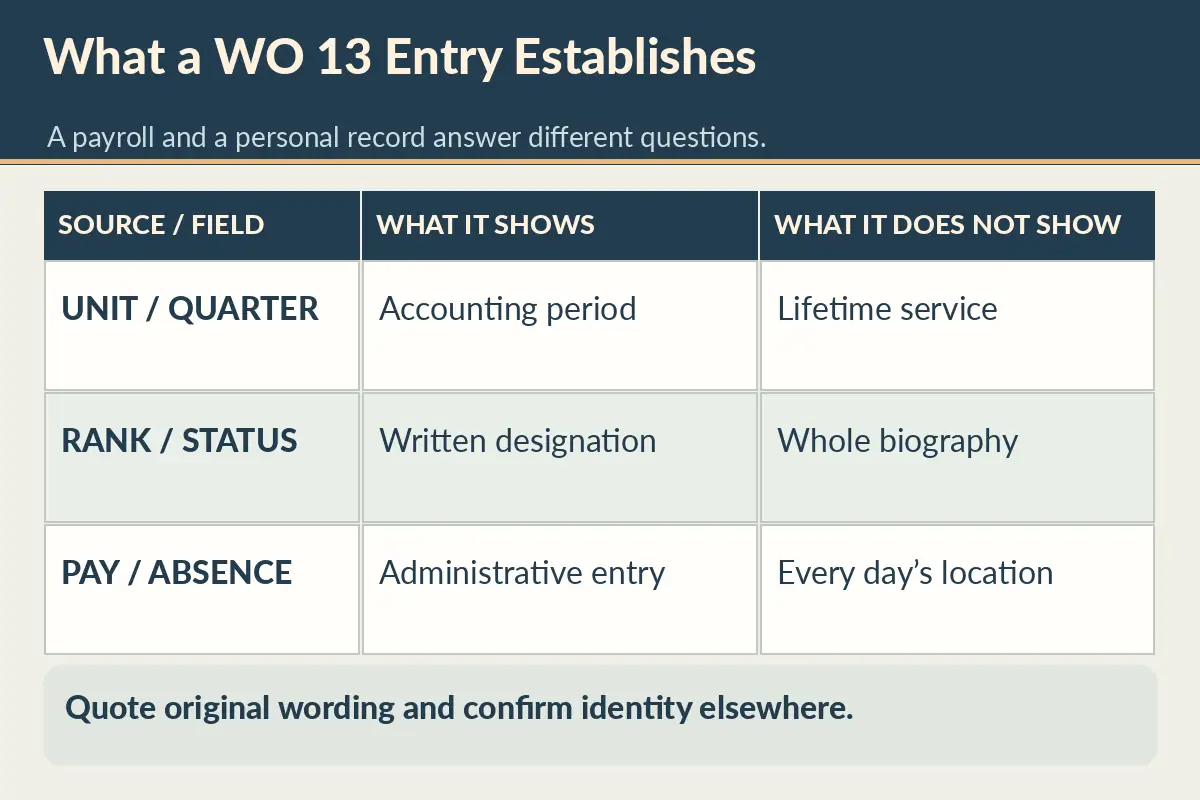
An officer’s commission, a private soldier’s appearance on a payroll and a paper documenting enlistment answer different questions. The militia research guide also points to WO 68 enrolment and casualty books, WO 96 attestation papers and other officer commission sources. When a person’s identity is still uncertain, use each series for its own documentary purpose. A muster may give dates or rank without preserving the physical description or place of birth that a later attestation supplies.

Read the Accounting Period, Not a Whole Career
A muster or pay list is evidence about the unit at the time the entry was made. Read the opening and closing dates on the actual roll, the heading naming the unit and any status notation beside the person. A single quarter cannot safely establish uninterrupted service across several years. Likewise, pay due or recorded absence is not an independent certificate that a man physically attended every drill during that period. Record unclear abbreviations literally before interpreting them.
Make one ledger row per observed entry: piece reference, page, exact dates, unit, recorded rank and the words or marks beside the name. Different rolls may use different formats, especially across administrative changes. If a page includes a total of men present, that total is not a list of identifiable relatives. A transfer to another formation must be supported by dated information in both sets of records or another service document, not inferred from a name disappearing.
Resolve Two Soldiers With the Same Name
A common surname in neighboring counties can produce multiple apparent matches. Build a candidate table for each man using the county, regiment, rank, dated appearances, and independently documented age or parish where available. Do not backfill blank fields with details copied from a different person’s pension or attestation. The question is not whether two records share a name but whether their date and unit combinations can describe the same military career without contradiction.
For example, a plausible John Turner in a Lancashire militia volume should not be joined automatically to a John Turner in a Yorkshire unit one month later. Check whether the known enlistment and transfer evidence could support such a move. If not, keep both candidates open. The strongest next record might be a WO 96 attestation or a parish marriage that records a recognizable regimental identity. The outcome should state why alternatives were excluded or retained.
Use Attestations and Casualty Books as Separate Tests
Militia attestation papers in WO 96 often preserve biographical particulars but have their own distribution and survival. The militia guide notes that most of the available online attestations date from the mid-nineteenth century. A soldier could appear in WO 13 even if a matching personal paper is absent; the reverse is also possible when a relevant unit’s accounting book has not survived or cannot be found. The two sources corroborate different aspects of service.
WO 68 enrolment and casualty books offer another unit-based route. Check that the regiment and date agree before using a discharge, desertion or casualty notation. An administrative label must be quoted accurately, without converting it into a criminal conviction or a claim about a person’s character. Keep the source hierarchy explicit: a catalogue summary suggests a volume, its original pages record the action, and independent evidence connects the named entry to the target ancestor.
Record What an Unsuccessful Search Actually Tested
A defensible no-result statement specifies which counties, unit names, record references and date spans you examined. It does not announce that a man never served in the militia. Different regiments leave different runs of material, while accounts may be arranged by brigade, unit or alternative historical spelling. The Archives notes that pre-1881 unit names matter; a modern regimental name can hide the earlier formation under which the rolls were filed.
When writing the finding, distinguish an attestation date, a muster period and a later pension or discharge event. Cite the exact WO 13 piece and page for a confirmed entry. Preserve a photograph or transcription only where access permits and record any uncertain letters. If coverage stops unexpectedly, use local newspapers or county archival material as leads, but do not claim that they replace a missing original military roll.

How We Research This Archival Series
Our method starts with the record creator and the legal or administrative purpose of the surviving series. We distinguish a public catalogue, searchable index, manuscript page and later transcription rather than treating them as interchangeable proof. A meaningful negative search documents the actual place, years, variants and holdings examined. To identify a person, we cross-check an independently created source and preserve conflicts in wording or dates. We do not claim that general collection descriptions confirm any individual’s history.
More Records and Archives Guides
Official Sources and Exact Evidence Limits
The main National Archives resource supports this key point: Identifies WO 13 militia and Volunteer muster rolls/pay lists 1780–1878 and search by county or pre-1881 regiment name.. The additional official guidance supports a separate limitation: Distinguishes general WO 12, militia WO 13 and the post-1878 WO 16 muster arrangements.. Check the current Discovery catalogue item for piece-specific coverage and access before ordering or citing it. If only the official guide has been inspected, use conditional language for the content of a specific person’s record.
The series is primarily approached through county, regiment and date; name-search coverage varies.
The Archives guide lists militia musters and pay lists from 1780 to 1878.
No. WO 96 holds personal attestation papers; WO 13 records unit accounting and musters.
No. First establish whether that unit’s volume survives and inspect other quarters.
Consult officer and commission records in the militia guide rather than treating a payroll as the commission.