
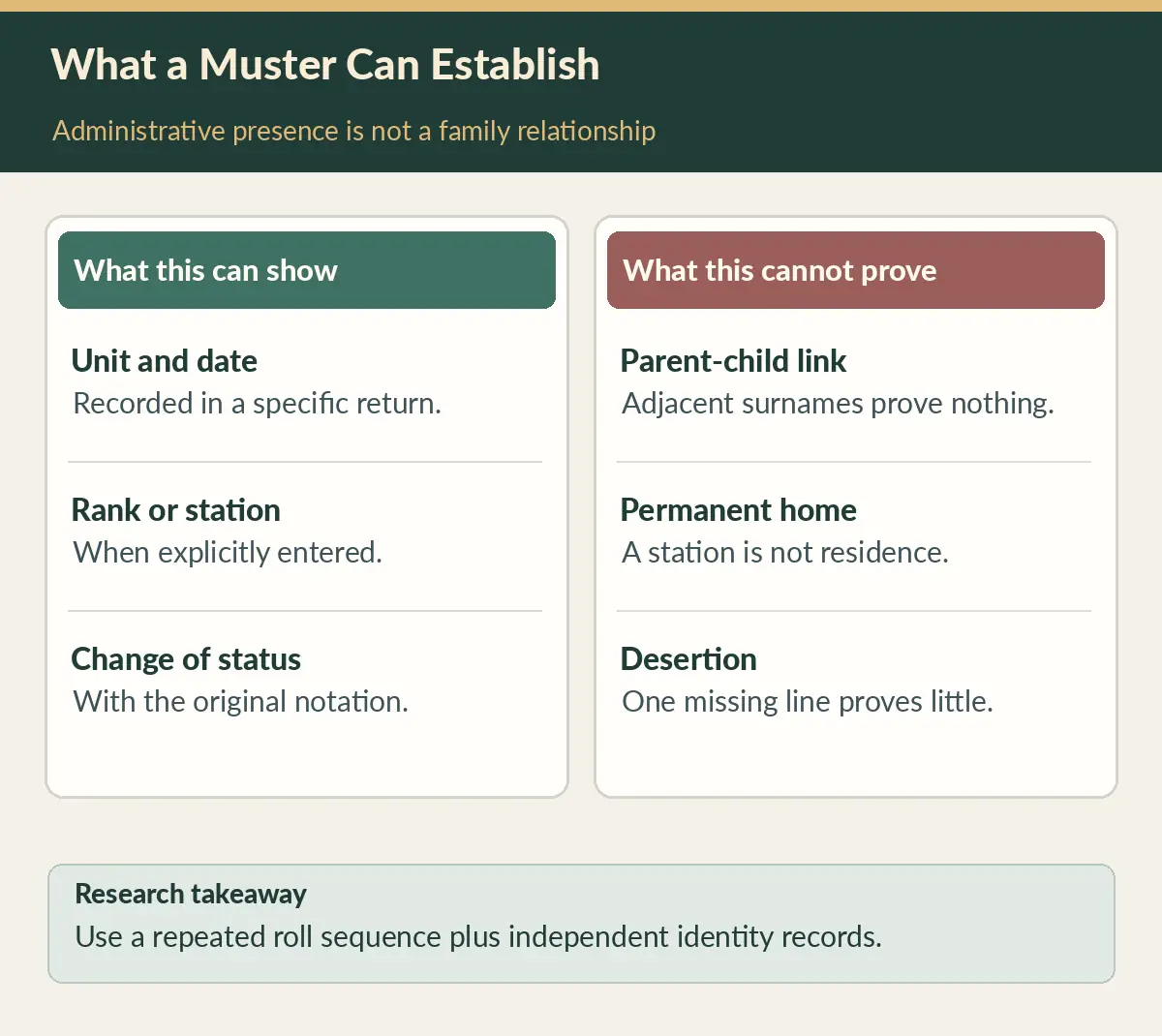
To trace a British Army soldier in the historical muster books, identify the regiment and approximate service date first, then route to WO 12 for general regimental lists through 1878 or WO 16 for the later period. The National Archives muster guide warns that these are regimental accounting records, not a single national name index. A soldier’s presence at a muster may document service or stationing, not parentage.
Start With a Regiment Rather Than a Surname
A broad search for a common soldier’s surname can return unrelated regiments or nothing at all, because most muster volumes are organized by unit. Find a regiment from a discharge paper, pension record, medal roll, letter, uniform identification, or a dated marriage record naming an occupation. Write the regimental designation exactly as recorded and note whether it describes a battalion or a numbered infantry regiment.
A precise year is more useful than a vague service era. The same man may appear in repeated quarterly accounting returns, allowing a documented sequence that begins with a single sound unit identification. Do not choose a regiment simply because a namesake served there.
Route WO 12 and WO 16 by Date and Unit
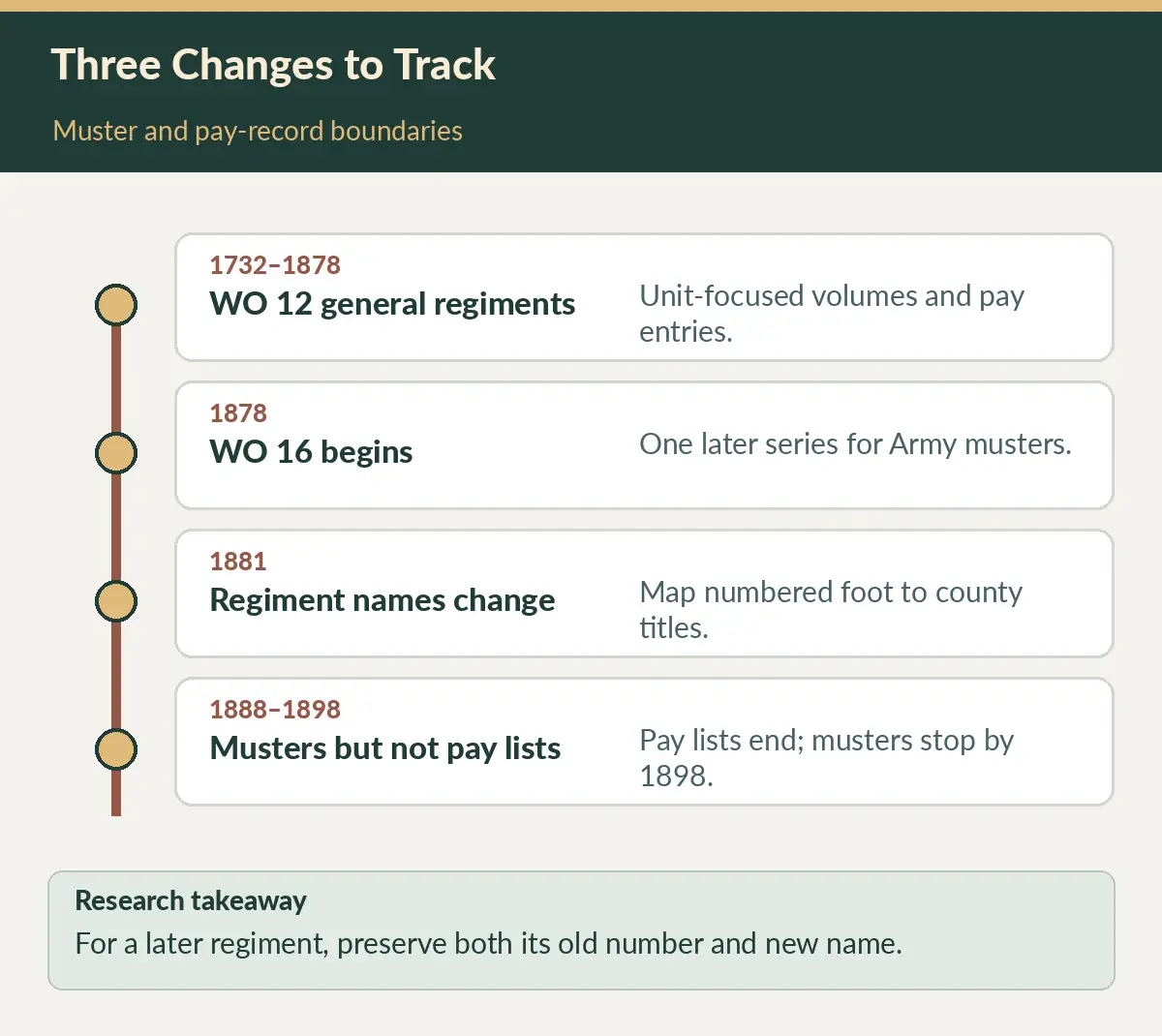
For general regimental musters from 1732 through 1878 the principal series is WO 12; artillery, engineers, militia and volunteers require other series such as WO 10, WO 11 and WO 13. For 1878–1898 look to WO 16, where pay lists cease from 1888 although musters continue. The repository’s table of branches is essential: not all troops fall inside WO 12.
Record the unit type, its series, and the year before ordering a volume. A negative result in the wrong series is no evidence of nonservice. Some small portions of WO 12 are online, but most pieces need access to originals.

Resolve the 1881 Regiment-Name Change
The Childers reforms of 1881 reorganized infantry units, replacing many numbered regiments with county-titled regiments and creating new first and second battalions. A soldier listed with an older numbered regiment may therefore be in a differently titled WO 16 volume for a later year.
The National Archives recommends using contemporary Army Lists to map new names and earlier regiment numbers, particularly second battalions. Keep both the old and new designation in a chronological worksheet. Never assume a change in a unit title means that the soldier personally transferred; test the evidence against muster date, rank, service number if present, and a continuous period of enlistment.
Read the First and Last Entries Carefully
Musters and pay lists were compiled for pay and strength accounting. An early entry for a recruit may note age, enlistment location and trade; later entries can reveal movement, transfer or departure. From 1868 to 1883 the special lists of men becoming non-effective may record birthplace, trade and discharge or death information.
Transcribe the heading, roll date and exact category along with the soldier’s name. A note such as absent, sick or detached is an administrative condition, not proof of a permanent move or a medical diagnosis. Never interpret a blank in one month as desertion without checking the adjoining returns and the recorder’s conventions.
Build a Month-by-Month Service Ledger
Create a table with volume reference, covered months, regiment, battalion, rank, stated location and the soldier’s actual entry. Examine one muster before and after a suspected transfer or discharge. A useful hypothetical example is a private recorded in 1877 with the 28th Foot and in 1882 under a Gloucester Regiment battalion.
That pairing is historically plausible under the reorganization, but identity still requires continuity and a compatible entry date. Search nearby rank lines and changes in unit structure to avoid reading a different soldier as the same man. The document may indicate station rather than a civilian place of residence.
Use Description Books and Discharge Papers as Separate Tests
Musters supply a chronological backbone rather than a full biography. WO 25 description books can offer physical description, age, birth locality and trade; WO 97 discharge records sometimes provide more direct individual information. The soldiers research guide outlines different record routes and cautions that survival is incomplete.
Compare year of birth, place, rank and family clues in independent documents. If a similarly named man has a different birthplace or conflicting enlistment, retain both as candidates. A service entry alone cannot establish a marriage, a child’s identity, or descent.
Understand Partial Digitization and Missing Years
Searchable web snippets do not reproduce every page of WO 12 or WO 16. The National Archives notes that a small selection of WO 12 images can be viewed online through a commercial partner, and the Waterloo-period sample may be name searchable. Most historical muster research remains regiment-and-volume work through Discovery and archival access.
A missing person-name hit in a commercial index is not proof that the unit ledger lacks the person. Record precisely what range, regiment, site and original pages were examined. If access is unavailable, label the claim as a located volume not yet inspected. Do not turn one unavailable scan into a broad claim that records were destroyed.
Cite Every Pay Return at Its Real Level
A retraceable citation identifies The National Archives, War Office series, piece number, named regiment, date of the muster and the image or folio inspected. Where the soldier appears on adjacent returns, cite each separately instead of treating a database person profile as the source. Distinguish a catalogue entry, third-party transcript, photograph of the page, and contemporary War Office register.
The source hierarchy changes what can be asserted. If a scan contains a damaged surname, transcribe the uncertain letters with brackets and compare other months, rather than silently accepting the modern search-site spelling. Preserve both normal and original regiment names.
How We Research British Army Muster Evidence
We begin with a documented unit-and-year hypothesis; map the branch and 1878 series boundary; check the regiment’s title across 1881; then examine a short sequence of original returns. Every observation is linked to its page and dated heading.
We record the separate evidentiary status of a recruit note, a later duty entry and a discharge indication, and cross-check independent papers before identifying a family member. Paid access is never confused with guaranteed coverage. See our affiliate disclosure for the website’s relationship policy; the official guide remains the controlling record-series description.
More Records and Archives Guides
Choose the Next Search From the Actual Gap
When the ledger ends after an abrupt rank change, inspect the next volume, other battalion, and possible unit transition before proposing death or desertion. When a matching service number or recruitment note is absent, seek WO 25 and WO 97 or an independently dated civilian document.
A purported family relationship should be tested by certificates or parish records, not inferred from a soldier’s presence alongside another surname. Finish with two statements: what exact record was observed, and what specific source would resolve the remaining uncertainty. That distinction makes an archival path reusable by another researcher and protects the family tree against attractive but unproved military stories.
Usually the reliable route begins with the regiment and date; only selected online material is name searchable.
WO 16 generally holds the musters for 1878–1898; branch-specific earlier series vary.
The 1881 infantry reorganization replaced many numbered regiments with county regiments and battalion designations.
No. Check the unit accounting notation and surrounding months for transfer, detachment or other explanations.
No. It records military administration; corroborate kinship using independent family documents.