
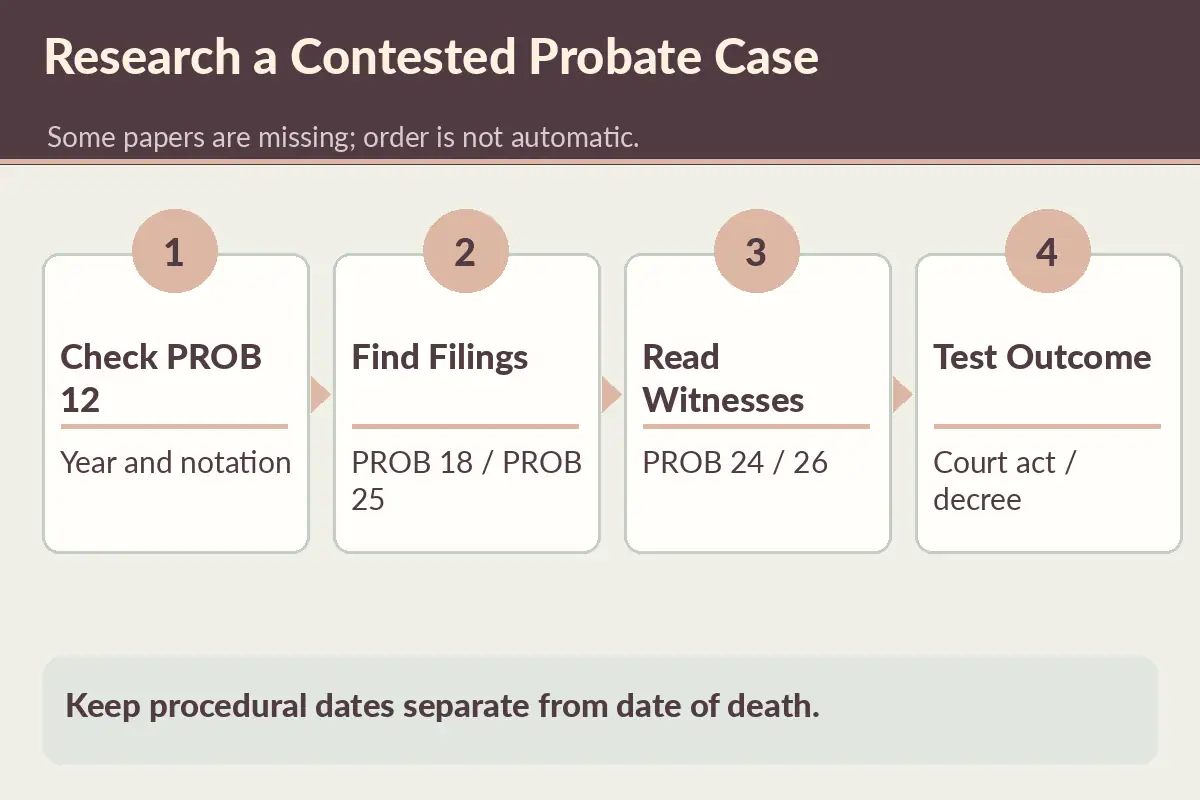
A probate index can flag a disputed will. Trace PROB 12 notes through PROB 18 pleadings and PROB 24/26 witnesses, keeping claims distinct. Start with the custodial archive guide for the actual series and coverage. See the GenHis affiliate disclosure when comparing commercial access options.
Identify a Dispute Without Assuming Fraud
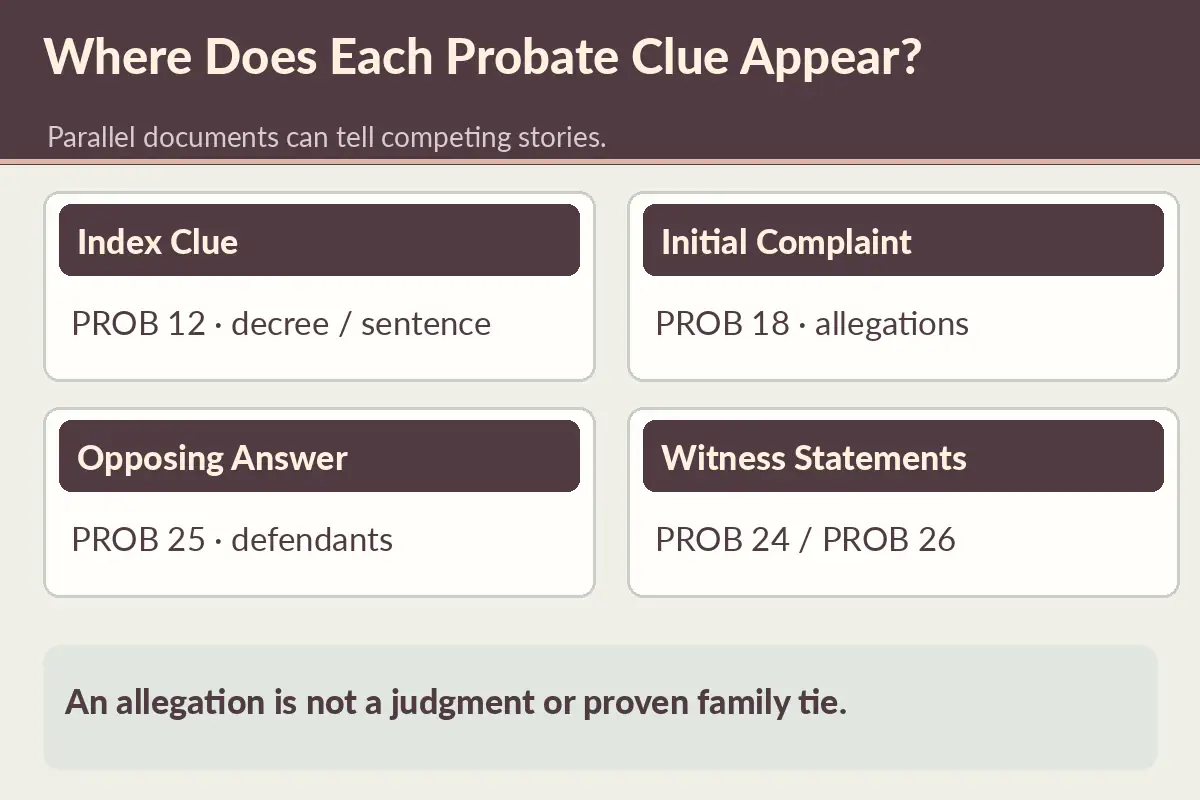
The National Archives advises checking PROB 12 index marginal notes for expressions such as “by decree” or “by sentence” when looking for contested probate. A mark is a clue that litigation or a formal judgment may be involved; it is not, on its own, proof of forgery, coercion, lack of capacity or a relative’s wrongdoing. Probate concerned the validity and administration of wills, and objections sometimes arose over procedure or conflicting testamentary documents. Begin by recording exactly what the original index says.
Locate the deceased’s name, death or probate period and likely probate court before selecting an index. PROB 12 belongs to the Prerogative Court of Canterbury record trail, so a will proved solely in a different ecclesiastical jurisdiction will not automatically appear in the same series. Names can have several spellings, and a probate date may be many years after death. A modern family tree’s story of a quarrel is not enough to establish that formal litigation occurred.
Use PROB 12 as the Doorway, Not a Trial Transcript
PROB 12 includes indexes historically used by the court to find wills and administration act books. The Archives’ pre-1858 probate guide shows that different centuries use different printed, typescript and original-index arrangements; do not expect one complete searchable web form for 1661–1858. Inspect the correct year’s index and record a marginal sentence or decree note if present. It points toward a judicial process, not necessarily toward surviving complete pleadings.
Copy the date, the deceased’s name, index location, variant spelling and any abbreviations exactly. A missing dispute annotation can mean an ordinary proceeding, incomplete indexing or an unsuitable search period. When a will itself is in PROB 11, that registered copy is not the entire dispute case. Compare the grant or act entry with the index wording, and keep the legal event separate from the date on a family member’s private copy.
Follow Allegations and Answers to the Correct Files
According to the disputed-wills guide, allegations—the initial complaints—may be found in PROB 18 for 1661–1858. Defendants’ answers are in PROB 25 for 1664–1854. These records expose competing claims, but one party’s allegation is not an established fact. Identify who filed the paper, whom it names, what issue is contested and which court stage it represents. A person described as “son” within a claim needs independent evidence before being assigned proven parentage.
The arrangement changes over time. The Archives notes indexes in volumes for earlier answers and later case bundles that may be labelled by the parties and testator but lack a complete name index. Search by litigant and deceased names, with historical spelling variants, and capture the bundle reference rather than making unsupported assumptions about a missing filing. If only an allegation survives, state that the opposing response has not been examined; do not present a one-sided account as a court finding.
Read Witness Depositions as Testimony, Not a Verdict
PROB 24 and PROB 26 contain depositions, or witness evidence, in the periods identified by the National Archives. A deponent’s account may contain valuable ages, occupations, addresses or statements about conversations and signatures. But testimony can be partial, mistaken or disputed. Preserve the exact question asked, the answer, the date and the witness’s relation to the case. If a witness repeats what someone else said, identify that second-hand nature instead of silently upgrading it to firsthand observation.
Different witnesses may contradict each other. Prepare a claim-level matrix: who stated the fact, how they could know it, which document contains it, and whether an independent record confirms it. A professional neighbor, household servant or named associate is not necessarily related to the testator. Record the handwriting and legal formula separately from the substantive statement. Where the archive’s guide says certain indexes remain at Kew, do not represent an online catalogue summary as a transcription of an unseen deposition.

Locate the Actual Court Outcome
A probate challenge can generate allegations, answers, witness statements, rulings and later actions. Their survival varies, and the existence of a pleading does not reveal the final judgment. The Archives recommends consulting relevant administration and probate act books as well as litigation series. Compare dates to determine whether the court admitted a will, granted administration or recorded another outcome. A registered will copy and a sentence entry can be complementary rather than interchangeable.
Where multiple wills or codicils are mentioned, avoid assuming that the document with the latest date was automatically accepted by the court. Read the specific court act and its context, identify parties correctly, and search for subsequent proceedings if the case continued. If the ending cannot be found, say the outcome remains unverified. For disputes that involve estates subject to death duty, post-1796 registers may add useful notes but do not eliminate the need for original probate process records.
Write a Source-Tiered Probate Dispute Summary
A careful account identifies the testator, the relevant probate jurisdiction and the procedural records found. For example, it may state that a PROB 18 allegation claims an earlier will was invalid, while a witness in PROB 24 disputes the claim. Only a surviving decree or comparable court record can justify a statement about the adjudicated result. Do not apply modern criminal labels to historical parties because they contested or defended an estate.
Build a source inventory that separates the index, registered will, allegations, answers, depositions and judgment, with exact archive references and dates. Flag unexamined files and missing bundles. The genealogical reward may be witness networks, residences and previously unknown relatives—but each relationship must be tested against independent vital, parish or property documents. This structured route is different from merely finding a probate copy or accepting every assertion in an old family narrative.
How We Research This Archival Series
Our method starts with the record creator and the legal or administrative purpose of the surviving series. We distinguish a public catalogue, searchable index, manuscript page and later transcription rather than treating them as interchangeable proof. A meaningful negative search documents the actual place, years, variants and holdings examined. To identify a person, we cross-check an independently created source and preserve conflicts in wording or dates. We do not claim that general collection descriptions confirm any individual’s history.
More Records and Archives Guides
Official Sources and Exact Evidence Limits
The main National Archives resource supports this key point: Confirms PROB 12 marginal decree/sentence clues and PROB 18/25 and PROB 24/26 ranges in pre-1858 contested probate.. The additional official guidance supports a separate limitation: Describes PROB 12 original indexes to wills and administration books, with different year-specific index arrangements.. Check the current Discovery catalogue item for piece-specific coverage and access before ordering or citing it. If only the official guide has been inspected, use conditional language for the content of a specific person’s record.
No. It signals a procedural clue, not proof of wrongdoing.
The Archives directs researchers to PROB 18 allegations for 1661–1858.
No. PROB 24/26 contain evidence that must be evaluated against a result.
Many later PROB 25 bundles are not comprehensively name indexed.
No. It is a party’s assertion; verify kinship in independent records.