
Find an E 190 port book through the historical head port, year and customs trade type. A lesser harbor may be filed under another town, and an entry naming a merchant is not proof of home address or ship ownership. Read our affiliate disclosure.
Locate the Head Port Rather Than a Modern Town
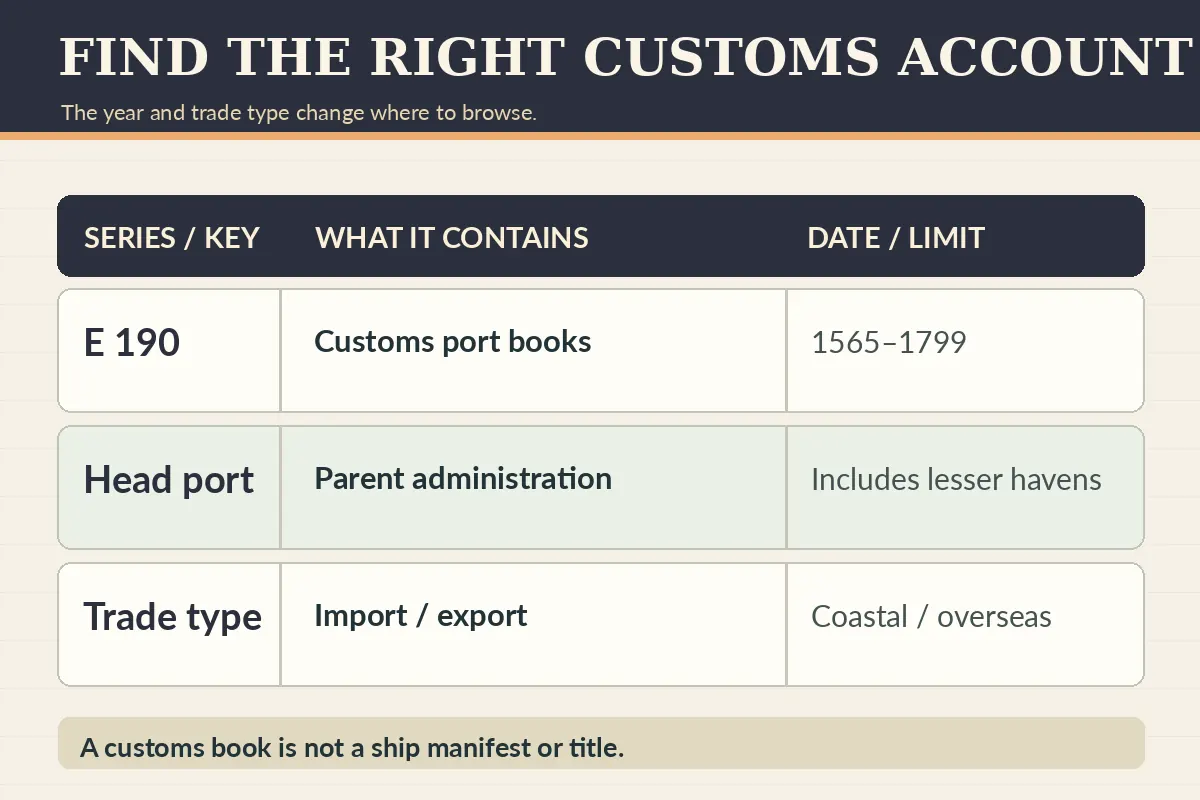
Start with the customs geography that existed when the trade occurred. The National Archives’ E 190 research guide explains that a head port could administer lesser ports, creeks and havens. A modern coastal village may appear under a much larger customs port’s books; conversely, today’s county boundary may be useless for locating a sixteenth-century account.
Record the alleged embarkation or landing place, nearby head-port candidates, a defensible year range and whether the shipment was coastal or overseas. A merchant’s name is normally a secondary clue once the correct geographic and administrative container is known.
Identify Trade Direction and Accounting Period
The E 190 port books are Exchequer customs records for the 1565–1799 period, not a national list of every vessel or every person who lived in a port. Search by port, controller, collector or searcher, and by the type of trade: import versus export or coastal versus overseas. Those terms can lead to different volumes for overlapping dates.
A book labelled for one accounting year might contain transactions recorded across administrative boundaries rather than a clean calendar-year interval. Read its opening page or catalogue description to determine the precise span. When a result falls slightly outside the target month, examine adjacent volumes rather than force a modern-year assumption.

Find a Volume in Discovery and Inspect Its Format
Start at the E 190 series catalogue and apply a date span plus likely head-port keywords. Save the catalogue reference and distinguish the series description from the document-level piece. A reference naming a customs collector may be more useful than a surname search because most individual merchant lines are not transcribed in Discovery.
The National Archives reports that these records are generally not available to view online. Plan a visit to Kew or request copies only after locating specific references. This affects budgeting and strategy: compiling likely pieces in advance is more productive than repeatedly searching a full-text box that has no indexed transactions.
Read Commercial Roles From the Original Column Labels
Open the account and transcribe the page heading before recording the line. A merchant name might refer to a party entering goods, a consignee, another actor in a shipment, or a party on whose behalf duty was assessed. A shipmaster is not automatically the owner; a customs officer is not the trader. Commodity descriptions, quantities, duties, destinations and vessel details vary across books and periods.
Preserve abbreviations in a literal transcription and expand them cautiously in a separate interpretation column. Read neighboring lines to check how the clerk used a column. A trade ledger is evidence of an attributed transaction, not by itself evidence of an entire commercial partnership or family connection.
Search the Lesser Haven Under Multiple Head Ports
Imagine a hypothetical Thomas Webb appearing in a local history as trading from a minor estuary in the 1720s. First research which head port accounted for that haven during those dates. Search E 190 for the head port and both coastal and overseas books, then compare vessel names, commodity and year. If another Thomas Webb trades from the same head port, keep them distinct until supplementary evidence joins them.
Name order and spelling may vary in the original handwriting. The absence of a Webb line in one import book does not rule out export transactions, a different customs account or missing volumes. Make a search log showing each piece actually consulted.
Use Related Records Without Merging Jurisdictions
Port books may be compared with civic freeman lists, parish registers, customs correspondence and maps of historic harbors. The High Court of Admiralty kept different classes of maritime evidence for disputes, wages and captures; its records are described in a separate official guide. Do not describe an Admiralty prize case as an E 190 customs entry merely because both mention the same ship.
Compare a supposed trader’s occupation with an independently dated tax or probate record, but be alert to merchants sharing initials. Local civic status might establish an affiliation at one date and still not establish ownership of imported goods in another year.

Record a Shipping Event as a Bounded Claim
A useful working table has seven fields: head port, subsidiary haven, account date, book type, original spelling, role or transaction text, and citation. Add a source-image column noting the exact folio. If a line says goods were entered under a named merchant, state that first.
A stronger assertion—such as ownership of cargo or legal title to a vessel—requires a different document and may not be knowable at all. A map pin for the head port identifies the administering customs office, not necessarily the trader’s dwelling or place of loading. Avoid assuming that all people listed on consecutive pages shared a workplace or household.
More Records and Archives Guides
How We Research Merchant Identity and Coverage
We first define what can be proved from customs accounting and reject impossible expectations of a national passenger list. We construct a port-administration map from the official E 190 guidance, search by the actual accounting period and class of trade, and verify the chosen volume’s heading before reading the targeted line. We record names as written and then test a merchant identification against a second, independent record such as probate or a dated town directory.
If an account is inaccessible or absent, that is recorded as a custody or survival limitation, not proof that the transaction never happened. The final citation distinguishes an original inspected folio from a catalogue description.
A robust port-book transcription records units as carefully as names. A word describing a commodity may be a local spelling, and a quantity may have a technical unit or customs measure unrelated to modern shipping weights. A blank or repeated-ditto mark can depend on the preceding entry. Review the page as a whole before calculating turnover or assigning a trader to a particular vessel. When connecting E 190 to a probate inventory, allow for inventory and customs dates to differ by years. Commercial participation, inheritance and partnership are different kinds of events; put each one on its own dated evidence line. A customs absence is meaningful only for the account books actually inspected, not for a whole town’s trading activity.
Not reliably. They document customs and trade transactions, often without proving domestic residence. Check local parish, tax and civic records separately.
No. Many lesser ports, creeks or havens were grouped under a larger head port, so searching the small place name alone may miss the book.
No. The National Archives states the originals are generally not available for online viewing; researchers may need to visit Kew or request copies.
No. A merchant, shipmaster, customs officer and owner have distinct roles. Read the register wording and corroborate ownership elsewhere.
Include head port, date or accounting period, E 190 piece reference, folio or page, item heading and the name or cargo line transcribed.