
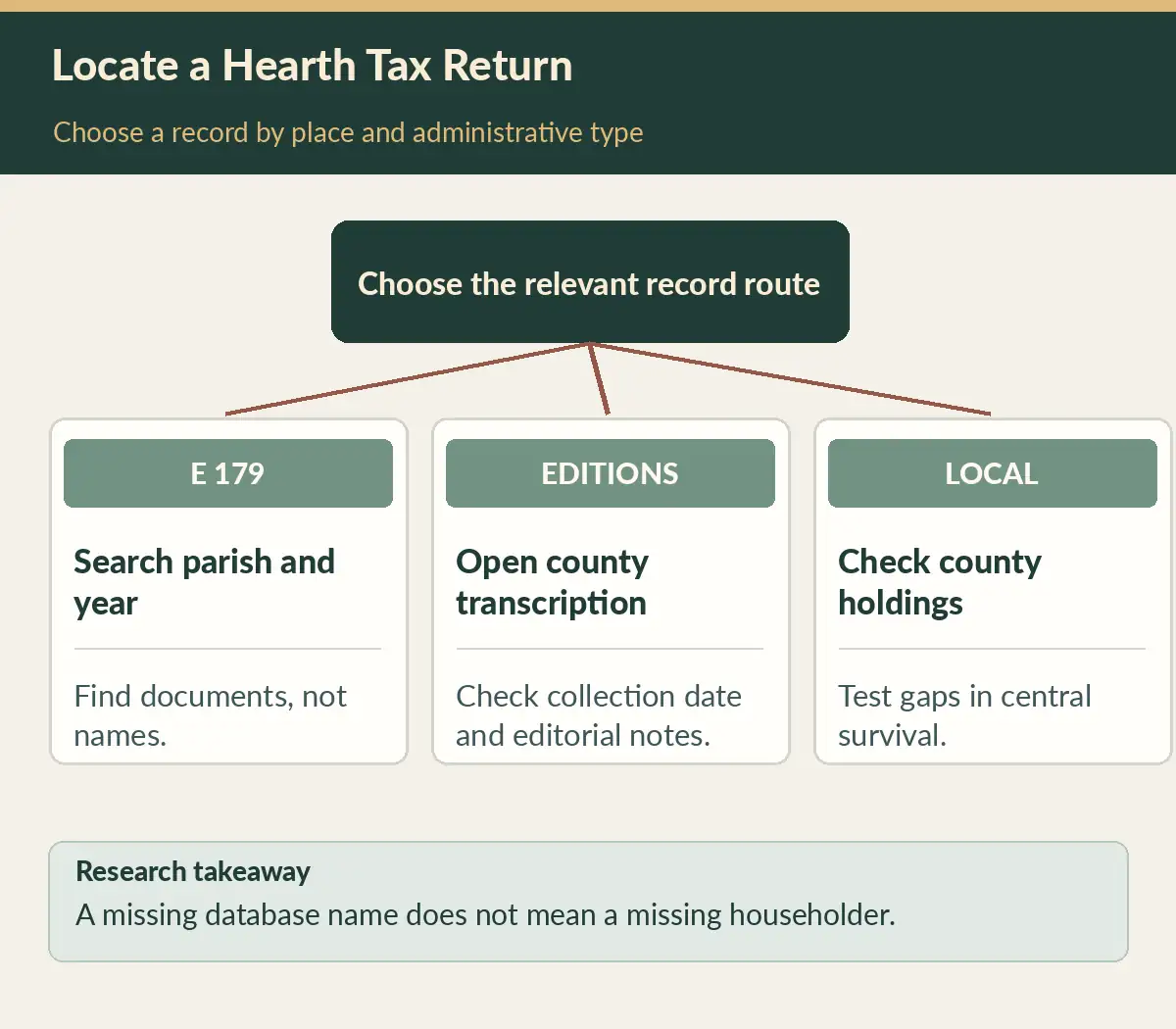
To find a householder in England’s 1662–1689 hearth tax, begin with a county, parish and likely collection year. The National Archives E 179 database identifies taxation documents by place and type, not by each taxpayer’s name. Then consult the surviving assessment, exemption return or reliable published transcription. Hearth counts are clues about a taxed dwelling, not a census of every resident or proof that the named person owned the property.
What the Hearth Tax Actually Counted
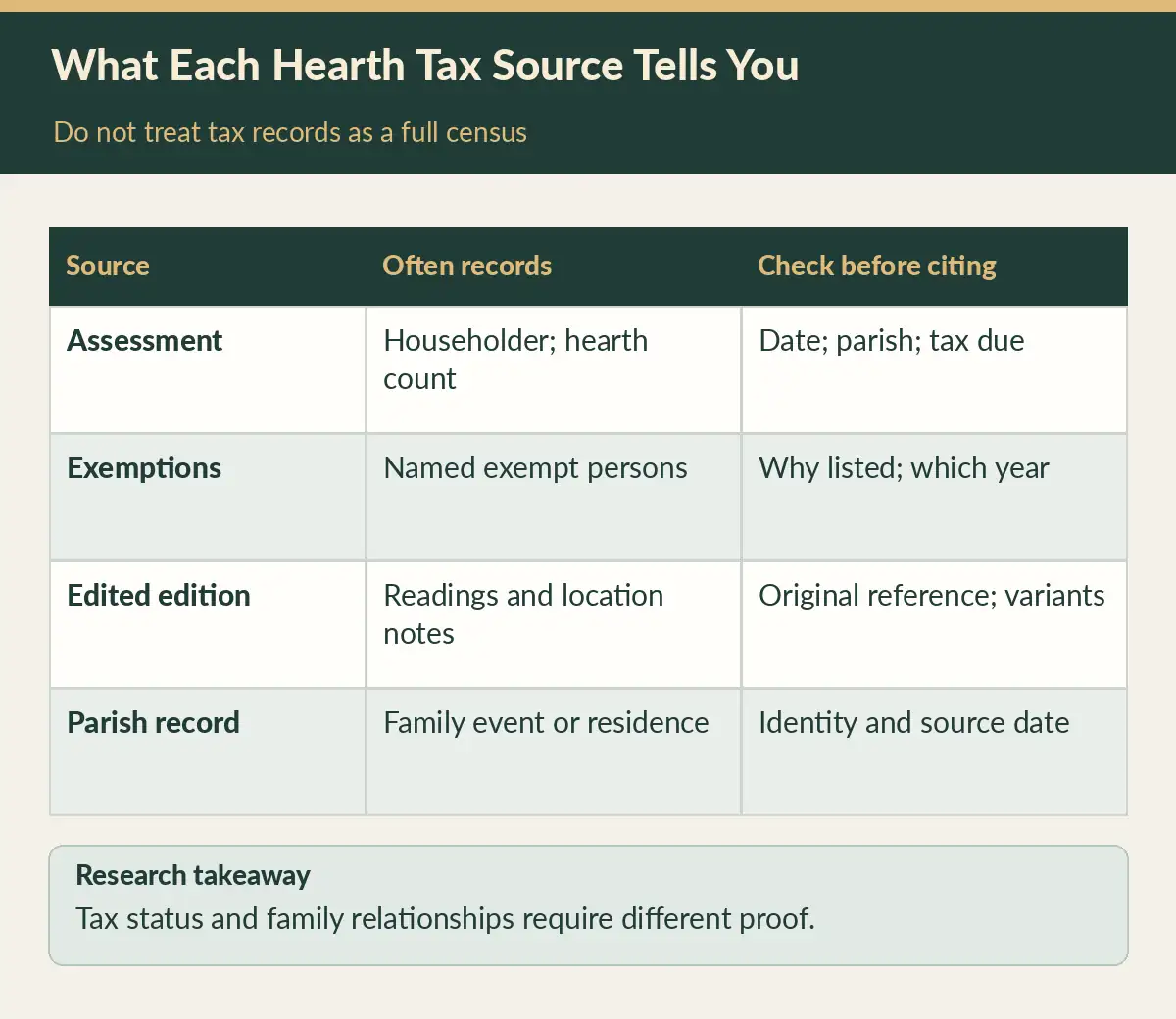
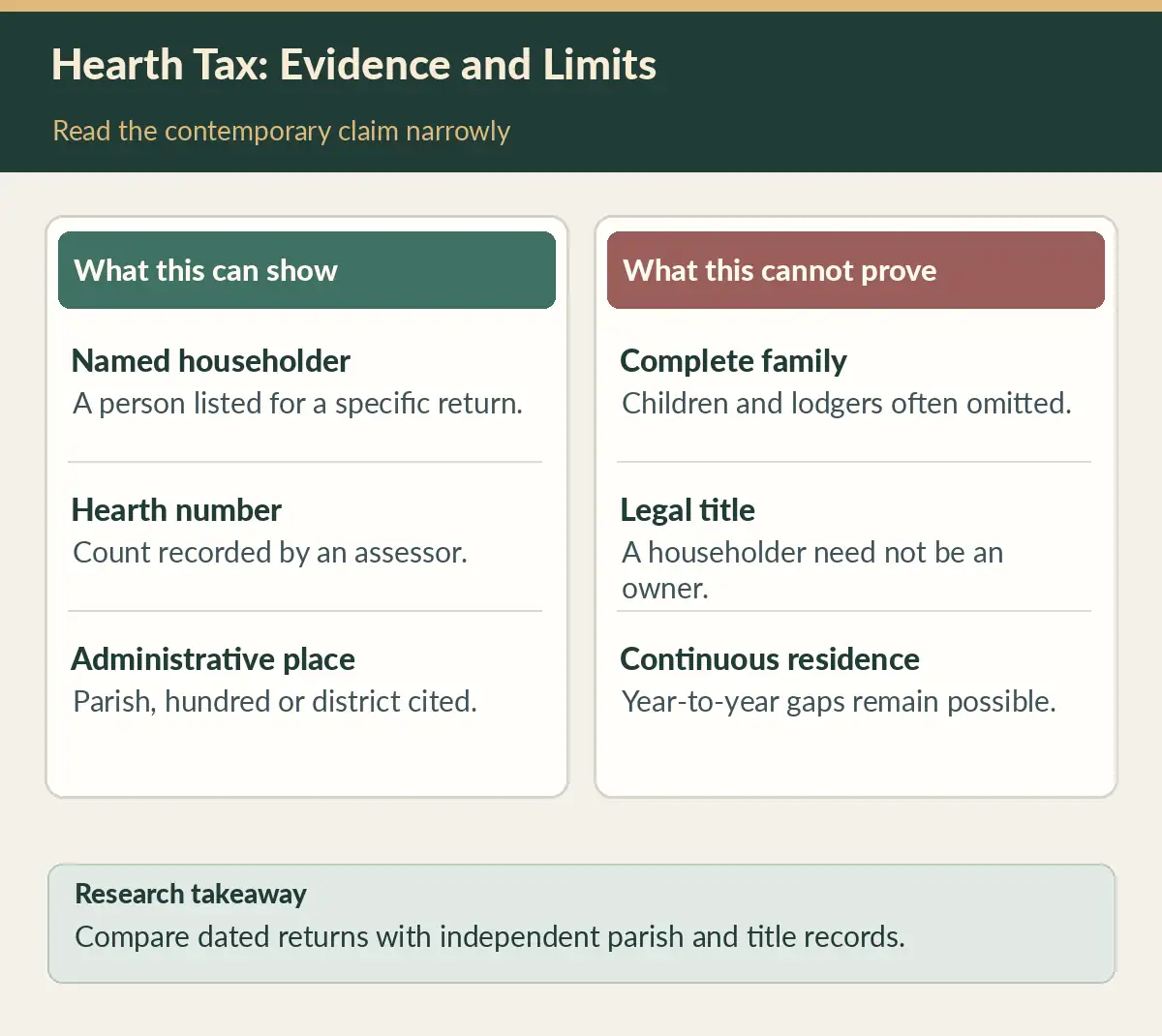
Introduced in England and Ireland in 1662, the hearth tax imposed a charge on fireplaces, hearths and stoves rather than counting individual people. The English tax was abolished in 1689. A surviving return can name an assessed householder and show the number of chargeable hearths; the entry is not necessarily a list of the spouse, children, lodgers or servants living under that roof.
A large count suggests a larger dwelling, yet interpreting wealth requires local context, exemptions and institutional buildings. Do not convert a tax assessment into a deed or household census. Write down the date and the administrative place alongside the recorded count before comparing families.
Start with Place and Surviving E 179 Pieces
The E 179 database describes tax documents, places contained in them, document types and sometimes their collections; its search does not identify named taxpayers within the pages. Enter a period-appropriate parish or hundred, then inspect variant place headings and nearby jurisdictions.
Refine by hearth tax grant and year, but remember that a narrowly selected collection may omit material not confidently assigned to it. Save full E 179 piece references and the original document descriptions. The 1662–1666 and 1669–1674 periods are especially prominent among surviving returns, but survival and legibility differ by county.
Decide Between Assessments and Exemption Lists
An assessment can record named householders who were charged for hearths, while other returns may identify people exempted or administratively excluded. Consult the National Archives taxation guide for distinctions in assessment, collection, exemptions and arrears.
In a worksheet, label a line as assessed, exempt, disputed or unclear rather than assigning every name an identical tax status. People omitted because of exemptions, destroyed pages, administrative changes or the lack of surviving records cannot automatically be treated as absent from the community. Preserve a return’s marginal notes, original spelling and number of hearths exactly as written.
Follow the Collection Year, Not Just 1662–1689
The dates printed on a website’s collection heading are not necessarily the date of a particular surviving manuscript. Hearth tax was collected repeatedly and the assessed householders, counted hearths and responsible officials could change between rounds. Ask which payment or collection the document covers, what geographical unit it actually lists and whether adjacent returns are truly comparable.
A person named in one year and missing two years later may have moved, died, changed tax status or simply fallen into a documentary gap. Two adjacent entries with the same surname are not evidence of siblings. Put every original date into a dated source log.
Locate an Edited Transcription Without Losing the Original
The University of Roehampton Hearth Tax Research Project provides scholarly county editions and free digital access to edited returns. Search the appropriate edition’s geographic contents and explanatory editorial notes before relying on a spelling-normalized personal index.
Transcriptions improve discovery but can silently expand abbreviations, normalize punctuation or group several manuscript lines into one entry. If a relationship claim depends on a disputed surname, inspect the original image or request a reproduction when possible. Cite both the E 179 source piece and the particular edition, including page or entry.
Compare Two Same-Name Householders Across Parishes
Imagine Thomas Baker occurs in a parish assessment and a second Thomas Baker appears across a county boundary. Construct two separate candidate files. Record return date, parish, hundred, hearth count, tax status and nearby named householders for each.
Parish baptisms, marriage entries, probate documents and land transactions may later identify a spouse, occupation or address, but the hearth register by itself usually does not. A match on surname plus two hearths is weak because such combinations may be common. A stronger link would include independent place continuity and a dated household or property transaction that specifically fits the same person.
Use Hearth Counts as Context, Not Property Titles
One hearth might identify a small dwelling or accommodation, but the physical count can depend on how the assessor treated shared space, outbuildings and exemptions. A six-hearth line does not establish the assessed householder as the legal owner. Conversely, a person living in rented quarters could still be represented in some records.
Compare the return with parish rates, a lease, manorial court roll or probate inventory if the question concerns ownership or occupancy. Show the evidence types in separate columns: taxed hearths, recorded resident or householder, and documentary title. Report what each supports without converting social context into an unsupported ownership claim.
Handle Empty Searches and Uncertain Place Boundaries
Negative searches are meaningful only after checking whether the relevant place, year, tax type and document class survive. The E 179 search may return a document from a broad administrative division whose manuscript never names your target parish directly.
A printed county edition may cover only selected years and another edition may preserve fragments of an exemption schedule. Write “not found in this examined assessment” rather than “the ancestor did not live here.” Search neighboring parishes and name variants, and inspect county archive catalogues for locally retained copies. Distinguish missing historical documents from the narrower failure of a modern index search.
How We Research an E 179 Householder
We first establish the historical place name and search E 179 by place, tax grant, document type and collection date. Next we inspect the source description and an available scholarly transcription, recording whether a named line is assessed or exempt.
We return to the manuscript where necessary to verify ambiguous handwriting and the hearth count. We compare the person with independently dated parish and probate evidence while retaining alternate same-name candidates. The affiliate disclosure explains editorial relationships; the official National Archives and Roehampton resources are our first reference points.
More Records and Archives Guides
Make a Reproducible Hearth Tax Citation
A useful citation gives the repository, E 179 piece or sub-item, historical county or parish, tax collection year, type of return, folio or line and the named entry. If the reading came from an edited county volume or Hearth Tax Digital, add the editor, edition, page or persistent identifier, and access date without implying the manuscript itself was viewed.
Transcribe the literal hearth count and any exemption note. When a later parish document resolves the identification, cite that document independently. A search log should specify which geographical units and collection years were checked so another person can reproduce a genuine absence or find a neglected alternative.
No. Assessments generally concern householders and hearth counts, not every occupant.
The National Archives E 179 database is a document locator, not a name index for each taxpayer.
No. Surviving assessments are uneven across years, document classes and counties.
No. Separate title and occupancy records are needed to establish ownership.
Roehampton’s Hearth Tax Research Project offers scholarly edited returns, including digital publications.