
To trace a Paris death into estate records, search the Archives de Paris DQ8 death and succession tables by the responsible tax office, year and surname initial. Read both facing pages: a date and registration number on the right may lead to an original succession declaration. A death-table entry, however, is not proof that any estate was declared or that a particular person inherited property.
Recognize the Fiscal Record Rather Than a Civil Certificate
Paris tax offices called bureaux de l’Enregistrement maintained tables of deaths and successions to administer inheritance duties. The DQ8 tables are not duplicates of civil death certificates: they can provide a date, residence, profession, tax references and sometimes later estate details, depending on their period and form. The original succession declaration may identify heirs, property and notarial acts; it is a separate source.
The Archives de Paris succession guide explains those differences. Do not label every DQ8 listing as a probate file. Identify the question first: death, tax domicile, heirs or the administration of an estate.
Pick the Correct Bureau and Administrative Period
Archives de Paris organizes its death tables by the Enregistrement bureau responsible for a person’s fiscal domicile. Use the archive’s concordance of arrondissement and tax office for the time of death, not the present-day district alone. The familiar modern arrondissement pattern changed as Paris expanded, including annexations in 1860; a neighborhood may have belonged to a different authority at the earlier date.
Note the address as it appears in the source and which bureau issued the table. A zero-result search for one bureau cannot establish that the person is absent from every Paris series. Try documented referrals and boundary-era alternatives before closing the search.
Search Married Women Under Their Birth Surnames
The Archives de Paris specifically instructs researchers to search married women under their maiden names in the DQ8 tables, while spelling and surname particles can add complications. Search a woman’s documented birth surname first, retaining accents, historical spelling and initials.
If the family knows only a married surname, locate a civil marriage act or another record that supplies the birth name before making broad search claims. The archive also notes that names with particles are often searched at D. Maintain a candidate list where names are uncertain, and do not assume that two women with the same surname and death year are identical without comparing addresses and family evidence.
Read Both Pages of the Entry
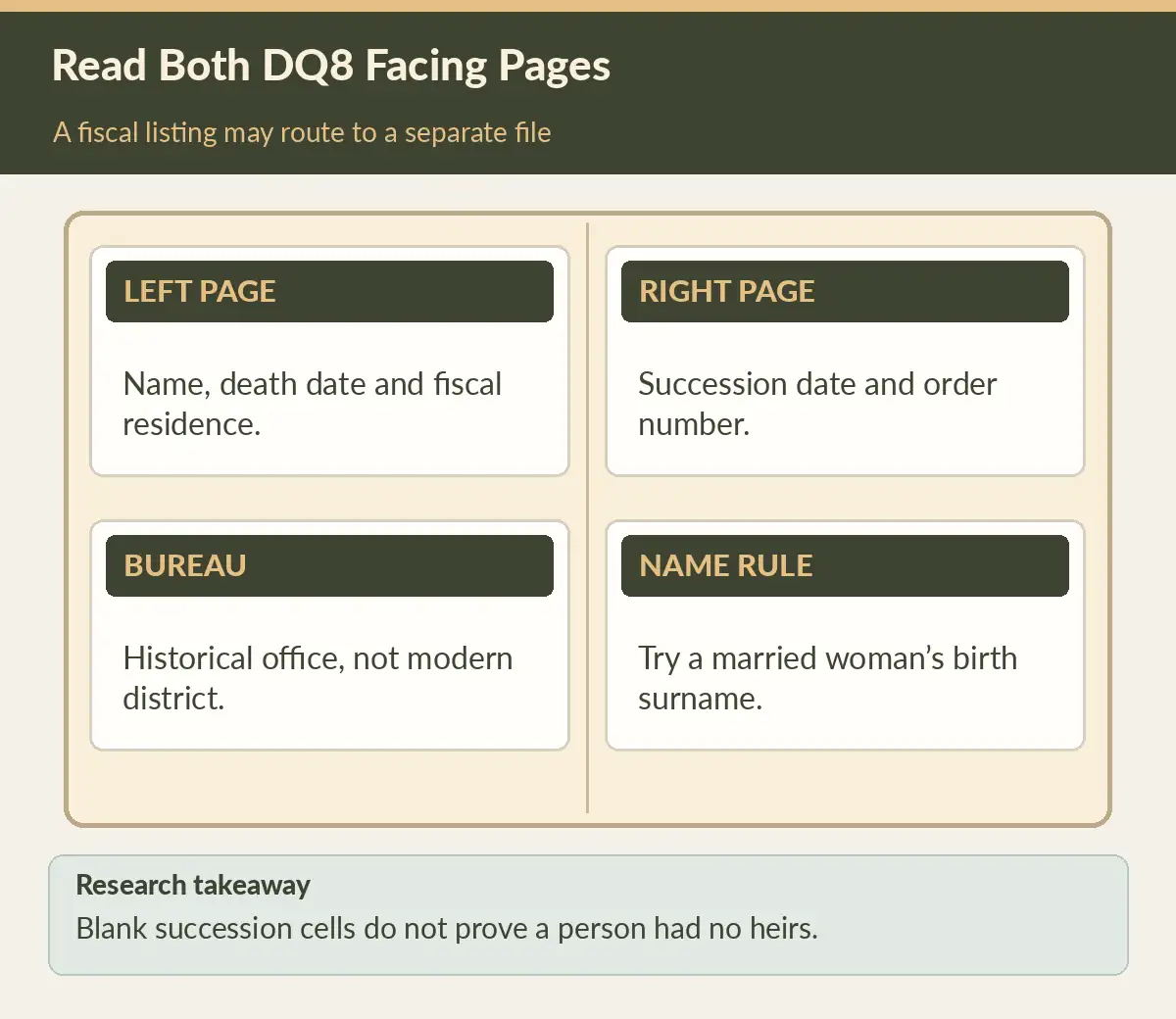
The DQ8 guidance explains that an entry extends across facing pages. The left side generally identifies the deceased and the date or fiscal location, while the right side can carry a date and order number for a succession declaration. Capture both pages and repeat column headings in your transcription; otherwise a number might be mistaken for a birth date or a certificate number.
In some periods, names are organized by calendar sequence under surname initials, not in a single modern alphabetical index. Scan the whole letter segment for a year before recording a negative result. The date of death and date of a tax declaration are distinct events.
Use the 1791–1817 and Later Table Distinctions
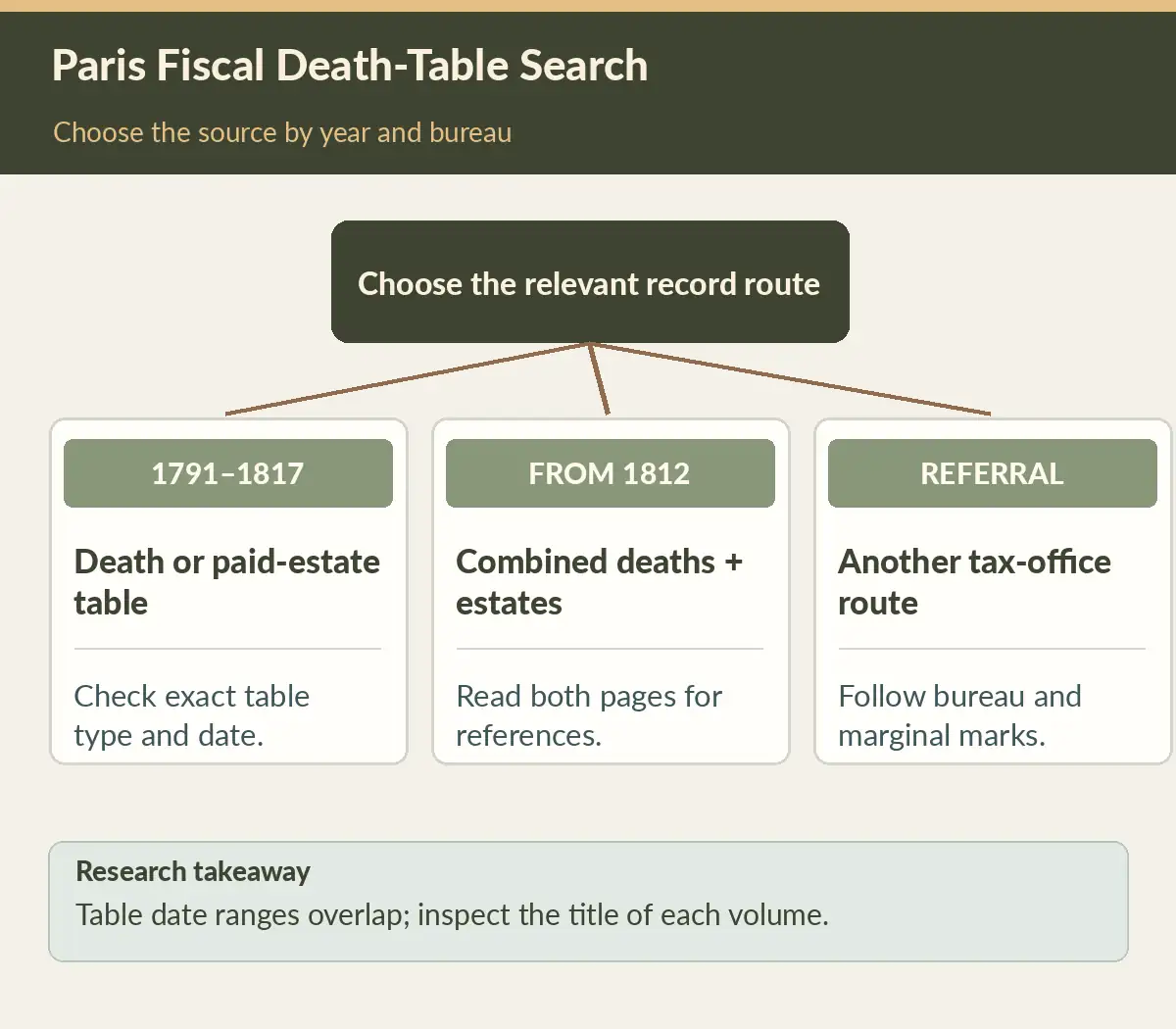
Paris archives identify separate early forms: death tables from 1791–1817 generally give death, occupation and address details, while paid-succession tables supply the lead to declarations. Combined death-and-succession tables occur from the early nineteenth century onward; some periods also include tables of children who died.
The digitized series is broadly presented as 1791 to around 1953, but each document has narrower dates and indexing conditions. Do not apply a column or coverage rule from an 1880 book to an 1800 register. Record the table type on every citation, then decide whether an estate reference is possible from that particular form.
Understand a Blank Succession Date
The archive’s DQ8 instructions explain that when the relevant right-page date is absent, no succession declaration was registered in that office’s series; this may indicate an absence of registered assets. It is not a civil judgment that nobody survived the deceased, that there was no will, or that the person possessed absolutely nothing.
A referral mark or other column may direct the researcher to a different bureau or another registered document. Keep three evidence statuses separate: death listed, succession identified, declaration inspected. The question whether a specific child inherited a Paris property cannot be settled by a blank in a death table.
Retrieve the Original Declaration with Date and Number
When a DQ8 row gives a succession date and order number, use the Archives de Paris finding aids for declarations of succession and the correct tax office. The archive explains that the corresponding original declaration registers may be consulted in the reading room rather than through the same online table interface. The separate declaration can record the deceased’s identity, heirs’ reported relationships, estate contents, property and notarial references, which must be read in context. Copy the right-page citation precisely and request the specific register by bureau, declaration date and order number; a vague person-name request may not identify a retrievable volume.
Compare Heirs with Independent Family Events
A declaration can state that Marie Dubois is a daughter or that a surviving spouse held certain interests, but the information was submitted for a fiscal purpose at a particular date. Compare such claims with civil births, marriage acts, death certificates and notarial deeds.
Maintain separate columns for reported relationship, documentary cross-check and outstanding contradiction. If an heir used a different surname or the deceased was known by a trade nickname, use known addresses and dates to resolve the variation, not a broad assumption that the declaration names every child. A succession record documents an estate process, not the complete population of a family tree.

How We Research Paris DQ8 to DQ7
We identify the historical arrondissement and tax bureau, search maiden-name variants in the correct DQ8 table type and examine both pages of every promising entry. We transcribe the death date, occupation, residence, possible referral and any succession number.
A declaration reference is traced separately through Archives de Paris registers and then checked against civil and notarial records. We do not treat an empty estate-date column as evidence of no relatives. The affiliate disclosure applies to our editorial material, while the official Paris archival instructions are the authoritative search route.
More Records and Archives Guides
Cite Each Fiscal Step and Access Condition
An effective citation identifies Archives de Paris, the DQ8 series, exact table title, bureau, date range, volume reference, two-page opening and the individual row. Cite a subsequently consulted estate declaration separately with the corresponding collection and register locator, date and order number, and describe whether it was inspected onsite or via a reproduction.
For a civil death act, use the correct civil register reference rather than reusing the fiscal citation. Note the access date for the digitized table and preserve any spelling changes. This makes the distinction between an index clue, a tax declaration and an independently verified heir visible to the reader.
No. Some deaths have no succession date or a reference elsewhere.
No. They are fiscal registers and should be checked against the civil act.
The Archives de Paris recommends using her birth surname.
The succession date and registration order number may appear on the right-hand page.
No. The archive directs some original declaration registers to reading-room consultation.