
French tables décennales are ten-year alphabetical indexes to civil registrations of births, marriages and deaths. Choose the correct commune, the event type and the decade first; locate the name in the table and then open the chronological civil register to read the full act. The table is a navigation aid, not the legal record itself. A date beside a surname may lead you to the correct act, but it does not prove the person is your ancestor, supply an entire family relationship, or establish that every event was indexed correctly.
Identify the historical commune and registry system
French departmental archives describe the civil-registration system introduced during the Revolution, replacing parish recording for civil events. Registers are organized primarily by commune. Earlier baptisms, marriages and burials belong in parish books and may have their own annual tables, but they must not be mistaken for the later civil ten-year indexes. Write down the event’s approximate date and the historical commune rather than beginning with the modern département alone. Administrative borders and commune names can change, particularly where several villages merged or a city developed separate municipal divisions. To go further, our guide “French Military Registres Matricules” shows how to find a recruit by class.
The Archives départementales de Seine-et-Marne describe tables décennales from the revolutionary period onward, commonly organized by commune and by birth, marriage or death. The departmental catalog can hold both municipal copies and court duplicates in differently named series. A missing scanned table is not proof that no act exists; determine whether the inventory covers your commune and specific years. Choose a ten-year interval that includes the event, and test adjacent intervals for uncertainty about a date or a late registration. Do not apply a modern standardized decade boundary without inspecting the catalog’s label. Our guide “Dutch Population Registers from 1850” covers a related question.
Read the alphabetical table before ordering an act
Open the departmental archive’s digitized civil-register section and select the historical commune, then the tables décennales collection. Browse the section for naissances (births), mariages (marriages) or décès (deaths). Alphabetization can be by first surname letter or follow local copying conventions rather than perfectly sorted full surnames. Search the whole letter run for spelling variations, accents and compound names. A maiden or married surname may be used in a different way from what a modern family database expects. Write the name exactly as the clerk entered it.
Copy the indexed date and every identifier shown on the scan, including page or image number. Then switch to the chronological register of acts for the corresponding event and year. Locate the act by date and number when available. Compare the person’s full names and the informative details in the original before accepting the match. The index may omit a number, transpose a date or point to a different entry after copying; never use an automatically extracted snippet alone as a source citation. Record the table reference and the original act separately.

Allow for Paris districts and documented missing series
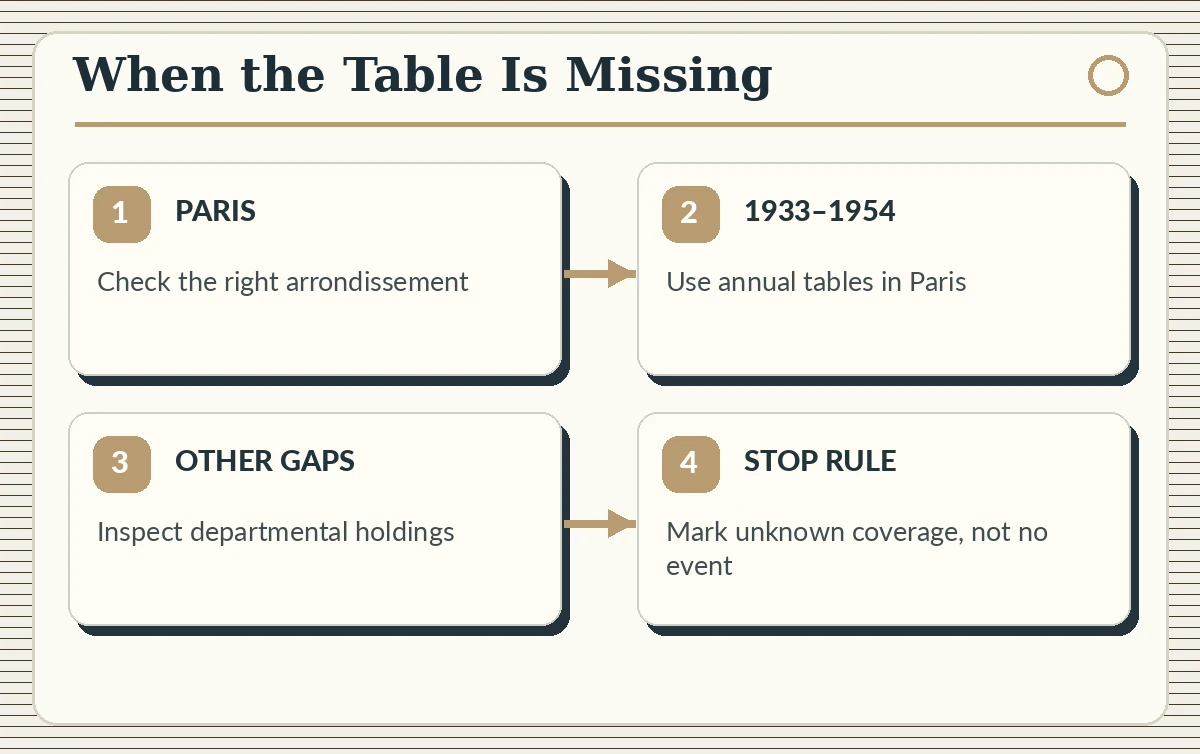
For Paris, the city archive explains that post-1860 civil records are arranged by its twenty arrondissements, with ten-year lists divided by event type. If you know the city but not the district, searching one convenient arrondissement is not sufficient. Work through the relevant districts systematically, record each negative result and then follow the indexed event to its act. Crucially, Archives de Paris states there are no tables décennales for 1933–1954: use the annual indexes for those years rather than falsely treating the missing decade set as a family absence.
Coverage varies in other departments too. The Tarn-et-Garonne archive warns that the early implementation of these tables was inconsistent, even though the revolutionary system began in 1792, and records particular missing runs. Towns, repositories and access rules differ: some indexes are online while the register page is onsite or restricted. The reader’s task is to distinguish an absent scanned image, an absent cataloged volume, and a genuinely lost historical document. When that distinction is unknown, write “not yet located,” not “did not happen.”
| Check | Evidence to record | Do not infer |
|---|---|---|
| COMMUNE | Identify town at the event date | A name alone is proof of identity |
| REGISTER | Read the chronological original | The index replaces the original |
| CITE | Keep both source references | Unverified kinship or an event |
Verify names and kinship in the full civil act
A table décennale line normally identifies an event well enough to locate the chronological record. The act may add the parents’ names, occupations, residences, witnesses or spouses according to record type and historical form. Examine the act itself instead of assuming those fields will always be present. If a marriage act identifies parents, compare its claims to birth and death entries; a witness sharing a surname is not automatically an uncle or a sibling. Separately transcribe the exact civil wording and translate it into English only after preserving the original. Our guide “Dutch Marriage Supplements” covers a related question.
Make a two-column source comparison. One column holds what the table explicitly says: surname, given names, event and indexed date. The second records the full act’s details and any divergence. Use the original act for the historical fact where it is readable, and keep the table as evidence of how you found it. Multiple people can have the same names in one commune. Check ages, occupations, spouse, parents and address and look for contradictory records before merging two candidates in a family tree.

Test a fictional marriage entry from index to original
Suppose a fictional Louise Bernard appears under marriages in an 1883–1892 decade table for a provincial commune. The index gives the year and a day in June, but a separate family note calls her spouse Émile. First locate the marriage act by the indexed day, then compare the spouse’s full name and the parents and witnesses stated in that act. If the spouse is different, this is another candidate or a family-note error, not permission to modify the register. Add the page and act number to a citation.
If no matching act appears on that date, search nearby pages and the neighboring chronological book, noting the discrepancy. It might be a copied index error, a catalog issue or a different commune with a similarly named person. Finish with one reproducible next action, such as requesting the missing civil volume from the departmental archive. This disciplined transition from table to act makes a short index entry useful without allowing it to impersonate the underlying legal document.
How We Research French Civil Indexes
We compared departmental archival explanations of the tables décennales with the Archives de Paris notice on arrondissement searches and its 1933–1954 exception. The names in our example are invented. Our method requires a table-to-act match and keeps genuine catalog gaps separate from no-result name searches; current restrictions must always be checked with the responsible repository.
More Records and Archives Guides
Official archive guides for french civil indexes
archives.seine-et-marne.fr — Seine-et-Marne departmental archive: commune indexes, civil acts and record classifications.
archives.paris.fr — Archives de Paris: arrondissements and lack of decade tables in 1933–1954.
archives.tarnetgaronne.fr — Tarn-et-Garonne departmental archive: early table gaps and registry history.
These sources are provided for archival research, not as paid endorsements. Review the GenHis affiliate disclosure. Coverage, digitization and access conditions can change. Historical documents may contain outmoded or biased labels; interpret them in context, and avoid sharing private information about living people.
They are ten-year name indexes for civil births, marriages and deaths, organized by commune and record type.
No. Locate the dated act and read its full details before asserting a relationship.
The tables are divided by arrondissement; for 1933–1954, Paris requires annual tables instead.
No. Early implementation and surviving volumes vary, so check the departmental inventory.
No. Compare the original acts, spouses, parents, ages and localities before merging identities.