
Start With the Municipality and Event Before the Name Index
Belgium’s State Archives explain that civil status registers were kept by municipal authorities from about 1797. Birth, marriage and death acts appear in chronological registers, while separate alphabetical indexes help locate them. The best starting point is therefore a municipality, an approximate event date and an act category, not a countrywide name result alone. A database hit is a pointer to a recorded event; the original act should be examined before asserting parentage or a precise date.
The Archives also describe earlier parish registers, but those are a different record system with different custodians and historic boundaries. If the event occurred before the civil system began, do not use the first nineteenth-century ten-year table as a substitute for the appropriate parish book. Record the municipality as it was named at the event, since modern borders and linguistic forms can change the location where an act was created.
Understand Annual Alphabetical Lists and Ten-Year Tables
Civil acts are kept in event-date order, while yearly alphabetical indexes point researchers to a record number or register page. The State Archives says that annual indexes were assembled at court registries into ten-year tables, for example 1851–1860 and 1861–1870. The table entry is an access device. It may contain a person’s surname and a reference, but it should not be quoted as though it contains all the witnesses or parents from the underlying act.
Start with a range matching the suspected event year and search original and alternate surname spellings. Note the exact decade, municipality, event category, surname, given names and referenced act number. If you search a later decade, preserve that as a separate attempt. A person who lived in one town may have married or died in another, so negative results must be qualified by municipality and event type rather than stated as a nationwide absence.

Open the Correct AGATHA Record or Image Set
The current AGATHA archive gateway provides access to genealogical sources, historic church books, civil registers and separate analyses or person-name indexes. The service distinguishes scanned archival images from volunteer-extracted names. Choose a municipality, then specify births, marriages or deaths and the appropriate period. Record which search you used before following an index reference to a chronological register.
An analysis search may list a named person but not reproduce the full act. Conversely, browsing a register can reveal a relevant handwritten entry that has not been indexed. When the surname is difficult to read, inspect neighboring entries and the act sequence to check a numeral, abbreviation or spelling. If the portal does not have an image, determine whether the underlying act remains at a municipality, branch archive or a not-yet-digitized holding.
Distinguish the Civil Act From a Copied Name Entry
The event type controls the identity test. For a birth, inspect the child, declarant, parents and the actual date fields shown by the act. For a marriage, separate the spouses’ identities from statements about parents and witnesses. For a death, check the reporter and whether the death date differs from registration date. Those fields can vary, so never assume an index contains all required information.
Preserve the archival record’s exact number, date, municipality and image link. A table may refer to an act that spans two images, or a page whose printed number differs from the browser image count. Cite the creator and record sequence rather than only the website delivering the scan. When two people share a name, compare occupation, age, family members and home locality; a ten-year surname listing alone cannot prove a connection.

Know What Is Digitized and What Remains Restricted
The State Archives’ AGATHA homepage describes a large set of digitized civil registers concentrated in historical years through about 1920; the holdings and image collections continue to grow. Public access rules for more recent civil records are not the same as the date coverage displayed by the search interface. A missing later record should not be treated as a historical loss without asking the appropriate municipality or archive about custody.
Belgian access rules distinguish births from marriages and deaths, and policy descriptions have been updated in different official guides. For recent records, the birth-access period is more restrictive than many older marriage and death records; the latest law and archive implementation must be checked before requesting personal details. Do not use historical research to disclose a living person’s protected information. Record any access refusal as an administrative limit rather than a negative event finding.
Use Municipal Geography and Language Variants Correctly
Belgian municipalities may be documented under Dutch, French or local historical spellings. Begin from a reliably dated place reference, then check how the archive groups the municipality at the relevant time. If an expected surname appears in several jurisdictions, avoid broad merging based solely on pronunciation. Link the event to a specific historical locality, decade, and act before comparing it to a household in a different region.
Keep an index spelling and a literal transcription of the act side by side. An indexer may modernize or misread accented letters, particles or a handwritten patronymic. In a marriage record, note each spouse’s own surname and whether names of parents were supplied by the parties or independently verified. Your proof question should concern one relationship at a time, supported by documents from the correct municipality and period.
Handle a Missing Act With an Explicit Search Log
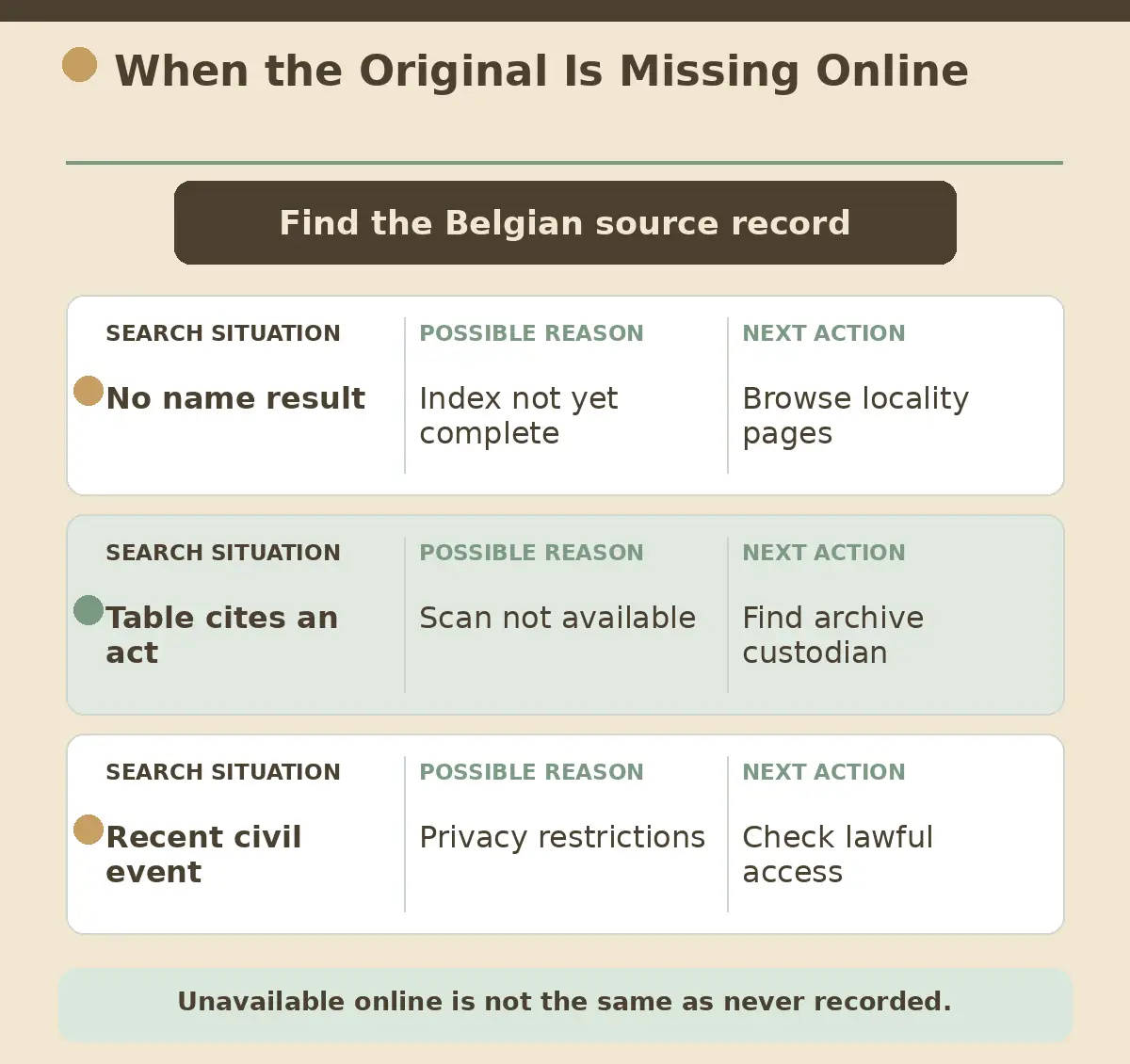
If a ten-year table points to a register that is not digitized, record the act reference and consult the State Archives’ guidance for the local branch or municipality. If no table entry exists, examine the annual alphabetical index or relevant pages when available. A gap may reflect scanning status, archival transfer, handwriting, an incorrect location, or the event falling just outside the decade that you searched.
For a negative search, record the exact municipality, period, index type, variations tried and whether original images were browsed. Follow any alternate birthplace, known partner or dated residence evidence into another municipality only as a documented new hypothesis. Never conclude that an event did not happen merely because one text search returned no hits; absence from an index is much narrower than absence of a historical event.
More Records and Archives Guides
How We Research a Belgian Civil Status Index Reference
We begin with AGATHA and the Belgian State Archives’ municipality-based inventory, verify which decade and event class covers the research question, and copy a ten-year table or annual index locator. We then browse the chronological original act, transcribe each relevant field and cite the municipal creator, year, act number and image where available. We do not use a volunteer transcription as a substitute for the original.
We separate lawful public access from modern protected records and test a namesake with independent residence, occupation and family evidence. Where an image is unavailable, we note the precise discovery or custody gap and provide the next contact path without asserting that the act is lost. Our affiliate disclosure describes editorial policies; this guide does not claim a paid relationship with the Belgian archives.
The State Archives describes municipal civil registration from about 1797, while earlier events usually require parish books.
It is an alphabetical reference compiled from annual indexes, used to find the original chronological act.
Not necessarily. Check whether you are viewing an index analysis or a scan of the municipal register.
No. The State Archives continues to digitize records and online coverage differs by municipality and series.
No. Access depends on event type, age and current legal rules; consult the responsible authority.