
Start With the Reconstructed Collection, Not a Missing Original
Most early Paris parish registers and civil registration books were destroyed during fires in May 1871. The Archives de Paris explain that this affected parish registers before 1792 and civil records before 1860, including earlier suburban localities later absorbed by Paris. The reconstructed collection is a partial replacement assembled from other surviving documents. A modern search that fails to find a person cannot prove that no birth, marriage or death took place.
The archive estimates roughly eight million acts were lost and nearly three million reconstructed in the first campaign; much of the surviving reconstruction concerns the nineteenth century. That scale matters for search expectations. Begin by determining the relevant event type and estimated year, then use the archives’ alphabetical fiche before opening any act. Do not describe a reconstructed act as the original register destroyed in 1871.
Search Alphabetical Cards by Event and Birth Name
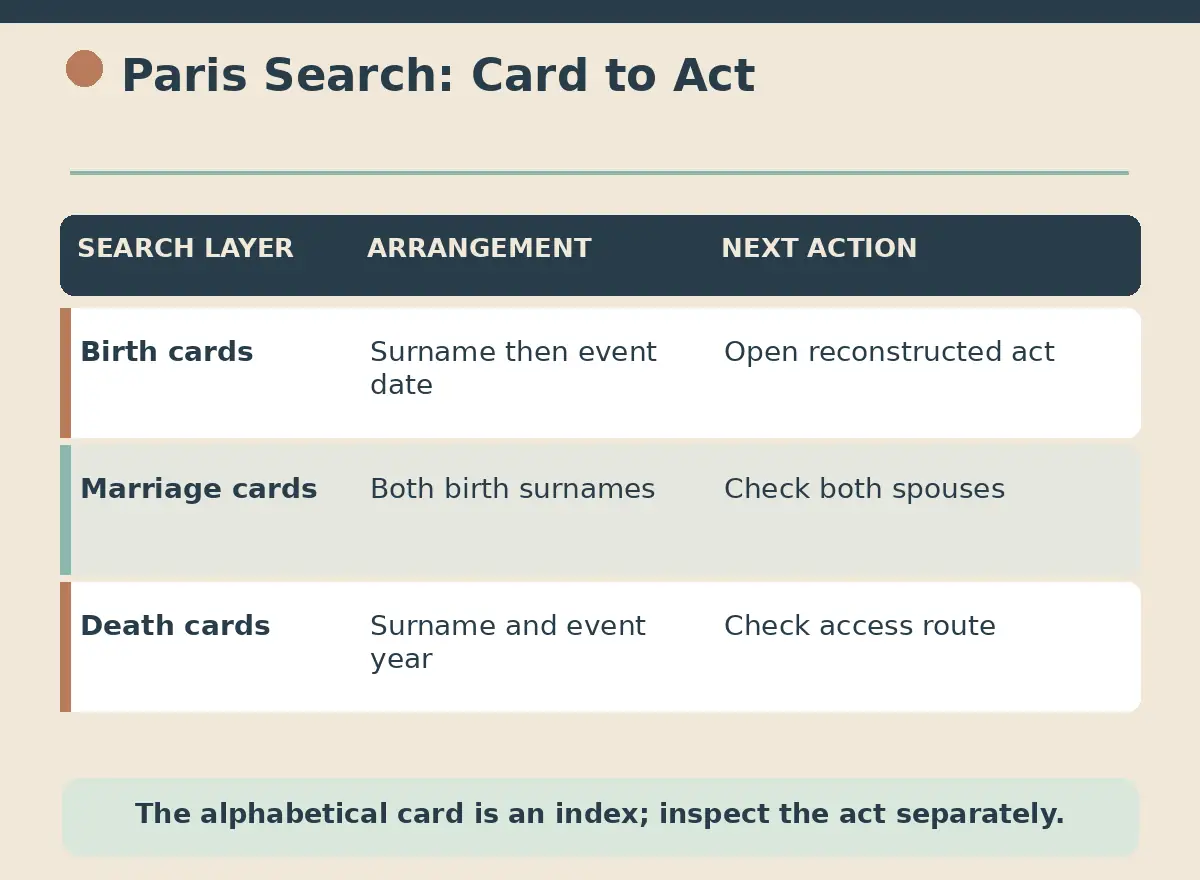
Open the digitized alphabetical files of the first reconstruction. They are arranged separately for births, marriages and deaths. Within each event category, look by surname and then date. The archive advises searching names with particles under the particle; do not assume that the expected modern alphabetization will always find the card.
For marriages, search both spouses independently: the archive created a card for each party, and the wife is indexed under her birth surname. Copy the exact spelling and given names, event year, date and the parish, former arrondissement or annexed commune shown. A card is a finding aid pointing to an event; it is not sufficient to decide the identity of parents or to assume two similar surnames refer to one household.
Move From the Fiche to the Chronological Act
Use the precise date from the card to browse reconstructed acts. The archive sorts acts first by date and then alphabetically, but warns that some items are out of order. When the expected entry does not appear, inspect all acts for that date instead of declaring a failed match after only one surname range.
Several views can relate to one person: a reconstructed act and sometimes copies of the documents used for reconstruction. Capture each image reference separately. A visible parental name or residence may have been supplied decades after the event from a family document. That information is useful, but its origin and date can differ from a contemporaneous parish entry. Transcribe both the act wording and any supporting copy.
Choose the Online or Reading-Room Access Route
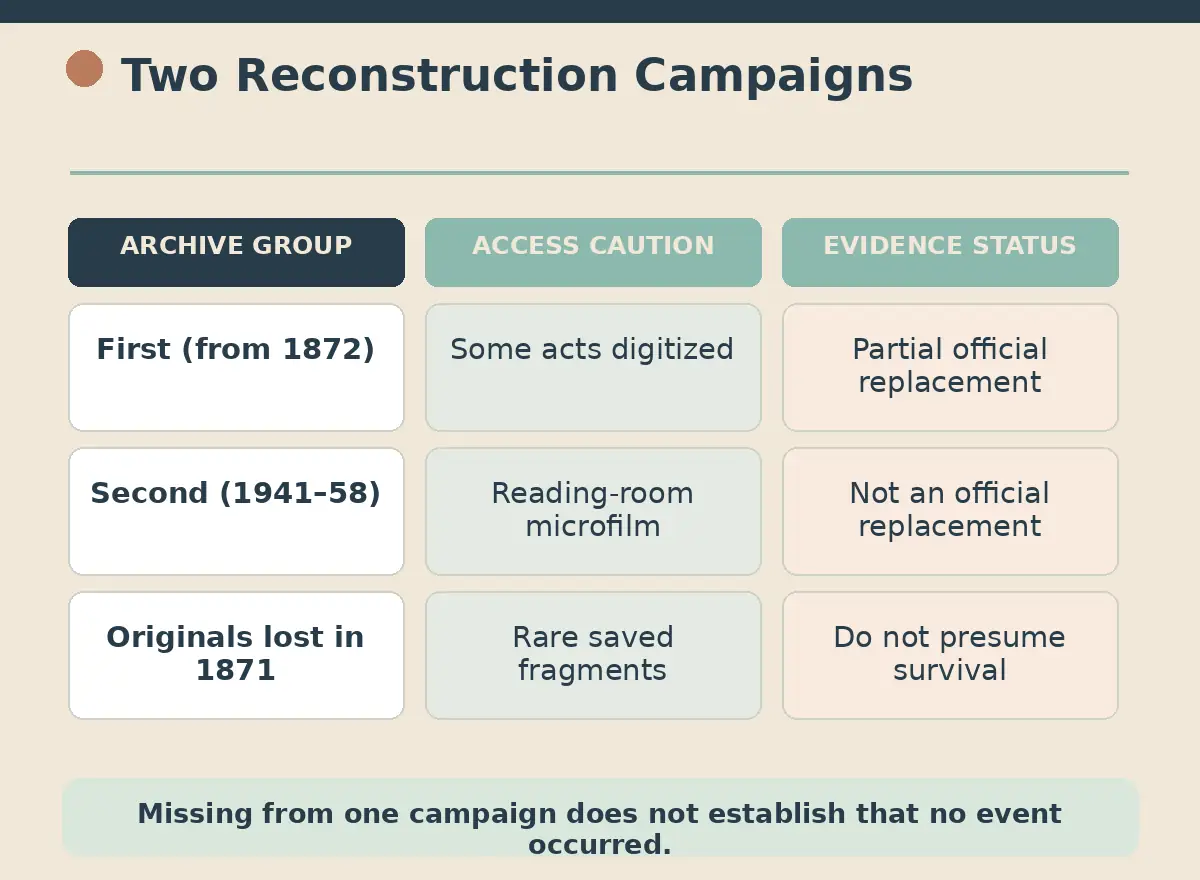
The Archives de Paris distinguishes the first reconstruction’s digitized alphabetical cards and some acts from material requiring consultation in its reading room. Its overview identifies online access for reconstructed births and marriages, while deaths and the second reconstruction are described as available on microfilm in the reading room. Check the current portal for the particular item rather than assuming that a search card guarantees an immediate image of every act.
The later reconstruction, undertaken in the 1940s and 1950s, is a separate body with its own index and acts, and the archive warns that this set lacks the same official status as the first. If your first search fails, record the scope of the first file searched and investigate the second reconstruction or other substitute collections. A lack of online images is an access limitation, not proof of no underlying reference.
Respect Old Paris Boundaries and Post-1860 Registration
Before 1860 Paris had twelve arrondissements, not the modern twenty. Annexed villages also appear in the lost registers and reconstructed material. Keep the historical place label exactly as written and use contemporary maps before converting a registration place into a modern address. A bare “Paris” does not identify a parish, an act type or the administrative area responsible for the old record.
The archives separate the reconstructed pre-1860 collection from the regular civil records of the twenty arrondissements beginning in 1860. They also note a special loss of certain twelfth-arrondissement births from January 1870 through May 25, 1871. Do not route every nineteenth-century Paris event through the reconstruction database; choose the branch by event date, place and record type first.
Compare a Reconstruction With Independent Family Evidence
Build an evidence table naming the reconstructed card, actual act image, possible documentary source within it, and independent birth, marriage or death evidence. Compare parental names, occupation, household address, partner and dates rather than assigning a source because the surname is rare. Where an act was reconstructed from an extract, ask when that extract was made and whose testimony it represents.
When a record is missing, search additional Paris sources recommended by the archives, such as surviving register fragments, announcements, notarial material or cemetery notices appropriate to the era. A substitute may prove only that a family reported an event, not the exact wording of the original missing civil register. Retain the distinction in the eventual citation and in any family-tree fact statement.
For marriage records, separate the date of a ceremony from the date when an extract was copied and from the date when reconstruction commissioners accepted that extract. The same document can carry all three. The reconstruction may preserve a spouse’s birth surname without providing the full wording of a lost original. Cite exactly which layer supplied the statement.

More Records and Archives Guides
How We Research Pre-1860 Paris Civil Records
We start with the archives’ own inventory and classification of the first and second reconstructions. We transcribe the event-specific alphabetical card, preserve its historical place wording, navigate to the dated act, and inspect any reconstructed source copies. A negative result is reported by collection and act type; it is never generalized into “the event did not exist.”
We cross-check the reconstructed entry against independently dated documents before assigning a parent or spouse. We cite Archives de Paris plus the specific file or act image rather than citing a commercial index as the origin. The affiliate disclosure describes site policies, but this workflow does not claim a relationship with any record vendor.
The Paris fires of May 1871 destroyed most parish registers before 1792 and civil registers before 1860.
No. The card is a finding aid; follow its event date to the reconstructed act when one is accessible.
Search her birth surname, because the archive created marriage cards for each spouse under their own names.
No. The archives describe reading-room microfilm access for deaths and the second reconstruction.
No. Reconstruction was partial and index order can be imperfect; try variant names and other records.