
Start With the City Archive and the Correct Record Type
The Municipal and Provincial Archives of Vienna (MA 8) hold historical residence-registration papers for roughly 1904–1975, subject to important survival and administrative limits. These are residence records, not birth registers, marriage certificates or proof of family relationships. The City of Vienna provides an official enquiry service rather than an unrestricted name-search database. A useful search begins with a historical person, an approximate period, and at least one independent identifying detail.
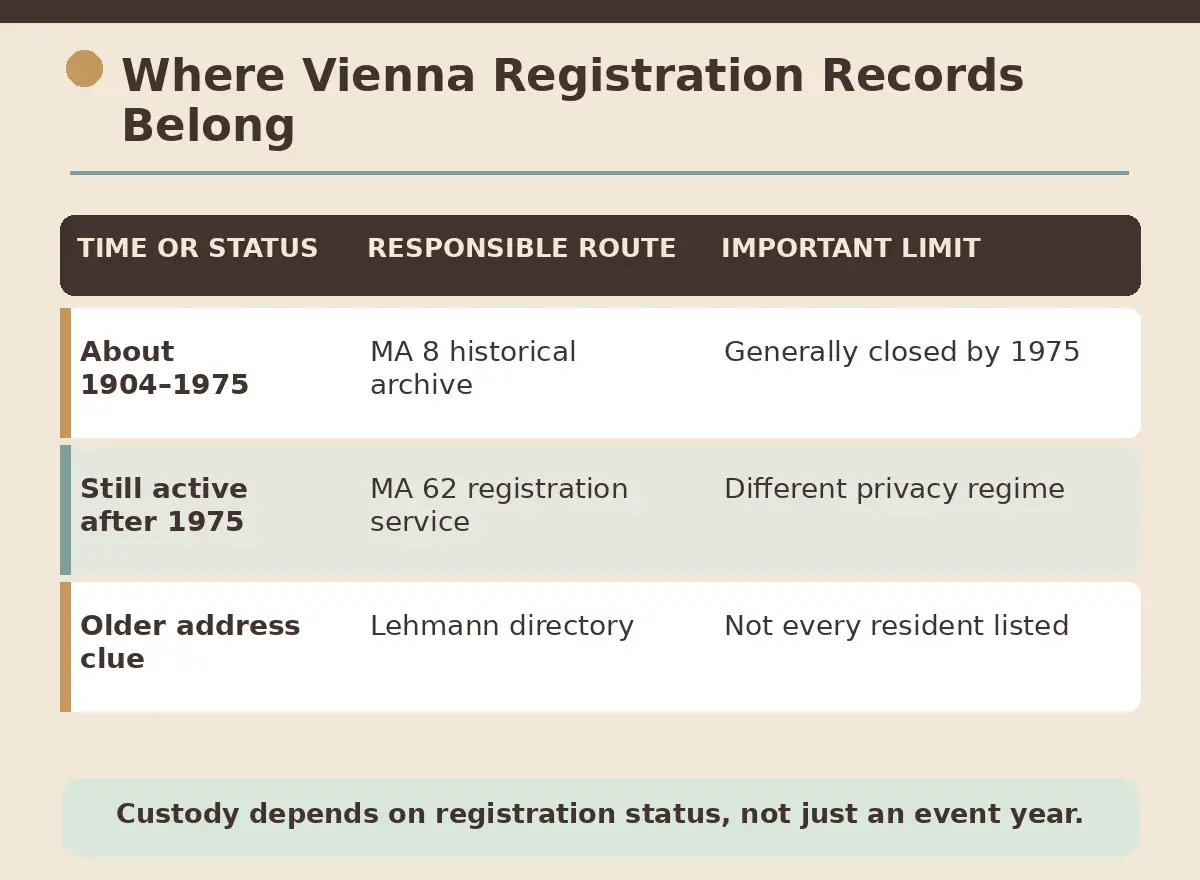
The city distinguishes registration records that were closed by deregistration no later than 1975 from registrations still current after that point, which belong to the central registration service (MA 62). Do not assume the archive has an entire continuous lifetime file for everyone who lived in Vienna. The article focuses on older, legally accessible historical research and does not provide a route for investigating the private current address of a living person.
Prepare the Full Name and One Additional Identifier
The official residence-record enquiry guidance requires a full name together with an additional identifier such as date of birth, occupation or address at a specific point in time. For a common name, add several independently documented details if available: known occupation, approximate moving years, spouse from a historical marriage record, or a dated directory listing. State the purpose and the historical date range clearly.
A request that only says “Find every person named Mayer in Vienna” is not a reproducible archival question. Prepare one subject per request and explain what is already known. The German city instructions describe a separate request form for each person and warn that insufficient identification may lead to rejection. Keep an exact copy of submitted clues and the archival response so a later researcher can distinguish your initial hypothesis from what the archive actually verified.
Separate MA 8 History From Later MA 62 Registration
Use the historical city archive service for appropriate records approximately between 1904 and 1975, especially registrations ending by 1975. The current central registration service handles records still active after that date. The distinction is based on administrative custody and status, not simply a person’s birth year. If someone moved into Vienna in 1940 and remained registered long past 1975, the relevant history may not be wholly held in the older archive.
When you do not know whether the registration ended during the historical period, ask the institution which lawful custodian is responsible instead of assuming both offices hold duplicate originals. The later current-registration system has different privacy rules and should not be used to bypass historical research limits. Record which authority answered, which years were searched, and which record type or custody boundary explains any unavailable information.
Use Lehmann Address Directories as Independent Context
Vienna’s genealogy guidance points to the historical Lehmann address directory, published from 1859. It is useful for finding an address or occupation before composing an archival request, but it does not enumerate every resident. The city warns that directory listings cover proprietors and tenants, not every subtenant. A name missing from a directory can therefore coexist with genuine residence in the city.
Copy the particular annual volume, street spelling, number and listed occupation, then compare that snapshot with a later or earlier edition. A directory address is not automatically a legal residence-registration period. If the archive returns moving or deregistration dates, keep these events distinct from a printed directory listing. Historical street and district numbering should be checked before matching an old address to a present-day building or a different household.

Respect Legal Protection and the Limited Access Model
Vienna’s official German application page explains that use of the historical registration collection is governed by municipal archival law and protection rules. Some historical information may be accessible, while other personally identifying contents cannot simply be disclosed. It specifically addresses unrestricted use of data exclusively concerning deceased people or those whose birth was at least 110 years ago, but the applicable legal assessment is made by the archive.
The city also states that direct inspection of the original registration records is not available for privacy and conservation reasons; copies can be supplied digitally when permitted. Do not promise a public download of an entire historical file. Avoid seeking a living person’s location or including unrelated sensitive details in an article or family tree. Where a request is refused or limited, record that as an access decision, not evidence the person never registered.
Read Registration Dates Without Inferring Ownership or Kinship
A Meldezettel or registration-card entry can support the fact that a particular address or registration event was officially recorded for a named person. It does not independently establish legal title to a dwelling, employment at the address, or a biological relationship to others who appeared there. When a document lists multiple dates, label each as registration, change of address, deregistration or later annotation only when the source wording supports that interpretation.
To identify an ancestor, compare the reported date of birth, occupation and historical locality with civil or parish records. Two people of the same name may appear at the same address at different times. Create separate candidate rows and avoid merging them without a consistent date chain. If the archive supplies a limited extract rather than a complete file, cite the extract and state which original fields were not available for review.

Track the Outcome of an Enquiry and Next Evidence
An archival answer may contain a copy, a brief summary, a direction to a different custodian or an access restriction. Keep these outcomes distinct in your research log. Record your request date, provided identifiers, coverage searched and the specific finding returned. If the address differs from a birth certificate or directory, verify the time period before deciding that the reports conflict; an individual can have successive addresses.
For subsequent proof of marriage, birth, death or property title, use the appropriate civil registers or deed records. The City of Vienna provides separate research guidance for such materials, and its enquiry service may charge for research or copies. Historical residence registration can make a migration timeline more precise, but it should be integrated into an evidence chain instead of treated as an all-purpose biographical record.
More Records and Archives Guides
How We Research Historical Vienna Residence Registrations
We begin with the official city custody description, not a generic online person search. We identify the period, establish whether the case belongs to MA 8 or another service, and prepare a minimally sufficient enquiry with a full name plus at least one corroborated identifier. We keep lawful privacy restrictions and the archive’s limits on direct inspection visible throughout the process.
After an authorized response, we cite the historical record or extract and its precise registration events, compare it with a dated Lehmann directory and independent civil documents, and mark unresolved identity questions. We never disclose an unconsenting living person’s address. The affiliate disclosure provides site policy; no Vienna archive access or paid research affiliation is asserted.
The city describes historical residence-registration records from approximately 1904 to 1975, with important custody limits for registrations active later.
No unrestricted public name-search route is promised; use the city’s authorized historical enquiry process.
A full name plus another identifier such as a birth date, occupation or dated historical address.
The city states that direct original inspection is not available; permitted copies may be supplied through its process.
No. Residence registration and legal ownership are different questions requiring different evidence.