
Begin a Civil War tax-assessment search with the historical collection district and division. RG 58 books separate annual, monthly and special levies. Read the original tax column before interpreting the amount, and do not confuse surviving assessment lists with the destroyed individual income tax returns. Read our affiliate disclosure for the site’s disclosure policy.
Search by Collection District Before a Surname
The U.S. Civil War tax assessment records are not a single nationwide alphabetical census of every resident. The most reliable route begins with state, collection district, division and date.
The National Archives’ tax records page points researchers to Internal Revenue Assessment Lists, principally 1862–1866, in Record Group 58. These lists can locate taxable businesses or property in years between federal enumerations, but a recorded name is not automatic evidence of citizenship, full household composition or legal ownership. Start with the ancestor’s independently documented county or town and note that federal revenue district boundaries are not always the same as county or modern jurisdiction boundaries.
Understand Why the Records Survived
The federal government created new taxes during the Civil War to raise revenue, and assistant assessors produced administrative lists. The NARA Prologue study describes annual and monthly assessments and special lists used for taxes outside routine entries.
It also explains that individual personal income tax returns were destroyed in the 1890s, while various assessment books survived because they documented other fiscal matters. Do not tell readers that a scanned assessment entry is a complete original income return. A surviving line may show a taxable profession, goods, license or amount assessed, depending on which list and year is open.

Separate Annual, Monthly and Special Lists
Annual (A), monthly (M) and special (S) schedules were compiled for different types or timing of assessment. NARA’s study names a special October 1864 income tax among other particular levies. A person could appear in more than one type, and absence from one should trigger a check of the others if the district and period survive.
Transcribe the book heading, item or taxable occupation, valuation and tax, distinguishing gross income wording from a rate or due amount. The same sum in two adjacent columns may mean different things. Do not reduce the entry to a generic “taxed $50” if the column actually identifies a valuation or a duty.
Find the Right State and Repository
NARA’s assessment lists update explains that the Civil War-period microfilm was digitized through archival partners. Many lists can be viewed at FamilySearch, while access through other sites may vary.
Some states were never microfilmed in that project; original early volumes and records after 1866 can be held by particular regional archives. Check the jurisdiction and current custodial notes rather than insisting that one digital search covers everything. For Confederate states, collection began at different times as Federal control changed, so a 1862 blank cannot be read as proof of an untaxed resident throughout the war.

Interpret Assessment, Residence and Occupation Carefully
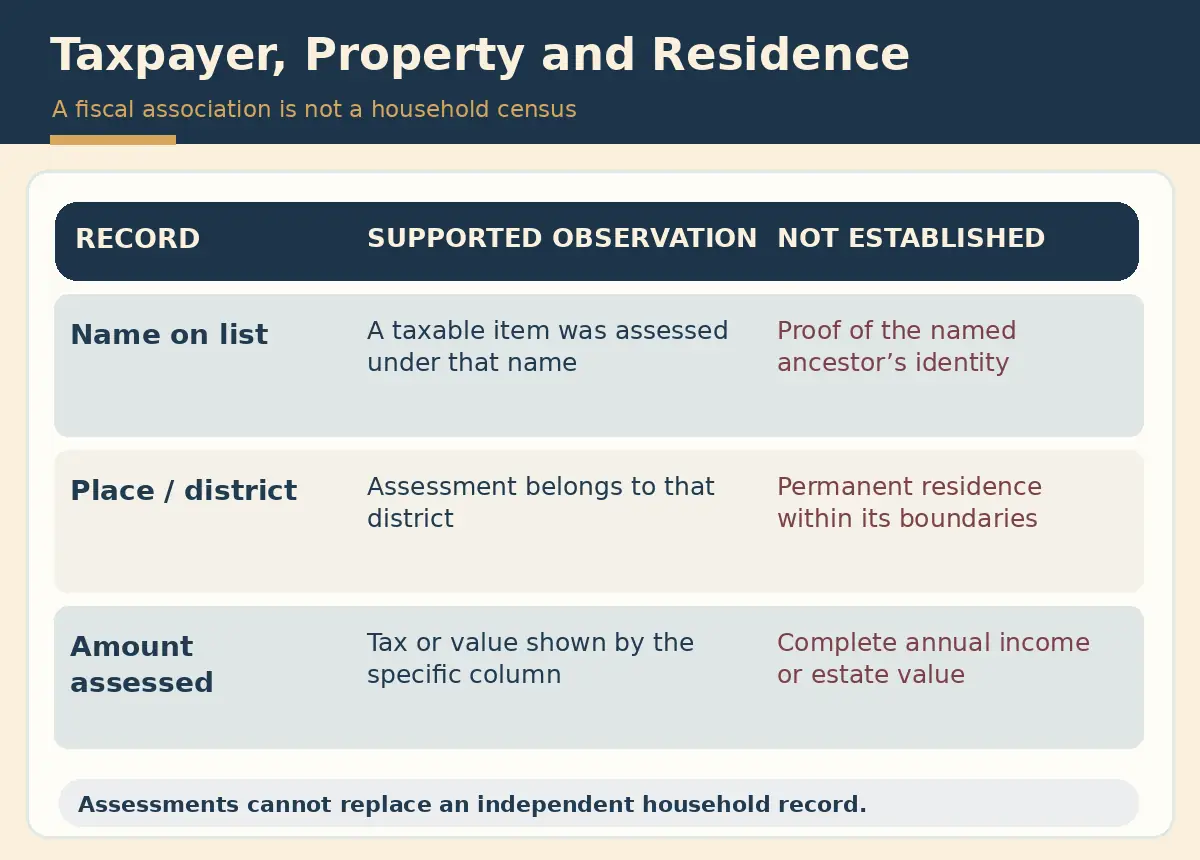
The assessment system could separate persons resident in the division from persons living elsewhere who owned taxable property there. Thus a listed name next to a town supports an administrative tax association, not necessarily a household address.
Business licenses and taxed commodities may reflect an occupation or enterprise at the time, but do not establish that the person worked continuously or was the sole proprietor. For a same-name candidate, compare street address when present, employer or trade, successive years and independent local sources. If two records differ about residence, preserve both observations until district boundary or movement evidence resolves the discrepancy.
Check Collection Changes and Missing Years
Coverage is especially uneven near the start and end of assessment programs. NARA notes that some western territories extend beyond 1866, while other states have limited filming or missing collection districts.
Create a search log specifying state, district, division, type of list, inclusive book dates and page range actually examined. A negative name search against partner indexing cannot establish a complete absence if pages were not indexed or the relevant district was omitted. Try business-name variants, initials, and OCR or handwriting misreadings; when possible browse the county or division images directly instead of trusting exact-match text.
Cite the Book, District and Tax Line
A useful citation identifies National Archives, Record Group 58, the particular state and collection district, division, annual/monthly/special list, volume or microfilm publication, date, page and name or taxable item. Keep the viewer URL as a retrieval aid but do not let it replace the archival arrangement.
If a microfilm series number appears on a partner record, verify that it corresponds to the actual state before copying it into a genealogy tree. A row transcribed without its column labels is easy to misinterpret. Record what was assessed and what was due separately when the form allows.
Worked Example: A Trade Tax Without an Address
Imagine an 1864 annual assessment list that names two people with the same surname in one division, one associated with a taxed trade and another with property. The entry should be captured with its complete annual-list heading, original spelling, division, amount and adjacent column labels. Before merging either person into a census family, check the town and occupation in a directory or another year’s assessment.
A taxpayer could have property outside the place of residence, and a professional occupation label may describe a licensing category instead of an everyday job title. Now suppose the name is missing from the month’s special assessment list. That does not negate the annual entry: the lists serve different administrative purposes and may cover different liabilities. A thoughtful negative search records the specific microfilm, division and pages examined rather than “no Civil War taxes.” The resulting family-history claim should state only the evidence-supported taxable association until independent residence and identity are verified.
More Records and Archives Guides
How We Research Civil War Assessments
We confirm a documented locality, identify its historical collection district, and search all relevant types of assessment list before interpreting any hit. We transcribe the original column headings, compare repeated entries for the same name, and test links against directories, federal and state censuses, or deeds.
We never recast an assessment as a surviving personal tax return or an independently proven residence, and we do not interpret a missing list as a negative record for every inhabitant. Our final worksheet keeps the exact tax statement, identity hypothesis, contradictory source and next-record action separate.
No. Individual returns were destroyed in the 1890s; surviving assessment lists report taxes and taxable categories in a separate administrative record.
No. The original records are organized by state, collection district, division and often date and type of list.
Annual, monthly and special assessment lists can cover different taxable obligations or corrections; a single search need not exhaust them.
No. Some lists included people who resided outside the division but held property there; verify residence independently.
No. Survival and digitization vary; NARA identifies exceptional territorial ranges and some uncopied or later regional holdings.