
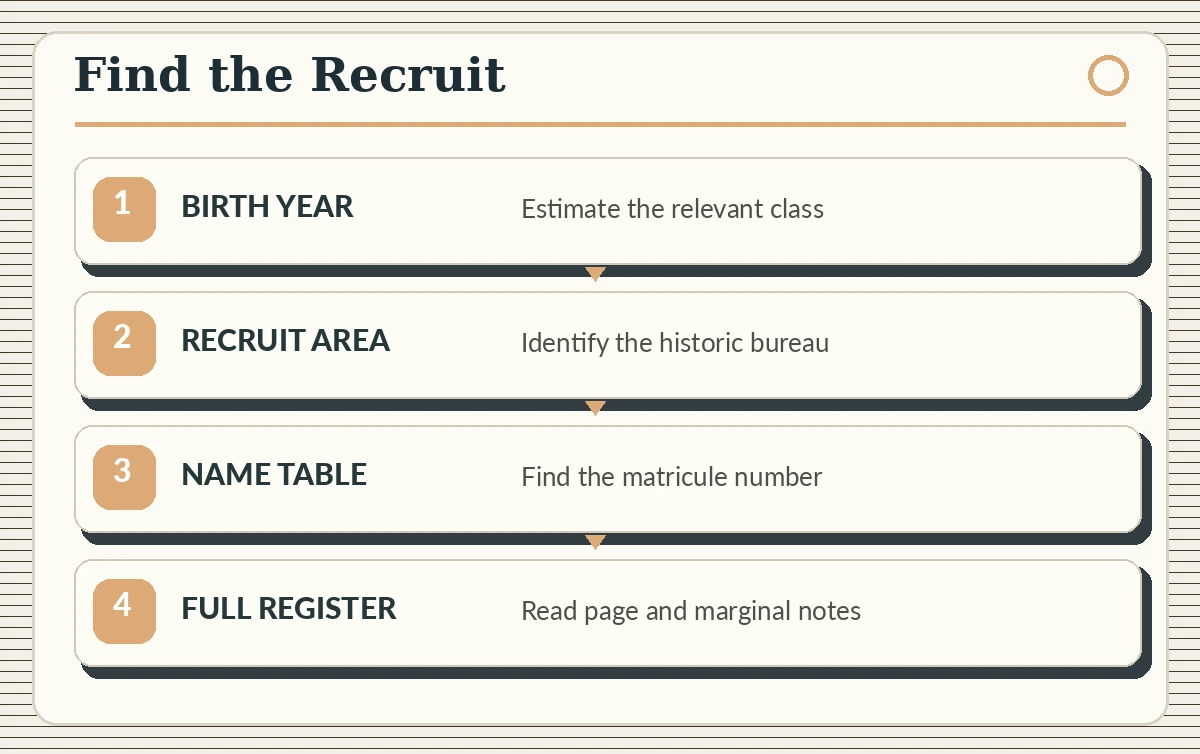
French military recruitment records, often called registres matricules, can give a detailed description of a recruit and may document addresses, occupations and later service. The efficient search is not a blind surname search: establish an approximate birth year, determine the appropriate recruitment class and bureau, then use the alphabetical table to obtain a matricule number and open the matching register page. The class often corresponds to the year in which the man reached twenty, but historical rules and exceptions matter. Being registered or examined is not the same as serving in a specific campaign or regiment.
Identify the recruitment class before opening a French military register
For many twentieth-century recruits, the class number is the calendar year of their twentieth birthday. A person born in 1894, for instance, ordinarily belongs to class 1914, not necessarily the year he entered military service. The Service historique de la Défense explains that legislation and recruitment systems changed over time, and nineteenth-century records do not all use the same arrangements. Do not extend a modern rule backwards to the Napoleonic period or assume every male resident appears in the same type of register.
Note exact date and place of birth when known, but also the place of residence at recruitment age. Recruiting bureaux could cover cantons across departmental boundaries, and archives are often organized by recruitment office rather than by town of birth. A later emigration or marriage place does not automatically indicate which bureau registered the recruit. Keep a small date-and-place worksheet before trying multiple years and offices. It saves the common error of rejecting a person solely because the first department search returns nothing.
Find the bureau, alphabetical table and matricule reference
The departmental archives commonly hold recruitment material within series R; the central military archives may hold other periods and categories. Search an archive’s official inventory for recruitment tables, tables alphabétiques, or registres matricules relevant to the class. An alphabetical table can point to a matricule number. That number is a key within the relevant class and bureau; it is not a universal military ID you can use without the archive context. Record all three parts together.
Once you have a candidate number, navigate to the corresponding register and inspect the complete page, including marginal additions. Some handwriting is compressed, and a later note may cross a gutter or be attached as a slip. Check whether adjacent numbering reveals a mismatched image or missing page. Record the archives départementales, series or inventory designation, bureau, class, number and image reference. Do not replace the register citation with a search result hyperlink alone.
Read physical descriptions and reported family details cautiously
A matricule page may contain civil status, parents, profession, residence, educational status, physical description, assignments and various administrative decisions. The fields vary by year and institution. Historical descriptions of health, education, citizenship or personal appearance use period-specific categories and should not be turned into modern medical diagnoses. An old address can be a strong lead for municipal, census or marriage records, but not evidence of continuous residence for the entire interval between updates.
Separate an observation entered at recruitment from later notes about training, mobilization, movements, illness, exemption or discharge. A unit name may appear as an intended assignment or a recorded posting, depending on the line. When the writing is uncertain, transcribe the exact French phrase and mark the interpretation as tentative. If a page gives parents’ names, test them with civil registration before extending the tree. If it reports a place of birth, seek the original acte de naissance.
| Evidence step | What to record | What it cannot establish |
|---|---|---|
| BIRTH YEAR | Estimate the relevant class | A name alone establishes identity |
| REGISTER PAGE | Recruitment or exemption detail | The index replaces a source image |
| CIVIL ACT | Resolve before using service notes | An uncertain link is proven |
Compare recruitment records with proof of actual service
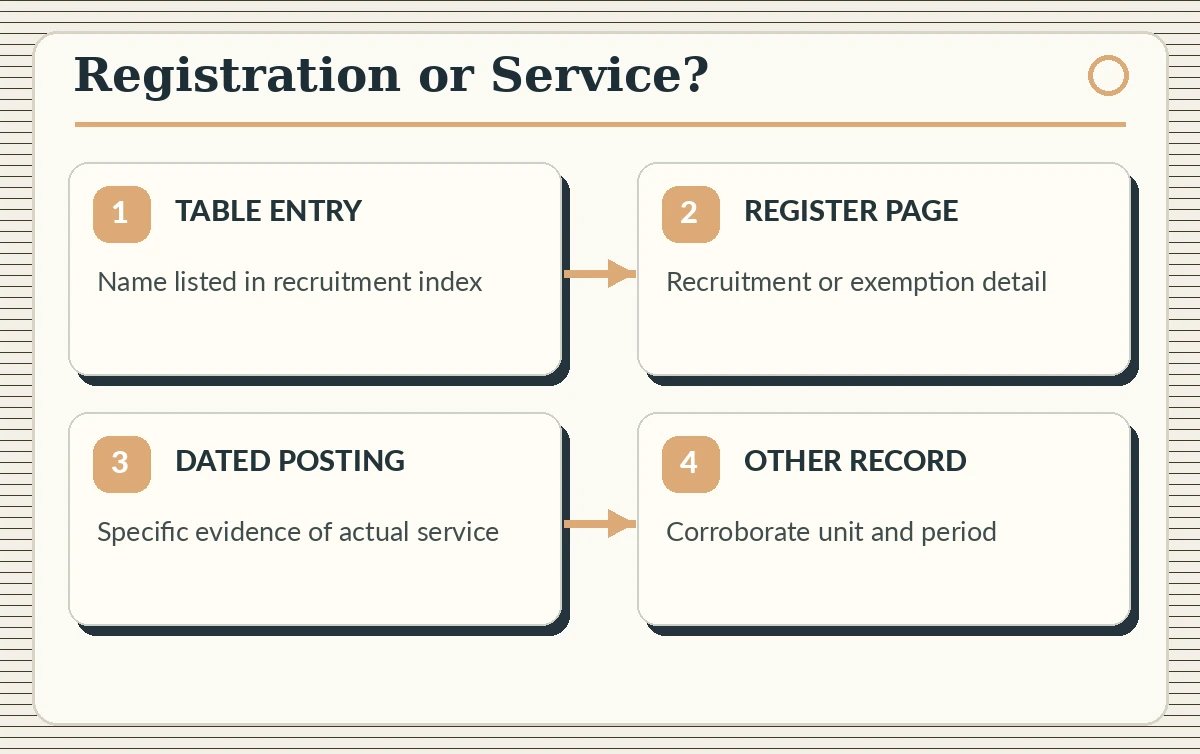
The army archives explain that some men appear on recruitment lists despite not being mobilized or despite exemptions. A record’s presence therefore answers a narrower question: this person was processed within a recruitment system. To support a claim that he served in a particular formation or campaign, look for dated incorporation, transfer or campaign entries and corroborate with unit histories where applicable. For First World War casualties, other official registers may be relevant, but an absence from a memorial is not evidence the man never served.
Build a two-column service timeline: on one side place the exact recorded administrative action and date; on the other, what remains an inference requiring another document. Do not infer battles fought merely because a unit was present at a battle sometime during the same war. If the recruit moved between bureaux, note the administrative transfer rather than treating similar names as one unbroken record. This protects against falsely attributing another man’s military experience to an ancestor.
Use a fictional 1914 recruit to demonstrate the three-key test
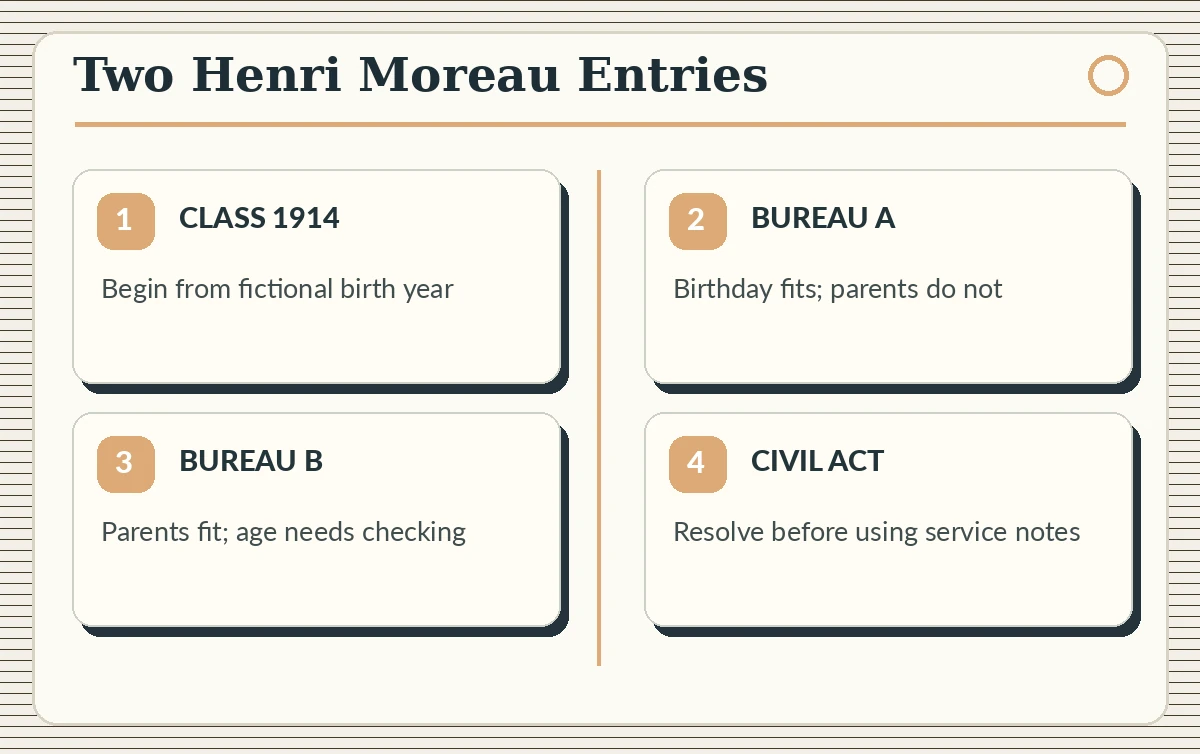
Consider a fictional Henri Moreau born in 1894, whose later residence is known but whose recruitment bureau is uncertain. Class 1914 is a reasonable starting point. Search the table for the bureau associated with his recruitment-age residence, then record each Henri Moreau and corresponding matricule number rather than assuming the first one is correct. Compare birthplace, date of birth, parents and occupation on the resulting pages with independently held civil records. Our guide “French Tables Décennales” shows how to find birth, marriage, and death records.
Suppose one record matches the birthday but not the parents; a second has compatible parents but an age discrepancy. Do not splice the details. Seek the birth registration and an address-linked document that can explain which candidate belonged to the relevant bureau. Only then interpret service annotations. If the match remains unresolved, record a pending alternate-bureau search. The output is a reproducible archival identification, not a decorative military timeline built from one indexed surname.
How We Research French Military Registers
We checked official Service historique de la Défense explanations of recruitment bureaux, series R holdings, the distinction between recruitment and service, and the ordinary twentieth-century class calculation. We also reviewed the Grand Mémorial search guide as an index route, not a completeness guarantee. Henri Moreau is fictional and no actual French soldier is identified.
More Records and Archives Guides
Official archival research sources for french military registers
www.servicehistorique.sga.defense.gouv.fr — Service historique de la Défense: recruitment records, series R, class and bureau organization.
www.servicehistorique.sga.defense.gouv.fr — Service historique de la Défense: recruit classification and exemption versus service.
donnees.culture.gouv.fr — French Ministry of Culture: Grand Mémorial index search and filters.
This guide provides historical research information, not legal, medical or investment advice. Archive coverage, costs and access may change. These links are editorial references, not paid recommendations; see the GenHis affiliate disclosure. Interpret outdated historical classifications in context and protect details about living people.
For many modern classes, add twenty to the birth year, then verify the period-specific rule in the archive guide.
The class, recruiting bureau, and matricule number; keep these together in a citation.
No. Examine dated service notations and corroborating unit records.
At departmental archives, often in series R, although custody varies by period and category.
Compare date and place of birth, parents, occupation and residence against independent civil records.