
Choose the Tax and Parish Before Searching a Surname
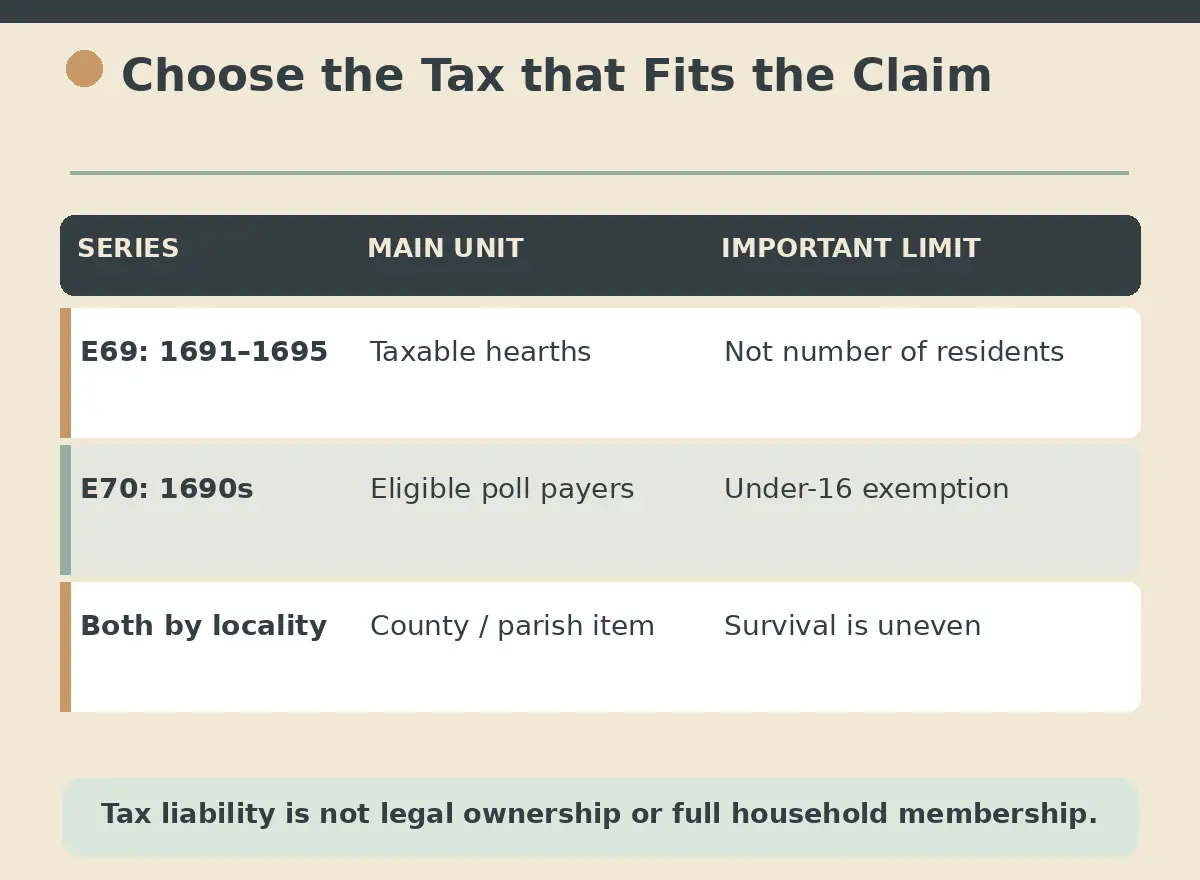
Late-seventeenth-century Scottish household research can use hearth and poll taxation, but these are different records with different coverage and purposes. The hearth tax rolls are principally National Records of Scotland series E69, broadly 1691–1695; the poll tax rolls are E70, mainly assessments in the 1690s. Begin with a historically plausible county and parish and check whether the surviving item actually lists people. A surname-only search without a survival screen can produce a misleading absence.
National Records of Scotland and Scotland’s People describe difficult collection conditions and incomplete returns. Depending on locality, a surviving piece may list householders or merely money totals. Neither series was meant to record every inhabitant by name. A taxable person, a described property and everyone living at the address are three different historical categories, and they should not be collapsed into one reconstructed family.
Read E69 as a Hearth Assessment, Not a Census
The hearth tax was imposed at 14 shillings per hearth, with collection beginning in 1691 and continuing in some localities until 1695. Landowners and tenants could be liable, while hospitals and the poor receiving parish charity were exempt. Lists can record an individual head of a household and the number of hearths, sometimes with occupation or designation. A figure beside a name is a number of taxable hearths, not a number of rooms or residents.
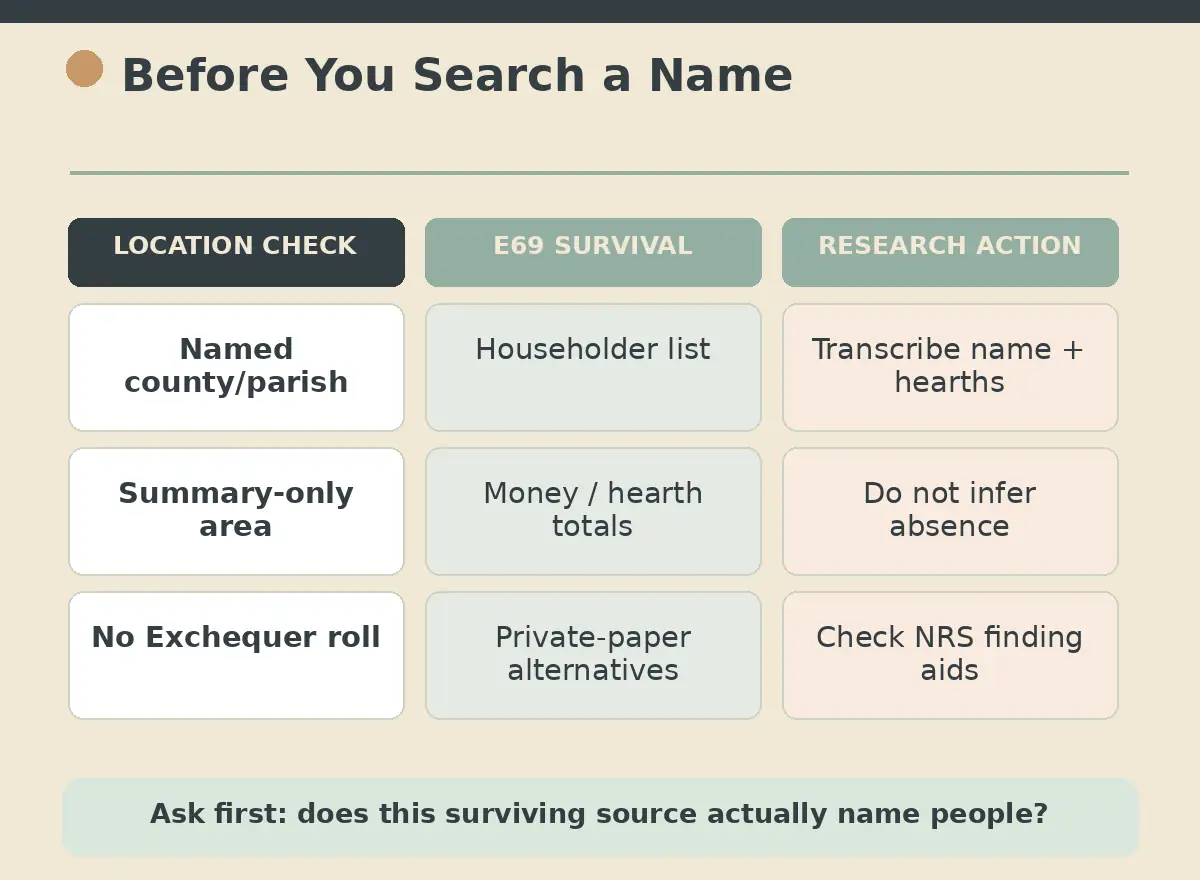
County survival is not uniform. Scotland’s People identifies named householder lists for counties including Angus, Ayr, Berwickshire, Fife, Midlothian and Perthshire, whereas returns for Aberdeen, Banff, Dumfries and several others may give only aggregate hearth totals. There are no E69 Exchequer rolls for certain northern and island counties. Verify the particular county and document class before telling a researcher a missing surname means the family was absent.
Use E70 Poll Rolls for a Different Evidence Question
Poll taxes in the 1690s targeted liable people, with charges graduated by position and means. National Records of Scotland explains exemptions for poor persons and children under 16, although some lists name children or servants as part of a household entry. The poll tax was imposed in 1694, 1695 and twice in 1698; surviving books and copies can include dates continuing into 1699 or later recording. Use the exact date given by the archival item, not a single generic “1698 poll.”
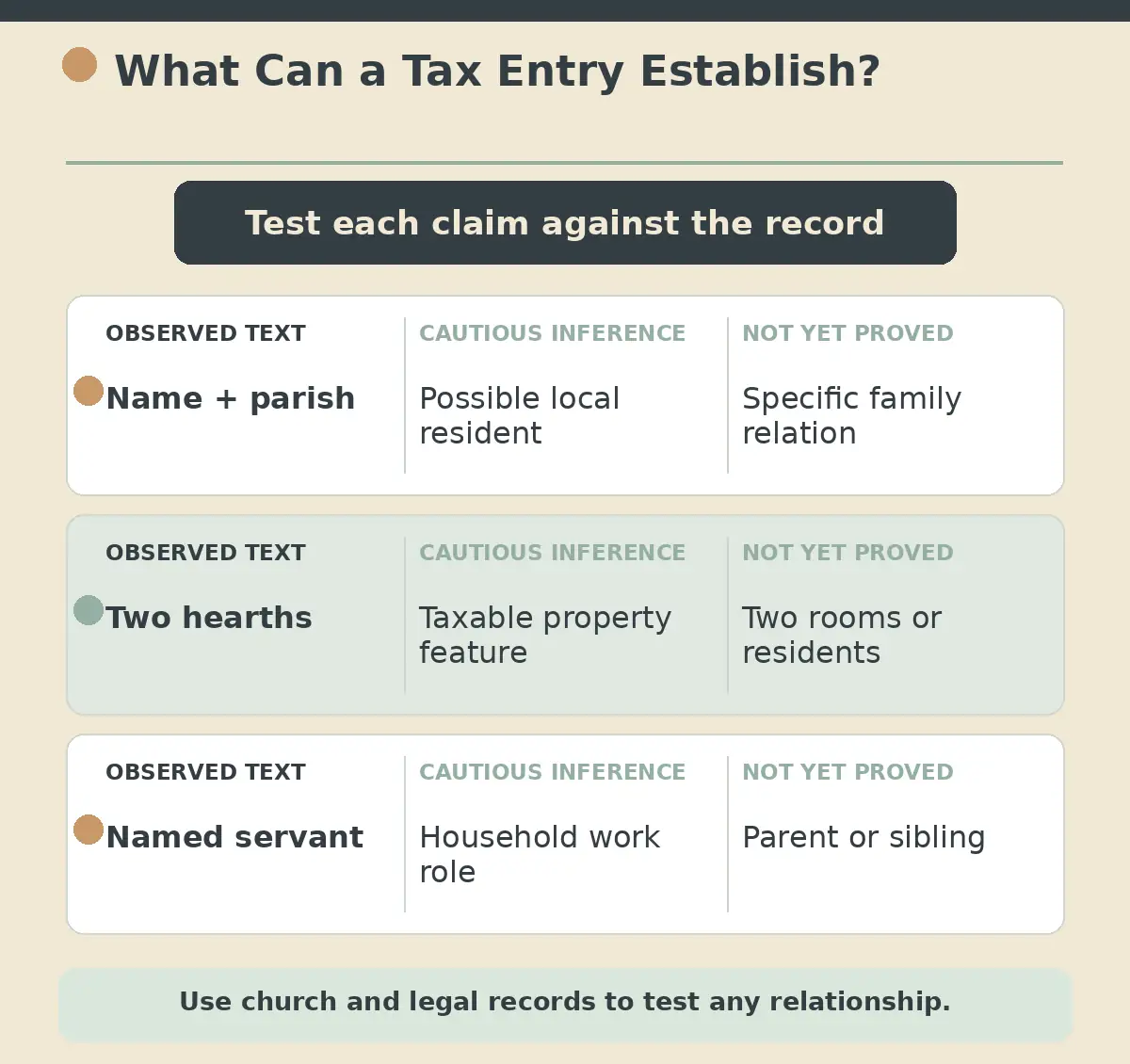
Write the payer’s exact wording, amount, parish and any relationship label. A household entry naming a wife, child or servant provides valuable reported context, but the tax collector was not compiling a modern family register. A missing child could simply be below taxable age or unnamed. A person listed as a servant has an occupational or household role that should not be automatically rewritten as family kinship.
Perform the County and Parish Survival Check
Begin in the official tax-roll guide, then use the place-oriented search where the collection is available. Confirm whether the item is an E69 hearth list, an E70 poll roll or an accounting summary. Note the series number, archival piece, county, parish, place and folio or page. The spelling in these documents predates standard place and surname forms; retain the version on the page with a separately recorded modern locality.
If the online view lists only an aggregate total, look for supplementary E69 private-papers holdings described in the National Records of Scotland guide. The archive points to additional collections that can provide specific missing-area lists. Private copies should be cited by their own call number and provenance, not relabeled as the main Exchequer E69 item. A negative check is meaningful only after surviving holdings have been inventoried.
Compare the Same Place Across Both Tax Types
Build a side-by-side locality sheet with columns for assessment date, original spelling, named liable person, tax type, value or hearth count and the repository reference. If the same unusual name occurs in the same parish in separate tax types, that is an identity clue worthy of testing. Changes in who paid, rates and household exemptions make direct population comparisons hazardous, so do not treat a missing E70 entry as evidence that an E69 householder died.
A record of two or three hearths may suggest the taxable property’s relative size, but without other documents it does not prove wealth, legal title or the number of co-residents. Try estate papers, sasines, kirk-session minutes or later local records to test the person’s position. Preserve a competing-namesake possibility when nearby parishes have similar names and periods.
Translate Historical Terms without Inventing Relationships
Tax returns can use Scots spellings, occupations, designations, contracted first names and period monetary notation. Transcribe what is written before modernizing: “tenant,” “cottar,” or a place description can assist an identity match but does not itself define ownership. Numbers beside a head of household should be attached to the correct column or assessment line. When a page is damaged, bracket uncertain letters and retain the original image reference.
If multiple people are listed together, distinguish explicit relationships from spatial proximity on the collector’s list. A poll roll might state “his wife” or name a child, whereas a nearby name may simply be another taxpayer. Build a table of claims for each person. When a relationship is only inferred, note it as a hypothesis until independent church, legal or estate records can confirm it.
More Records and Archives Guides
How We Research an E69 or E70 Scottish Entry
We first consult National Records of Scotland and Scotland’s People survival tables. We select an actual county and parish item, identify whether it names individuals and transcribe its tax and date precisely. Next we compare E69 hearth liability with E70 poll-liability rules rather than forcing them into a one-to-one population table. We document gaps, exemptions and extra family-paper holdings as limits on every negative result.
We use the Scottish tax-roll guide and the National Records of Scotland guide to establish series and coverage. A researcher should be able to reproduce a finding from the piece and page reference. Our affiliate disclosure provides site-level transparency; it is not a claim of affiliation with either archive.
No. E69 consists of hearth tax material; E70 records poll tax assessments with different rules and survival.
No. It counts taxable hearths, not family members, rooms or residents.
Some counties survive only as totals, while some northern and island regions lack Exchequer lists altogether.
No. Children under 16 were exempt, though some surviving entries mention children.
They can support a hypothesis, but test parish, dates and other independent records before linking people.