
Admiralty Correspondence ADM 12 is useful when it answers a specific historical research question, not when an index mention is treated as a complete biography. The direct route is to identify the record creator and series, find the original document by its correct reference, then distinguish what is stated from what is merely suggested. This guide explains the series, search strategy, evidence limits and practical independent tests.
Begin With the Naval Administrative Question
ADM 12 is an index and digest system for Admiralty correspondence, not a master service register of every sailor. It can help locate letters about naval personnel, operations, appointments, casualties, equipment and official decisions. The National Archives describes ADM 12/56–1518 as indexes to Admiralty incoming letters received between 1793 and 1913 and filed in ADM 1. The original communication—not the digest—must be read before accepting a historical conclusion.
Start with a named correspondent, ship, event, approximate year and subject. Identify whether the person was the author, someone discussed in a letter, a commanding officer or a witness. A name in a letter about a ship does not automatically establish the named person’s continuous duty aboard that ship.
Read the Index Entry as a Locator
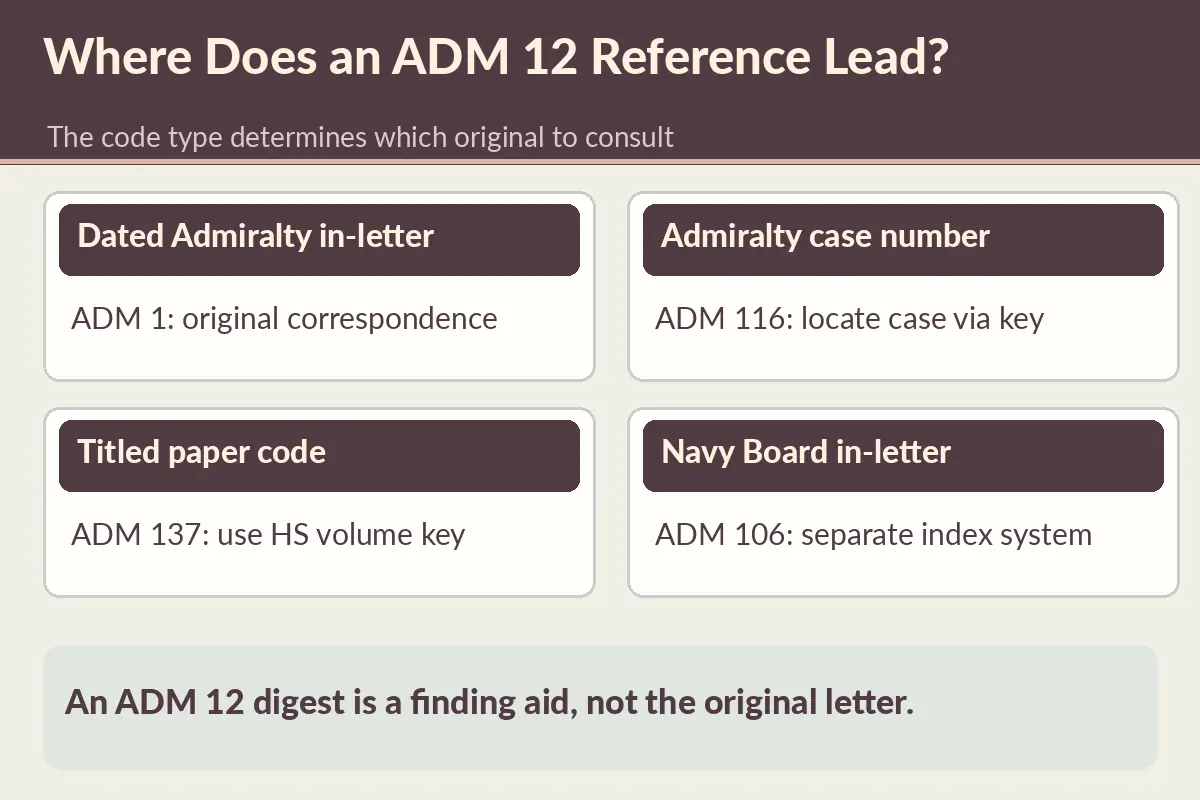
The Archives distinguishes ADM 12’s alphabetical indexes and subject digests. A reference can point to a letter in ADM 1, a case in ADM 116 or a titled paper now associated with ADM 137. The handwritten codes may differ with year and administrative practice. Transcribe the year, index volume, digest subject and complete reference exactly, including letters, numbers and any mark or date.
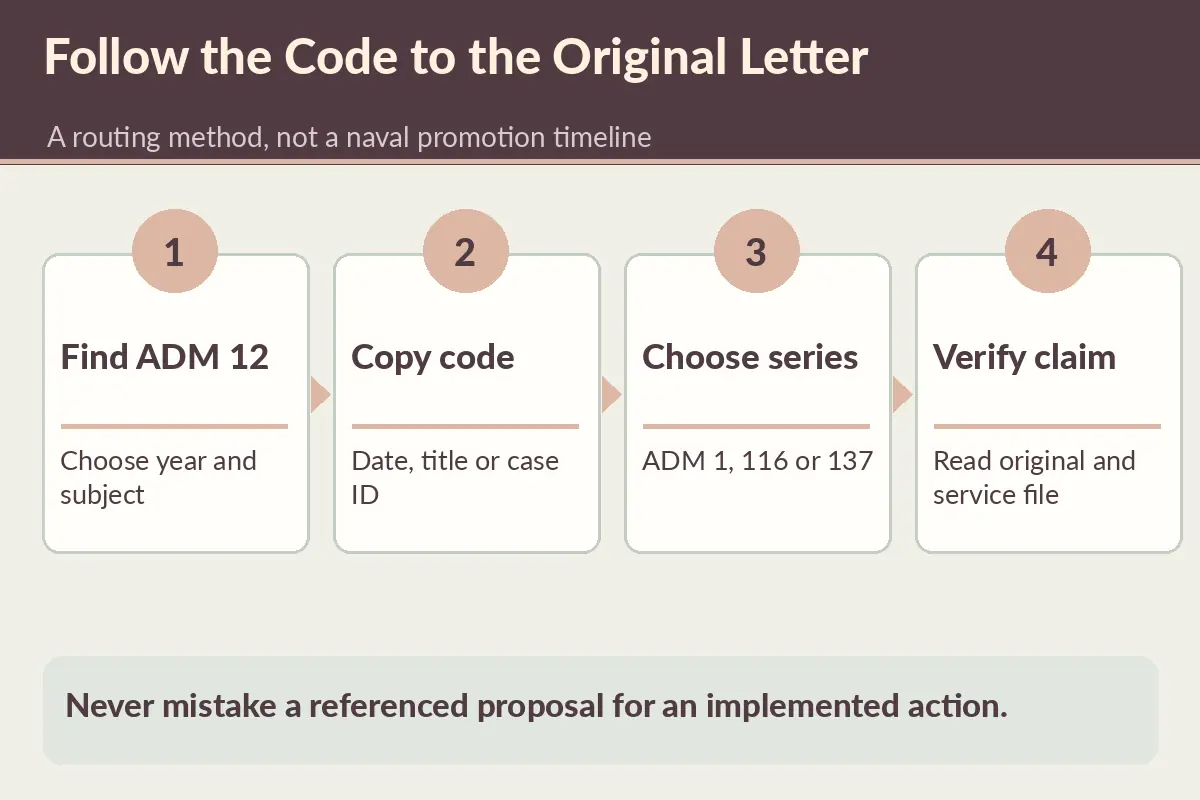
Do not treat an index phrase such as ‘appointments’ or ‘casualties’ as proof that an appointment was made or a casualty confirmed. Such labels are administrative categories under which correspondence was filed. A later document may reverse a proposal or reject a report. The reference must be followed to the original letter or case.
Know When the Destination Is ADM 1
ADM 1 contains Admiralty in-letters and associated reports. Before using a single surname as a key, check how that period arranged records: correspondence could be divided by the writer’s rank, surname initial, naval station or geographic location. The arrangement is not consistent through the whole series. An ADM 12 entry with a dated Admiralty reference may be traceable into the appropriate ADM 1 volume.
When searching Discovery, try the year and complete original code, then inspect nearby descriptions if the database returns nothing. Some volumes require browsing or consultation of printed finding aids at Kew. Keep the source year distinct from a later filing date, and do not invent an ADM 1 number by extrapolating from another reference.
Identify ADM 116 Cases Separately
A case number in ADM 12 can refer to papers assembled in ADM 116, a series of Admiralty Record Office cases. The archive advises consulting the ‘Key to Admiralty cases’ held with the printed catalogue at Kew to translate case numbers into piece numbers. Simply searching a case code online may not reveal the whole file. The original can be a correspondence dossier rather than one signed personal statement.
Read the entire case chronology: initial report, enclosures, minutes, responses and any final decision. A recommendation or allegation is not necessarily official acceptance. Record which named office authored each text. If the key does not locate an ADM 116 piece, the archive lists other possible series; absence from one result is not proof the papers never existed.

Follow Titled Papers Without Skipping the ADM 137 Key
Some ADM 12 entries use alphanumeric ‘Admiralty titled papers’ codes, not modern archive piece numbers. The Archives explains a route through the ADM 137 key to Historical Section volume numbers; that key is held with printed catalogues at Kew. After identifying an HS volume, the researcher can search by its reference and inspect the relevant ADM 137 file.
This is a cross-reference chain, not a sequence of events in the sailor’s career. The fact that an official history file contains a report about a battle cannot establish that a particular person served in it. A ship’s operations and an individual’s presence are separate questions with separate kinds of evidence.
Respect Administrative Changes Across the Twentieth Century
The ADM 12 system did not function identically in every decade. The archive warns that from 1922 changed Admiralty reference practices made these indexes less straightforward, while ADM 116 case numbers remained important. Between 1938 and 1945 ADM 1 references can involve specific code-based arrangements; after 1952 further registry systems appear. Do not extend an 1805 lookup recipe mechanically to a 1942 file.
Record the relevant administrative period before selecting a search method. An apparent gap may reflect a change in filing rather than missing correspondence. For later or restricted material, check current archive access rules item by item and do not use insecure methods to reconstruct private information about living people.
Distinguish Admiralty and Navy Board Correspondence
ADM 12 concerns Admiralty correspondence; the Navy Board kept a different set of in-letter indexes in ADM 106. The bodies oversaw different kinds of administrative business, and a dockyard supply question might belong in a Navy Board route rather than the fleet-operational Admiralty correspondence pathway. Using a familiar ADM prefix alone is not enough to find the right creator.
Before investigating a family story about a dockyard carpenter, verify whether the person was a civilian employee, an officer, a supplier or a seaman. The correct custodian and administrative channel determine the search; matching a vessel name in the wrong office’s correspondence can lead to a false biography.
Cite the Original Letter and Preserve Unknown Outcomes
A useful citation identifies the ADM 12 index or digest that supplied the route and the ADM 1, ADM 116 or ADM 137 original found through it. Include year, full reference code, correspondent, date, page or folio and the specific statement that supports the claim. When you have located only the digest, say that the original has not yet been examined.
Imagine a fictional lieutenant Thomas Avery in a correspondence index. That entry alone does not prove promotion, a posting or a family relationship. Compare the underlying letter, official Navy List and independent officer service records where applicable. The defensible result reports the administrative question and its documented response, and identifies the next record needed to verify the individual’s actual service.
How We Research This Archive and Test Namesakes
We checked the custodian’s research guidance alongside the related series description on 28 October 2026. We compare institutional purpose, years, jurisdiction, indexing, record roles and the restrictions described by the archive; a name hit is a locator rather than a verified historical person. The three illustrations are educational reconstructions, not authentic document facsimiles. We keep parallel identities distinct until a dated independent reference connects them. We also distinguish a negative search from proof that no record or event existed.
More Records and Archives Guides
Cite the Original Item and Respect Access Limits
Primary sources clarify this scope: ADM 12 indexes ADM 1 in-letters 1793–1913 and some ADM 116 cases and ADM 137 titled papers, with different reference systems; ADM 1 correspondence and ADM 116 operation case files may require ADM 12 indexes and digests. Record the repository, original series, full piece and item number, page, folio or membrane, document date, role and transcription uncertainty. The availability of a digital index does not mean every original can be viewed freely or searched by name. Use the GenHis affiliate disclosure for transparency about commercial links; no unverified partner relationship is assumed.
No. It indexes and digests Admiralty correspondence, not every sailor’s service.
The main ADM 12/56–1518 indexes lead to ADM 1 in-letters received from 1793 to 1913.
The original may be in ADM 116 and require the Key to Admiralty cases at Kew.
It is an older reference that may require the ADM 137 key to locate an HS volume.
No. Read the underlying report and verify the person and outcome separately.