
Cape Colony Correspondence CO 336 and CO 48 is useful when it answers a specific historical research question, not when an index mention is treated as a complete biography. The direct route is to identify the record creator and series, find the original document by its correct reference, then distinguish what is stated from what is merely suggested. This guide explains the series, search strategy, evidence limits and practical independent tests.
Start With a Letter Rather Than a Passenger Myth
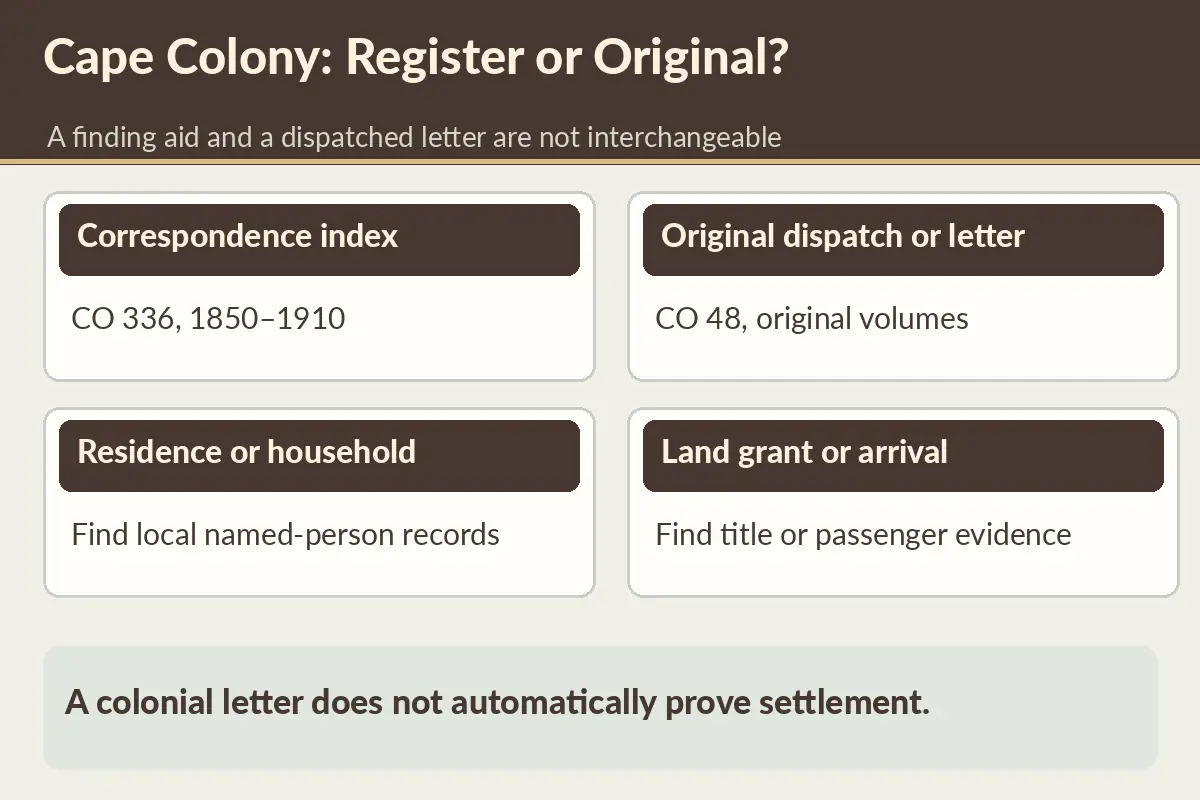
CO 48 contains Cape of Good Hope original correspondence received by the Colonial Office. From 1850 to 1910, CO 336 registers help identify correspondence about the Cape. These are administrative records about decisions, reports and requests, not a universal list of Cape settlers. A person mentioned in a dispatch may be an official, petitioner, complainant, shipmaster or third party who never lived there.
Frame a precise question: who wrote to London, what matter was discussed, which office received it and whether the underlying document survives. Record a historical place spelling and approximate date before searching names. The register may shorten or standardize names, so avoid assuming a catalogue entry reproduces the original full letter.
Know the Register and the Original Have Different Jobs
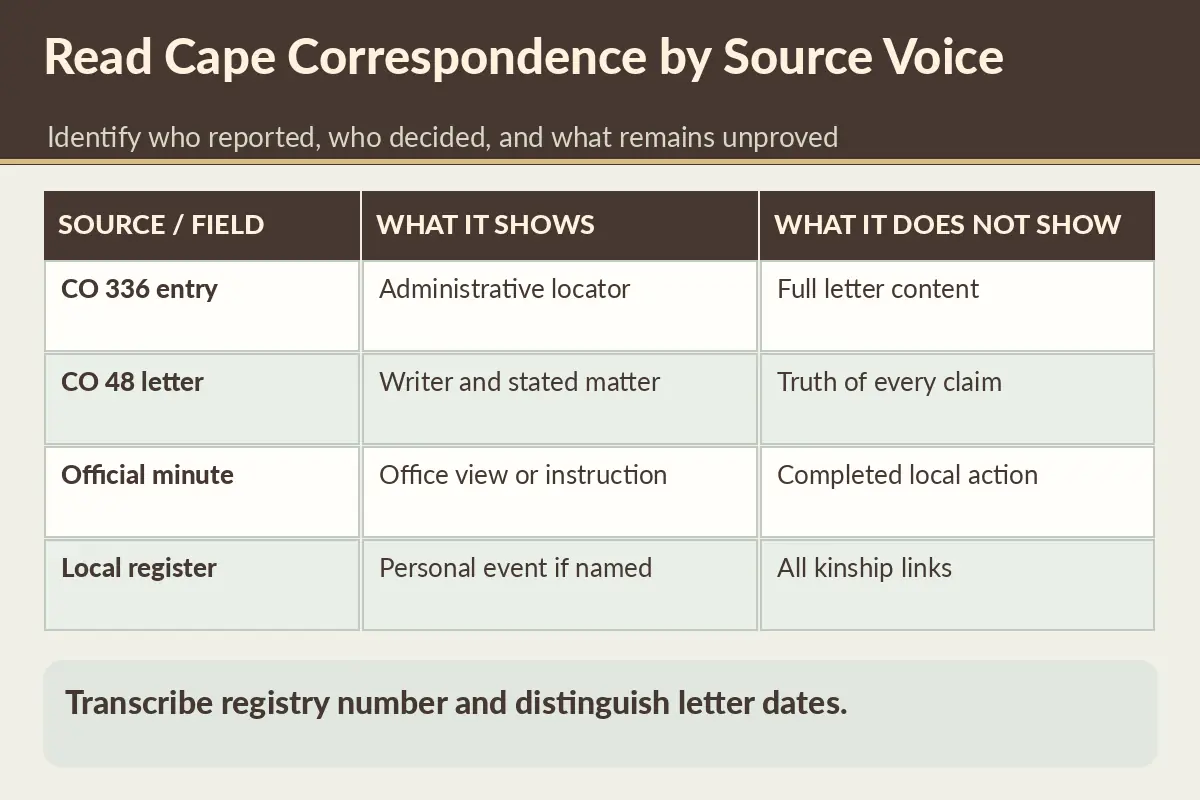
A register organizes incoming business and points the researcher toward a document. It may give a topic, writer, date, departmental classification or registry number, but it is not the letter itself. CO 48 contains the original correspondence volumes, which may also carry minutes, enclosures or later filing annotations. A brief register abstract can omit an essential qualification.
The National Archives includes a worked Cape correspondence example dated 19 June 1835 and identifies CO 48/161 as the volume covering the original. This demonstrates the method for earlier registers; do not falsely claim that CO 336 itself covers 1835. For the 1850–1910 period begin with the appropriate CO 336 register, then use the original date and reference to find the CO 48 piece.
Record the Registry Reference Before Searching by Name
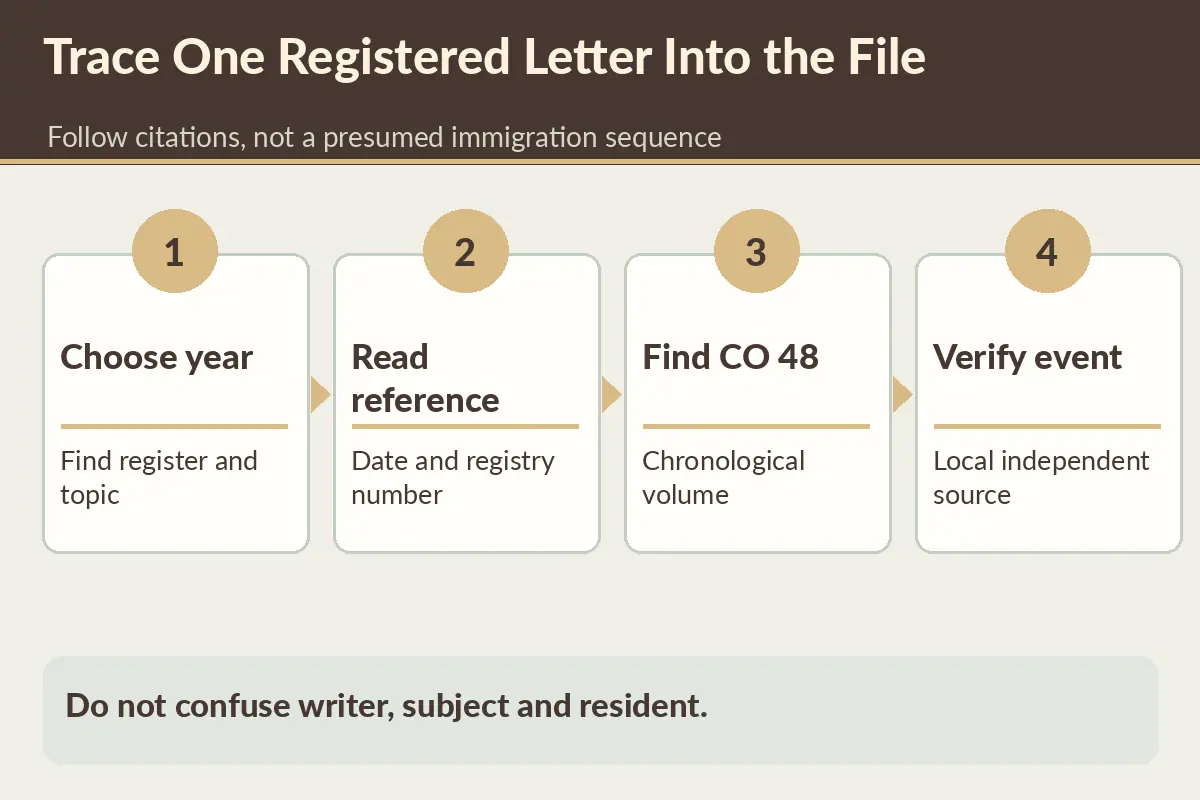
Browse the appropriate annual or subject register and transcribe the registry number, correspondent, correspondence date and short subject heading. The exact field headings can change with administrative practice; read the volume’s own headings before assigning meanings. A record filed under a colony may concern London financial administration rather than a journey to Africa.
Use the registry date and reference to search Discovery for the original correspondence volume. If a date straddles a book boundary, inspect neighboring volumes. Note the sending and receipt dates separately. Copy any later departmental code without treating it as a family identifier or a vessel registration number.
Open the Entire Letter and Its Enclosures
Read the original letter’s author, recipient, administrative role, place, date and letterhead. Follow marginal minutes, attachments and any references to earlier or later correspondence. A report that someone requested a land grant shows a request was reported; it does not prove a grant was made. Similarly, an official description of a migrant group is not a verified passenger list of each individual.
Cite the register as a finding aid and CO 48 as the source of the actual statement. Distinguish quotations from an informant, the colonial governor’s own comments, and a London official’s decision. If the document is an extract, say so; a clipped transcript may omit the surrounding issue and the evidence that changes its meaning.
Follow an Administrative Issue Across Several Dates
One petition could generate a dispatch, departmental queries, local inquiries and a final instruction months or years later. These are not guaranteed steps, and their documents may survive in separate volumes. Create a date-indexed table showing which action is actually documented. A recommendation to settle someone on a farm cannot be promoted into a signed title, completed relocation or confirmed residence.
Where a document cites a previous registry number, follow that reference backward. When you find a reply or minute, verify it belongs to the same administrative issue and not another case about a person of the same surname. File references are often stronger links than a common name alone.
Separate the Cape Jurisdiction From Later Borders
The Cape of Good Hope was a historical colonial administration, and the place described in a nineteenth-century record may lie within a modern province or country whose boundaries changed. Preserve the contemporary district, town or port exactly as written and record the date. Do not use a modern map label as proof of the correct 1850 jurisdiction.
If a letter concerns people displaced by colonial policy, Indigenous communities or labor arrangements, keep the source’s viewpoint explicit. Official correspondence is often an administrative voice, not a complete account by affected individuals. Seek local archives, contemporary registers or records created by the communities themselves when the biographical question warrants it.
Verify a Named Person Against Independent Cape Records
Suppose a register lists a fictional Edward Mason in connection with a shipping complaint. The same name may appear in a town directory, but neither finding proves he was the complainant. Compare occupation, vessel, correspondent address, local associates and dates. Separate sender, person discussed, traveler and resident in your evidence notes.
For a claimed marriage or death, seek an actual church, civil or burial record where available. For legal land tenure, seek the relevant grant or transfer. For arrival, seek a genuine passenger or port record. CO 336 and CO 48 explain the action taken by an office; they do not replace the independent record for a personal event.
End With a Traceable Reference and a Clear Unknown
Cite the complete CO 336 register entry, the CO 48 piece and the page or folio of the letter, including any enclosed item that supports the finding. Include both writing and receiving dates where they differ. State whether you examined the original image, a transcription or only a catalogue description.
A good conclusion says, for example, that the Colonial Office received a report naming an individual and considered a proposal in a specified year. It does not assert that the person emigrated, owned land or was related to another named correspondent without separate sources. Keep unsuccessful variant searches in the log and name the next original record that could resolve the uncertainty.
How We Research This Archive and Test Namesakes
We checked the custodian’s research guidance alongside the related series description on 28 October 2026. We compare institutional purpose, years, jurisdiction, indexing, record roles and the restrictions described by the archive; a name hit is a locator rather than a verified historical person. The three illustrations are educational reconstructions, not authentic document facsimiles. We keep parallel identities distinct until a dated independent reference connects them. We also distinguish a negative search from proof that no record or event existed.
More Records and Archives Guides
Cite the Original Item and Respect Access Limits
Primary sources clarify this scope: Colonial Office register-to-original example routes a Cape 1835 letter to CO 48/161 by letter date and registry number; CO 336 registers of Cape of Good Hope correspondence cover 1850–1910 and lead to CO 48 originals. Record the repository, original series, full piece and item number, page, folio or membrane, document date, role and transcription uncertainty. The availability of a digital index does not mean every original can be viewed freely or searched by name. Use the GenHis affiliate disclosure for transparency about commercial links; no unverified partner relationship is assumed.
CO 336 is a later series of registers; CO 48 holds original Cape correspondence.
No. The archive example demonstrates the register route but CO 336 is described for 1850–1910.
No. It may involve an official or a person discussed at a distance.
No. Inspect the CO 48 document and associated enclosures for context.
Record registry number, date, writer, subject and original volume or folio.