
To find a historical English or Welsh death duty entry, look up the deceased in IR 27 indexes and use the court, year and folio or entry number to locate the corresponding IR 26 register. These Inland Revenue records span 1796–1903 and can name executors, beneficiaries and sometimes children, with later annotations not always present in the will itself. They document a taxation process, not every estate or every relative. Begin with The National Archives’ detailed death duties guide and retain the source labels in your research notes. Our affiliate disclosure explains our editorial relationship policy.
Determine the Probate Court and Year
Write down the deceased’s name, likely death date, place and any known probate year. Probate can happen weeks or years after death, and duty-register organization often follows the probate or administration process rather than the family’s remembered death date. Before 1858 several ecclesiastical courts operated across England and Wales; a family’s county alone does not identify a court. After 1858 civil probate administration changed the search route. If an ancestor appears in a Prerogative Court of Canterbury will, that is a clue to use a PCC-related register section, not permission to assume all estates were processed at that court.
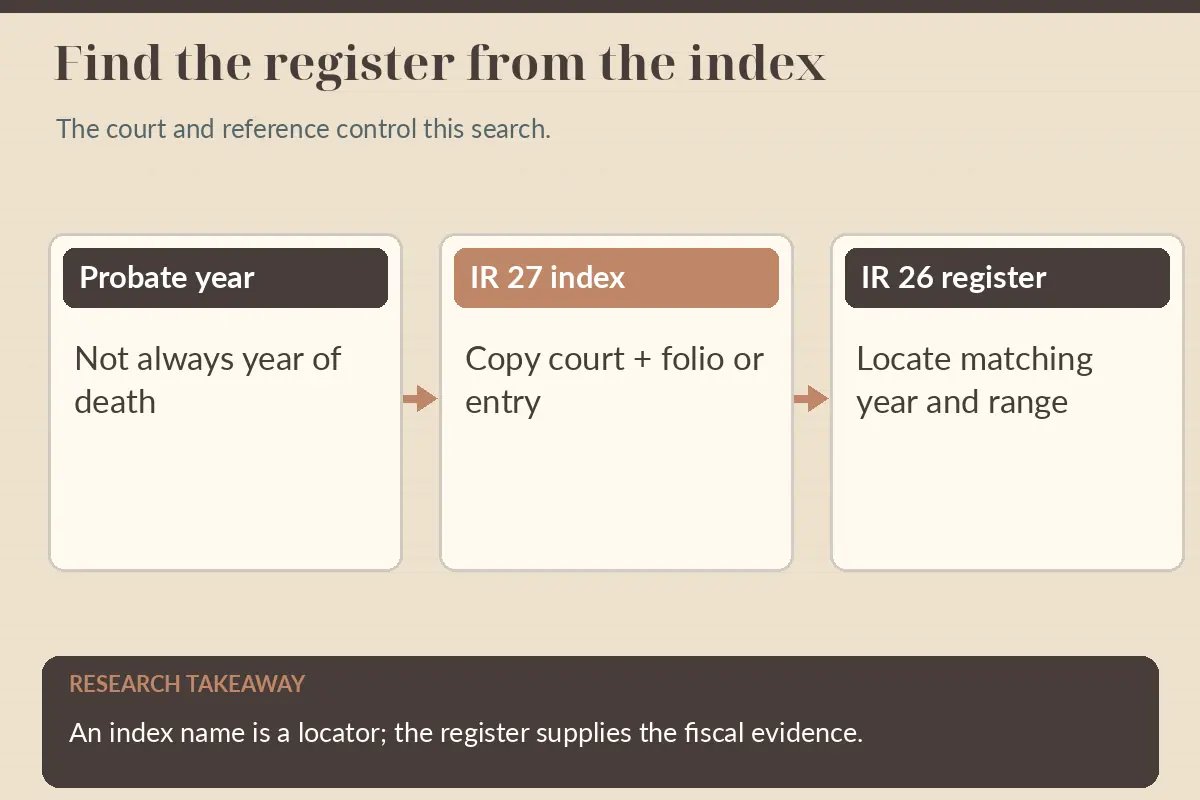
The tax office received probate details and organized registers for the Prerogative Court of Canterbury separately from those of country courts. IR 26 contains registers; IR 27 contains indexes created to find them. This archival difference is central: a name in a computerized index is a pointer to a fiscal entry, not the full entry’s content or evidence of a particular bequest. For 1796–1811 the guide describes entry numbers, while later indexing commonly refers to folio numbers. Transcribe the index notation as written and photograph its column headings; changing ‘folio’ to ‘page’ can direct a researcher to the wrong place.
Use IR 27 to Find the Folio
TNA’s method uses surviving IR 27 images through Findmypast to identify the person’s name, court, probate year and matching folio or entry number. The search may require paid access outside an institution. Check the original index image, not only the name transcription, to distinguish will from administration and to capture the reference accurately. The registers in IR 26 are then located by year, type and folio range within the catalogue; multiple books may exist for a busy court. For country court registers of 1796–1811, TNA notes special direct catalogue searches and incomplete survival. Access arrangements vary, so inspect the item description before arranging a visit.
Locate the Correct IR 26 Register
An IR 26 entry can show the deceased’s address and occupation, executors, personal estate, legacies, beneficiaries, duty and probate details. Such records are particularly useful where relatives appear in a tax context that clarifies the distribution of personal property. Not every named beneficiary is necessarily a child; note the relationship terminology, if any, and the degree to which it was reported or assumed. A gift to ‘my friend’ does not establish kinship, and an executor is an administrative role, not automatically an heir. The pre-1858 wills guide gives the parallel probate search.
Some IR 26 entries were updated many years later: marriage or death of a beneficiary, birth of a posthumous child, a changed address or a legal dispute might be noted after the initial administration. Distinguish the date of this annotation from the original probate date. A later note may lead to a separate civil or ecclesiastical source, but should not be silently backdated as information known to the original will-maker. If handwriting crosses pages, record which continuation folio holds each detail. Such entries can resolve family-history puzzles only when their people are independently identified.
Interpret Beneficiaries and Later Notes
The property category also matters. The archive describes registers concerned with personal estate and taxes; they do not act as comprehensive title registers for every parcel of freehold land. A farm’s presence in a will and an estate figure in a duty register answer different questions. Never divide a listed estate value among presumed children without reading exactly what the duty entry taxes. Gross amounts, unpaid liabilities, specific legacies and other notations require attention to column headings. Compare a contemporary probate instrument with the register rather than treating one as a verbatim duplicate of the other.
A missing IR 26 record has several explanations. Certain close relatives enjoyed tax exemptions during portions of the period; some minor estates were outside the tax process; and many books from the 1890s were lost in a fire. According to TNA, an IR 27 entry without a folio number can mean no tax was payable and therefore no corresponding duty register entry survives. For earlier country courts, survival is incomplete. A failed search cannot establish that no will existed, the deceased left no property, or relatives were intentionally excluded. Log the year, court, record class and survival limitations before writing any conclusion.
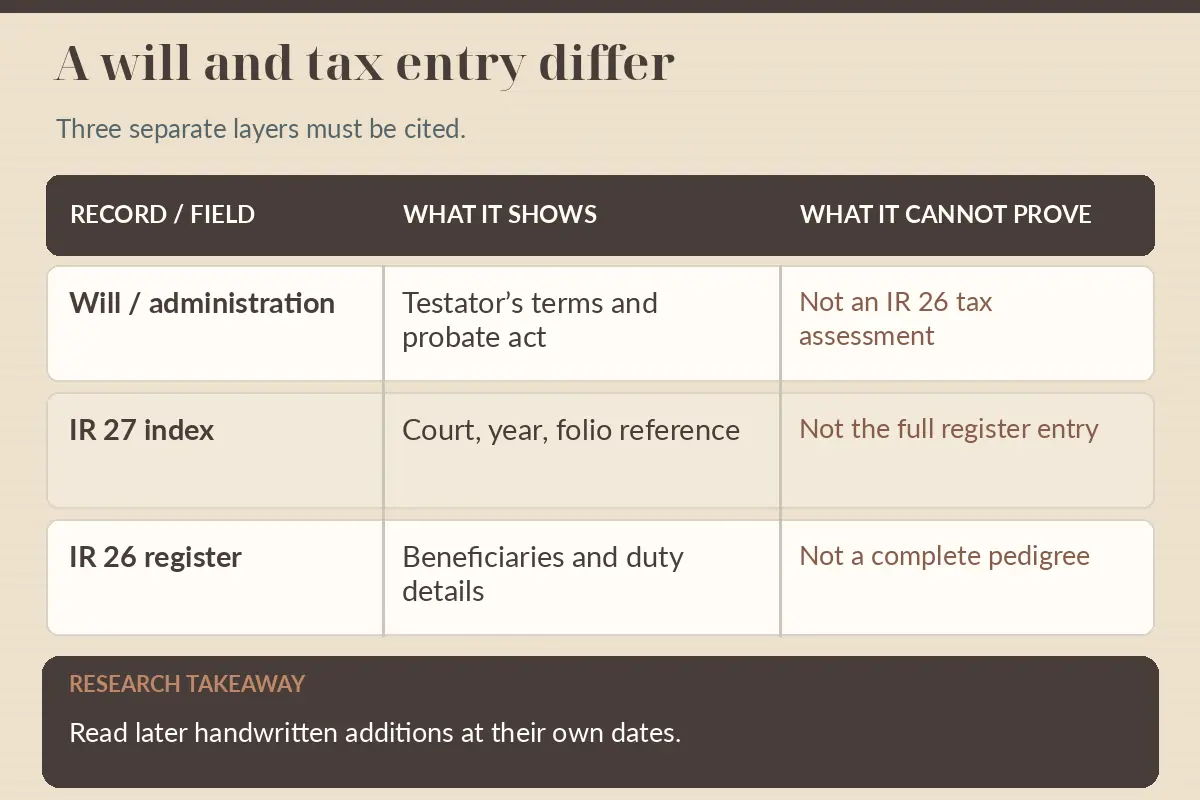
| ARCHIVAL SOURCE | WHAT IT CAN SHOW | WHAT IT DOES NOT PROVE |
|---|---|---|
| Will / administration | Testator’s terms and probate act | Not an IR 26 tax assessment |
| IR 27 index | Court, year, folio reference | Not the full register entry |
| IR 26 register | Beneficiaries and duty details | Not a complete pedigree |
Explain Exemptions and Missing Entries
An efficient matrix holds one row for probate evidence and another for duty evidence, each with its own date and reference. Use the probate original to test testamentary intentions, the IR 26 entry for the Inland Revenue’s assessment and beneficiary details, and separate vital records for births, marriages and deaths noted later. Even when a register names a ‘son,’ corroborate the individual’s identity in a baptism or civil source if same-name candidates exist. This protects against the common mistake of treating every marginal entry as a contemporaneous family testimony.
Consider fictional Sarah Palmer, who died in 1836 in an English market town. A will was proved in 1837, but a name-search for IR 26 under 1836 fails. The appropriate next move is to locate the probate court and 1837 IR 27 reference, then the register’s folio range. Imagine a later tax note that calls one beneficiary ‘Sarah’s daughter’ and reports her subsequent marriage in 1842. That note is a clue about 1842, not a statement that Sarah herself anticipated the marriage when she made her will. Verify the later event in an actual marriage entry.

Worked Example: Probate and Tax Diverge
Cite the index and register separately: The National Archives, IR 27 piece and indexed name, court, year, folio/entry number; then IR 26 piece, folio and the specific dated notation. Retain whether a page was accessed digitally through an intermediary or consulted on site. A screenshot of an indexed surname without its reference is not a durable citation. Record alternate spellings, the court selected, rejected matches and access restrictions. Keep a separate reference to the actual will or administration if examined; that instrument belongs to a different legal stage.
More Records and Archives Guides
How We Research Death Duty Evidence
We check the archive’s surviving-court arrangements before choosing the IR 27 index, then carry the original folio or entry code into IR 26 and inspect the actual register. We distinguish original assessment from later family annotations, recorded beneficiaries from conjectured kinship, and a tax exemption from a missing probate. A positive duty finding may add names beyond the will, but only independent life-event records can resolve a disputed identity. The result is a reconstructable evidence chain rather than an unsupported family-tree expansion.
No. IR 27 is the index series; IR 26 contains the registers.
An index entry without a folio can indicate that no duty was payable; some registers were also lost or never survive.
No. They are fiscal records with variable beneficiary information and exemptions, not complete family registers.
Yes, later marginal updates may document changes occurring after probate; retain each annotation’s own date.
No. Search the relevant court and probate year and record the separate death date.